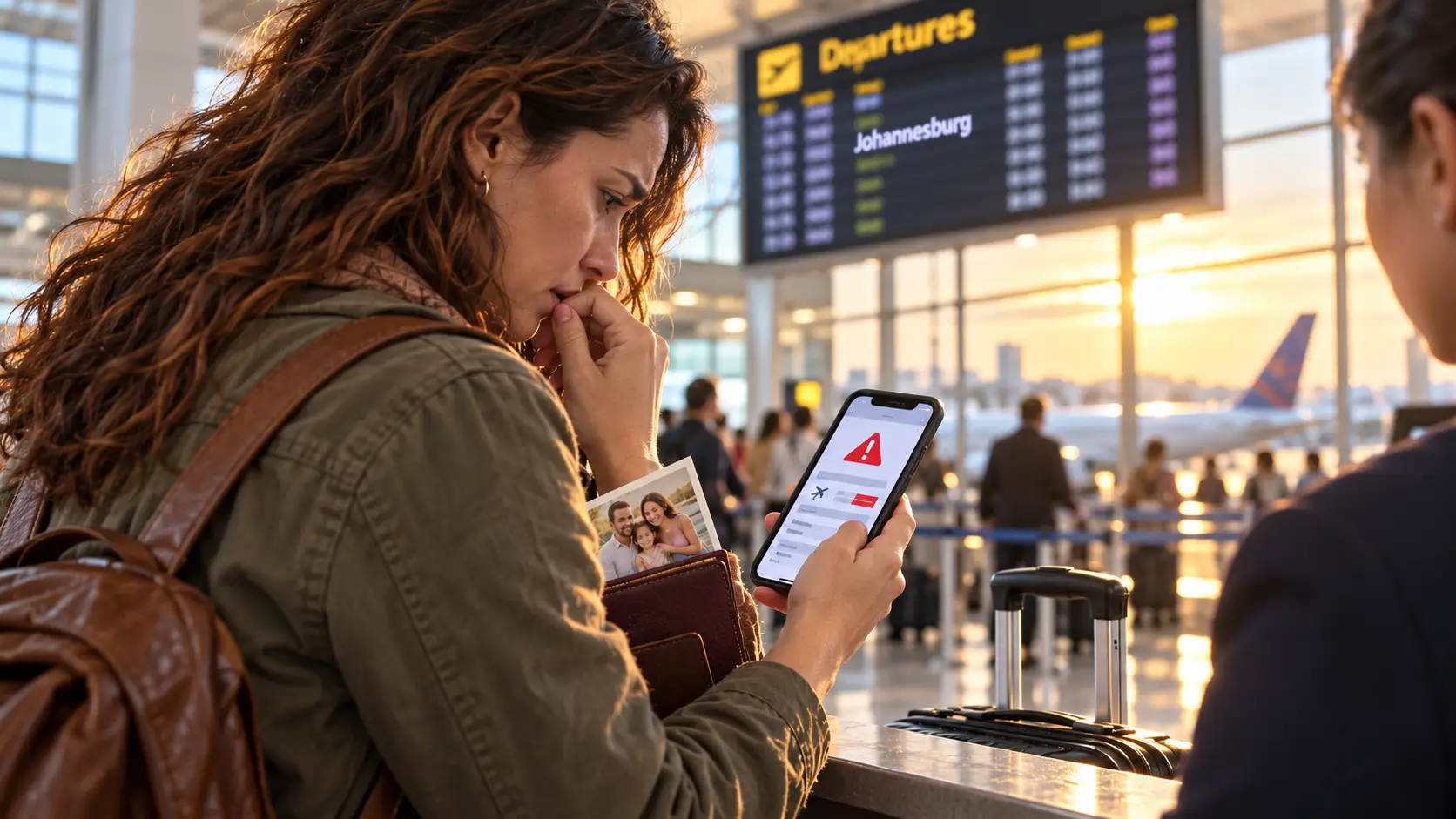
For many South Africans living abroad, December means one thing: going home. Flights to Johannesburg, Cape Town and Durban fill up early, prices climb, and families start hunting for a deal. That is exactly when fake flight tickets and other flight ticket scams do their best business.
This guide is for expats and visitors flying home to South Africa for the holidays, whether you are leaving from the UK, Europe, the Gulf, Australia, New Zealand or North America. It explains the scams that target this route, the difference between a booking and a ticket, and, most importantly, how to confirm your flight booking is real before you pack.
Why flying home to South Africa makes you a target
Fraudsters know that people visiting friends and family are a reliable market. In a report with ABTA and Get Safe Online, the UK’s Action Fraud noted that airline ticket fraud targeting the visiting-friends-and-family market was dominated by flights to Africa and the Indian subcontinent, and that over half of all travel fraud reports involved airline tickets. The partners suggested scammers were exploiting how little most travellers know about the rules governing ticket sales.
More recent UK figures show the scale. Action Fraud received 6,066 holiday fraud reports in 2024, with losses of over £11 million, and more than half of those reports mentioned social media. The pattern is the same elsewhere: Australia’s Scamwatch has warned about fake booking sites selling “tickets” for real airlines, where victims are handed a booking number that does not exist with the airline.
Expats are an easy audience to reach. Community groups for South Africans abroad, WhatsApp groups and Facebook pages are full of people asking “anyone know a cheap way home in December?”, which is exactly the question a fake agent wants to answer.
A booking reference is not a ticket
This is the single most useful thing to understand, and the one most scams exploit.
- A booking reference (also called a PNR or record locator) is usually a six-character code such as K7X2QP. It shows that seats were reserved in the airline’s system. A reservation can be created without paying, and if no ticket is issued it is cancelled automatically, often within a day or two.
- An e-ticket number is a 13-digit number, and it only exists once the fare has actually been paid and the ticket issued. The first three digits identify the airline that issued it. For example, 083 is South African Airways, 176 is Emirates, 157 is Qatar Airways, 125 is British Airways, 074 is KLM, 235 is Turkish Airlines and 071 is Ethiopian Airlines.
The classic scam works like this: the “agent” creates a real reservation on the airline’s website without paying, sends you a convincing confirmation, and takes your money. You check the reference on the airline’s site, and it really is there. Then, a day or two later, the unpaid reservation drops out of the system, and so does the agent. Many victims only find out at check-in.
How to confirm your flight booking is real
Do these checks yourself, using the airline’s own website or app, not a link or phone number the seller gave you.
- Ask for the 13-digit e-ticket number for every passenger. No ticket number means no ticket, whatever the confirmation email says. A genuine seller can give it to you within minutes of payment.
- Check the first three digits match the airline that issued the ticket (on a codeshare it may be the partner airline’s code, so ask if it doesn’t match).
- Open “Manage booking” on the airline’s official website or app, typed in yourself, and enter the booking reference and surname. Check every name (exactly as on the passport), date, flight number and route.
- Look for signs the booking is ticketed: on many airlines you can select seats, add baggage or see the ticket number inside Manage booking. A booking that shows “pending payment”, “on hold” or a time limit is not ticketed.
- Phone the airline on the number from its official website and ask: “Is this booking ticketed, and what is the ticket number for each passenger?” This takes ten minutes and is the most reliable check of all.
- Make sure your own email address and phone number are in the booking. Some agents only enter their own details, so you never receive the airline’s own confirmation, schedule changes or cancellation notices. Ask the agent to add yours, or add them yourself in Manage booking.
- Check again a few days later, and again a week before you fly. An unpaid reservation will have disappeared; a ticket bought with a stolen card may have been cancelled.
- Check in online as soon as it opens. If online check-in won’t accept your booking, call the airline immediately, not on the day of departure.
Fake flight tickets and other scams on flights to South Africa
1. The unpaid reservation
Described above: a real booking reference with no ticket behind it. The fix is the e-ticket number check.
2. Cheap tickets bought with stolen cards
Some “discount” tickets are completely real at first, because they were bought with stolen card details. Interpol warns that if the card owner reports the fraud before you fly, the airline cancels the ticket and you cannot travel. If it is reported while you are away, the return leg can be cancelled and you could be stranded abroad. For expats, that means being stuck in South Africa when you need to get back to work. Interpol notes that these tickets are often offered only a day or two before departure, before the cardholder notices.
3. The call that knows you were searching
In one UK wave, ABTA and Action Fraud warned that victims were cold-called by “travel companies” that seemed to know they had recently searched for flights, probably because they had entered details on a bogus search site. A tempting quote followed, then a confirmation email for a booking the airline had never heard of. Treat any unsolicited call, text or email with a cheap fare as a warning sign, however much the caller knows about your plans.
4. Fake airline pages, groups and “crazy deals”
South African airlines are regular targets. SAA has warned about WhatsApp and Facebook messages offering “90% discount” tickets with payment links, and FlySafair has warned about fake Facebook profiles promoting impossible free-flight specials, reminding customers that its real accounts are verified. Only book a domestic connection, such as Johannesburg to George or Durban, on the airline’s own website or app, or with a registered agent.
5. Fake airline customer service
This one hits people who already have a real ticket. When flights are delayed or cancelled, travellers complain publicly on social media, and scammers pounce. In September 2026, Check Point described fake airline support accounts that watch for complaints, copy airline branding, and move the conversation to private messages to offer “refunds” or “rebooking” for a fee. Disruption to Gulf routes, which many expats use to connect to South Africa, has fuelled a surge of fake airline help accounts on X; Etihad has said it will never ask for passwords, one-time codes or payment details via social media.
Facebook is no better. A Surfshark investigation found fake customer-support groups impersonating 14 of the 15 largest European airlines it checked, often with a WhatsApp number in the group name. The US Federal Trade Commission advises contacting airlines only through their official app, website or a number from the official site, and finding social media accounts through the airline’s own website. And a search engine is not a phone book: fake “airline” numbers can appear at the top of search results.
6. The flight-and-accommodation package
An “agent” offers to sort out everything: flights plus a holiday home, at a price nobody else can match. The flights turn out to be unpaid reservations and the house belongs to someone else. Check each part separately, directly with the airline and with the property. Our guide to holiday accommodation scams in South Africa covers the accommodation side, including a deposit checklist.
Red flags before you pay
- A fare far below what the airlines and major booking sites are showing for the same December dates.
- Payment by bank transfer to a personal account, crypto, vouchers or a money-transfer service.
- The seller is only reachable on WhatsApp or social media, with no registered business, address or landline.
- You get a booking reference but no e-ticket number, or are told the ticket “will be issued later”.
- Pressure: “prices go up tonight”, “last two seats”, “pay within the hour”.
- The seller won’t put your email address in the booking, or asks you not to contact the airline.
- Tickets offered one or two days before departure at a big discount.
Check the seller where you live
Every major departure country has a way to check a travel company, and a place to report fraud. Spend five minutes here before paying anyone you don’t already know.
- United Kingdom: check membership on ABTA’s website and look for an ATOL number. Under the ATOL rules, a UK company selling you a flight must either issue a ticket straight away or confirm your ATOL protection; if you pay a deposit or don’t get a ticket immediately, you should receive an ATOL Certificate as soon as you pay. No ticket and no certificate is a serious warning sign. Report fraud to Action Fraud. Our UK flight ticket guide goes into more detail.
- Canada (Ontario): travel agencies and booking websites based in Ontario must be registered with TICO, and you can search its online registry before booking. Report fraud to the Canadian Anti-Fraud Centre.
- Australia: Scamwatch suggests checking that a booking site gives a local contact number and address and that its ABN is registered to the trader named on the site. Report scams to Scamwatch.
- United States: report scams to the FTC at ReportFraud.ftc.gov.
- Anywhere: if an agent gives you an IATA number, you can check it with IATA’s free CheckACode evaluation tool. Not every legitimate agent is IATA-accredited, but a fake IATA number is a clear red flag.
- South Africa: if you were scammed by a seller in South Africa, open a case with SAPS and report it to your bank. The Financial Intelligence Centre also suggests reporting to the National Consumer Commission.
How to pay for flights
- Book directly with the airline wherever possible, by card.
- Use a credit card if you use an agent. Card schemes allow a chargeback if what you paid for is not delivered, and this works whether you pay an airline or an agent, including debit and prepaid cards. Chargeback is a card-scheme process, not a legal right, and has time limits; in South Africa, banks have quoted 120 days from the date of non-delivery, so act quickly.
- UK readers: Section 75 of the Consumer Credit Act can make your credit card company jointly liable for purchases between £100 and £30,000, but it is more complicated when you book through an agent. In a Financial Ombudsman decision, for example, a claim could only be made against the agent who took the payment, not the airline. Chargeback may still be available.
- Never pay by bank transfer to someone you can’t verify. Action Fraud and ABTA specifically warn that bank transfers give you little protection.
If someone at home is booking for you, or you are booking for them
Many expats book flights for parents or relatives travelling in the other direction, or have family in South Africa arrange their tickets through a local agent. The same rules apply in both directions: get the 13-digit e-ticket number for every passenger, check it on the airline’s site yourself, and put the traveller’s own email and phone number in the booking. Older relatives travelling alone should know never to pay a “rebooking fee” to anyone who contacts them, and to call the airline on the number on its website instead.
Already paid? What to do
- Call the airline on its official number and ask whether a ticket exists. If you have an unpaid reservation, you may still be able to pay the airline directly and keep the seats.
- Call your bank or card provider immediately to stop or dispute the payment.
- Report it in the country where you paid (see above) and, if the seller is in South Africa, to SAPS.
- Keep everything: the advert, messages, confirmation emails, payment proof and the booking reference.
- Ignore anyone who offers to recover your money for a fee. These recovery scams often follow the first one.
Our step-by-step guide on what to do immediately after being scammed has more detail.
Where AdUncovered fits
Before you pay an agent or booking site you haven’t used before, run its website link through our free Quick Check. It is a quick, shallow screen, so a clear result is not a green light. For a larger booking, a Quick Report or Comprehensive Report looks at the business behind the site: whether it is registered, how long its website and online presence have existed, and where its details appear elsewhere, with every finding linked to its source. We check the business, not the airline ticket itself: only the airline can confirm a ticket.
Heading home for December? Our festive season scams in South Africa guide covers what to watch for once you land.
Check before you pay
About to pay a seller or business you don’t know? Start with a Free Quick Check of the advert link. It screens for common warning signs and shows where each result came from.
If you need the seller researched, a Quick Report or Comprehensive Report brings together source-linked Search Results on the seller and the offer. Neither gives a verdict: you check the sources and decide for yourself.
This article provides general scam-awareness information, not legal or financial advice. Sources are linked beside the claims they support and were checked in October 2026. Airline ticket-number prefixes are given as examples; confirm any ticket directly with the airline. Rules on travel protection and card disputes vary by country and card issuer.