
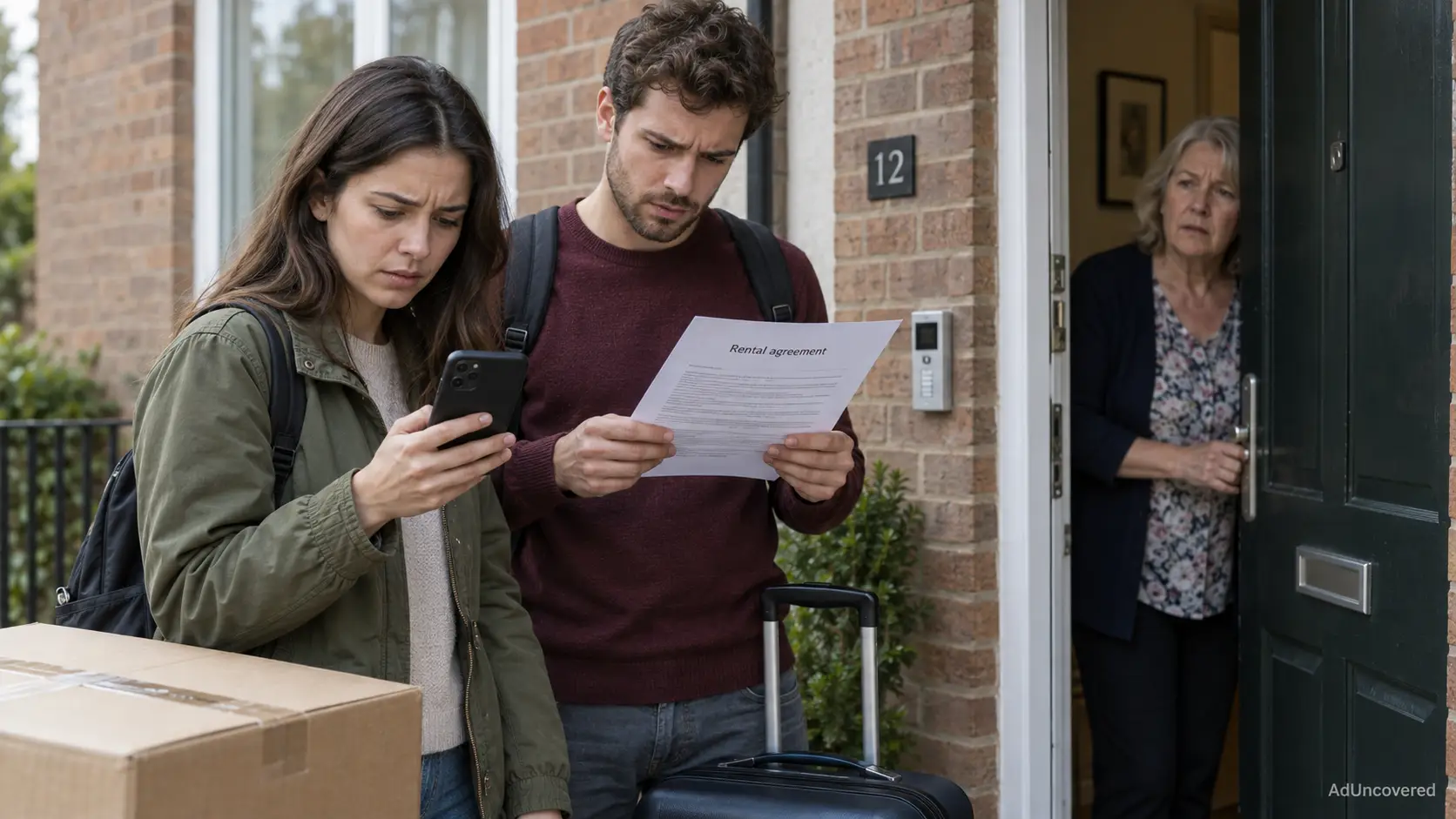
You Paid the Deposit. But Who Owns the Property?
Residential rental scams: copied listings, fake agents and payment demands that can leave you without a home.
Rental scams exploit more than the desire for a bargain. They exploit the need to find somewhere to live before your options run out.
Your lease is ending. A new job starts soon. Your children need to be near their school. After days of searching, a listing finally fits: the right area, enough space and rent you can afford.
The person answering your message sounds helpful. But there are other applicants. Pay the deposit today, they say, and the property will be yours.
You send the money. Then the viewing is postponed. The keys never arrive. Or you discover that the person you paid had no authority to let the property.
You paid for the promise of a home. But who could actually give you the right to live there?
What the Research Shows About Rental Scams
In December 2025, the US Federal Trade Commission reported nearly 65,000 rental-scam reports and approximately US$65 million in reported losses, covering January 2020 through June 2025. In the twelve months ending June 2025, approximately half of reports identifying a platform said the scam began with a fake Facebook advertisement.
These are figures from the FTC’s reporting system, not worldwide totals or South African statistics. The cumulative loss figure is not a single year’s loss, and unreported incidents are not included. FTC rental-scam research
The wider lesson is practical: an attractive advertisement on a familiar platform is not confirmation that the advertiser controls the property.
Copied Listings: A Real Home, a False Contact
Scammers do not need to invent an apartment. They can copy photographs, descriptions and virtual tours from a genuine advertisement, then replace the contact details.
The FTC describes both copied listings and advertisements for properties that are not available to rent. The fraudster may collect an application fee, deposit or rent before disappearing. FTC rental-listing guide
Search the exact address and distinctive phrases from the description. Compare photographs and contact information across results. Check the established agency’s own website, then contact its office using details you found independently.
Different prices or contacts deserve investigation, but duplicates do not automatically prove fraud: genuine properties can be advertised on several platforms. Equally, an absence of duplicates does not establish safety.
The property may be real while the offer is false.
“The Owner Is Overseas. Pay First and I’ll Arrange the Keys.”
An unavailable owner can be a plausible explanation. People do legitimately let properties while living elsewhere.
The warning is the combination: no independently verified representative, no reliable viewing arrangement, and pressure to pay before the offer can be checked.
The FBI has documented rental scams in which supposed owners claim they cannot show the property because they are away, then require payment before providing access. It recommends researching ownership through public records and confirming the landlord’s identity. FBI rental-fraud warning
A scanned identity document or polished lease is not enough. Documents can be copied, altered or used without the named person’s knowledge.
A Viewing Helps—but Keys Do Not Prove Authority
Viewing is an important safeguard. The UK’s Report Fraud service recommends that you, or someone you trust, inspect the property in person before signing or paying. It advises overseas students and workers to seek assistance from their university or employer. Report Fraud guidance
However, access alone does not prove ownership or a letting mandate. The FTC has warned about criminals obtaining lockbox keys, making copies and posing as legitimate rental agents. FTC advice on keys and false agents
Being shown a property answers “Can this person get inside?” It does not necessarily answer “Can this person legally let it to me?”
Do not enter an occupied property without permission or confront residents or an alleged scammer. Verification should not put your safety at risk.
Ownership and Authority Are Different Checks
A genuine agent or property manager does not need to own the home. An authorised representative may act for an owner, and a lawful sublet may involve a tenant rather than the registered owner.
Your task is to understand the relationship:
- Who owns or otherwise controls the property?
- Who will be named as the landlord or lessor?
- What authorises the person advertising it to negotiate, sign and collect money?
- Does that authority cover the particular property and proposed tenancy?
Where official records are available, obtain them independently rather than relying only on a document supplied by the advertiser.
For example, HM Land Registry’s title register can identify the registered owner of property in England and Wales. Scotland and Northern Ireland have different systems. An online copy is useful information, but the government distinguishes it from an official copy required as formal proof of ownership. HM Land Registry guidance
South Africa’s Deeds Registry can provide information about registered owners. Searching can require property identifiers beyond the street address, particularly for sectional-title units. South African Deeds Registry guidance
A matching owner’s name still does not prove that the person messaging you is that owner or represents them. Unclear ownership, company-held property or subletting arrangements may require independent professional advice.
Fake Agents Can Borrow Genuine Credentials
A logo, business card or agency name is not independent verification. Contact the agency’s established office and ask whether the person works there, whether the property is available and whether the agency has authority to handle the tenancy.
In South Africa, the Property Practitioners Regulatory Authority advises consumers dealing with property practitioners to verify the practitioner and firm’s registration and valid Fidelity Fund Certificates. It also advises checking the firm’s trust-account arrangements before handing over trust money. PPRA consumer warning
These checks concern regulated property practitioners. They should not be applied as though every private owner letting their own home must be an estate agent.
A certificate is not proof that this particular listing is genuine, or that a payment request came from the certificate holder. Verify the transaction as well as the credentials.
Application-Fee Harvesting: Small Payments, No Real Opportunity
Not every rental scam seeks a large deposit. A fabricated listing can collect smaller application or screening payments from people who believe they are competing for a tenancy.
Another route involves a supposed credit check. The FTC has documented rental approaches directing applicants to low-cost credit-check offers that enrol them in recurring paid memberships, sometimes generating affiliate payments for the promoter. FTC research on screening-related scams
Before paying, establish what the charge covers, who receives it, whether the property is genuinely available, and whether the charge is refundable or recurring.
“Only a small fee” does not make the opportunity genuine. Nor does paying an application fee guarantee approval.
Not Every Deposit or Screening Request Is Fraud
Legitimate rental processes can involve affordability checks, identity verification and deposits. The applicable rules depend on the country, state or province and type of tenancy.
In England, current government guidance permits certain payments, including a refundable holding deposit subject to rules and limits, while restricting other tenant charges. This is not a rule for the entire UK or the rest of the world. England’s tenant-fee guidance
In Australia’s New South Wales, official guidance specifies permitted starting costs and says tenants must not be charged additional application, background-check or viewing costs. NSW tenancy-cost guidance
The useful distinction is between a verified, lawful rental process and an unexplained payment demanded by someone whose offer and authority remain unconfirmed. Calling a fee “standard practice” does not establish that it is lawful.
Protect Your Documents During Screening
Rental applications can legitimately require sensitive information. US consumer guidance explains that landlords may use screening reports containing credit, rental and other background information. FTC tenant-screening guidance
That makes verification important before submission. Confirm the agency or landlord, the screening provider, the reason for each document and the submission channel.
Ask whether unrelated financial information can be redacted and whether a purpose-specific watermark is acceptable. Neither measure guarantees protection, but both can limit unnecessary disclosure.
Never provide online-banking passwords, PINs or one-time codes to prove affordability. Supplying appropriate evidence of income is different from allowing someone to access your account.
“Pay Today or Lose It” Is Pressure, Not Evidence
Competitive rental markets can involve genuine deadlines. Fraudsters can exploit the same conditions.
Pause when the deadline prevents a viewing, independent contact or review of the agreement. Ask whether the urgency is supported by a verified process or only by the advertiser’s claim.
The NSW Police rental-fraud advice warns that competition can be used to pressure applicants into upfront payments and recommends confirming ownership and identity. NSW Police rental-scam guidance
Another applicant’s supposed interest does not establish this person’s right to take your deposit.
Before Paying: Check the Entire Arrangement
- Confirm the exact property. Check the unit, address, advertised condition and availability—not just the building’s existence.
- Arrange a reliable viewing. Inspect yourself or use a trusted representative. Do not treat a video or key code as proof of authority.
- Verify the landlord and representative. Establish ownership or lawful control, agency involvement and authority to let.
- Read the written terms. Identify the parties, rent, tenancy dates, deposit purpose, holding conditions, deductions and handover arrangements.
- Check the payment recipient independently. Explain any mismatch between the agreement and recipient. Verify changed account details through an established channel.
- Understand local protections. Check permitted fees and any required deposit, bond or trust arrangements with official local guidance.
- Keep the evidence. Retain the advertisement, agreement, correspondence, receipts and verification records.
Bank transfers are commonly used in legitimate rentals. The payment method alone does not establish fraud or safety. What matters is whether the recipient and purpose have been verified and what protections apply.
Already Paid and Something Is Wrong?
Contact your bank or payment provider immediately through its official channel. Explain the suspected fraud and ask whether the payment can be stopped, recalled or disputed. Recovery is not guaranteed. FTC payment-response guidance
Save the listing’s URL, messages, telephone numbers, supposed agent details, lease, payment references and account information. Report the advertisement to the platform and suspected fraud to local police. Notify the genuine agency if its identity was used.
If documents were disclosed, seek country-appropriate identity-protection advice. Stop sending additional “release”, “refund” or “verification” payments while the arrangement is being checked.
For a fuller checklist, read What to Do Immediately After Being Scammed.
A Deposit Dispute Is Not Automatically a Rental Scam
A real tenancy can lead to disagreements over damage, deductions or repayment. Those disputes need evidence and the appropriate housing-resolution process, not an automatic accusation of fraud.
Western Cape government guidance recommends joint inspections, written records of existing defects and evidence of repair costs. Its Rental Housing Tribunal offers a free route for qualifying landlord–tenant disputes in that province. Other jurisdictions have different services. Western Cape rental guidance
Verify the Home, the Authority and the Payment
AdUncovered can research an identifiable agency or rental business’s public background, credentials and reported concerns. A research report does not replace an inspection, professional title or mandate checks, legal advice or urgent bank contact, and cannot guarantee possession or recovery.
Wanting to secure a home is understandable. But before paying to reserve it, establish who can actually let it to you.
The photographs show a property. The keys open a door. Neither, by itself, proves that the person asking for your money can give you a lawful tenancy.
Check before you pay
About to pay a seller or business you don’t know? Start with a Free Quick Check of the advert link. It screens for common warning signs and shows where each result came from.
If you need the seller researched, a Quick Report or Comprehensive Report brings together source-linked Search Results on the seller and the offer. Neither gives a verdict: you check the sources and decide for yourself.