
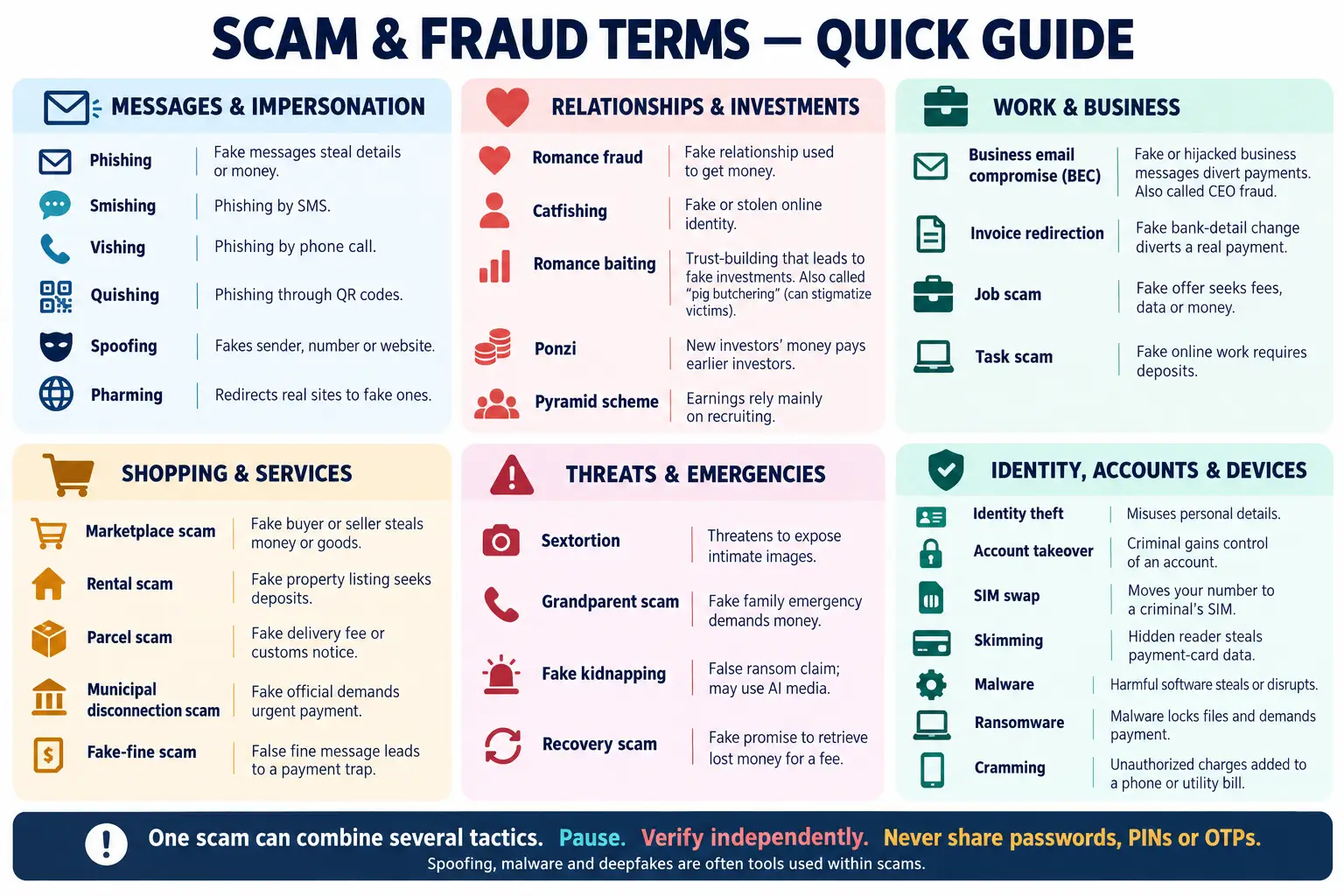
Scam and fraud terms: a comprehensive reference glossary
Scam and fraud terms and definitions
This glossary groups alternative names under the same or closely related schemes. Scam terminology is not fully standardized, so an “also called” label may be a synonym in some sources and an overlapping variant in others. A single scam can involve several terms—for example, a fake SARS refund sent by SMS is government impersonation, smishing, and phishing.
Messages, calls and fake identities
| Term | Definition | Other names and related terms |
|---|---|---|
| Phishing | Deceptive communication that pretends to come from a trusted source to steal information, prompt a payment, or get someone to take an unsafe action. It commonly uses email, websites or messaging apps. | Email phishing, credential phishing. Smishing and vishing are channel-specific forms. |
| Smishing | Phishing through SMS or text messages. A message may contain a fraudulent link, payment request or request for personal information. | SMS phishing, text-message phishing. |
| Vishing | Phishing by phone call or voicemail. The caller may impersonate a bank, government department, police service or business. | Voice phishing, phone phishing. |
| Quishing | Phishing that uses a QR code to lead to a fraudulent website, trigger a download or solicit a payment. | QR-code phishing, QR scam. |
| Pharming | Redirecting someone from a legitimate website or web address to a fraudulent one, often without the person noticing. It can involve compromised devices, network settings or domain-name systems. | Website redirection fraud, DNS spoofing (a possible method, not an exact synonym). |
| Spoofing | Faking the apparent identity or origin of a communication, such as its caller ID, email address or website domain. Spoofing is a technique that can support many scams. | Caller-ID spoofing, email spoofing, website spoofing, number spoofing. |
| Impersonation scam | A scammer pretends to be a real person, company or institution to gain trust, obtain information or get money. | Imposter scam, impersonator scam, masquerading. |
| Government impersonation scam | A scammer poses as a government department, tax authority, police officer, court or other official and may claim the target owes money or is under investigation. | Government imposter scam, official impersonation, fake police scam. |
| Bank impersonation scam | A scammer poses as a bank employee or fraud investigator and seeks credentials, verification codes or a transfer of funds. | Fake bank-fraud call, bank imposter scam. |
| Safe-account scam | A scammer claims a bank account is compromised and instructs the victim to move money to a “safe” account controlled by the scammer. | Account-protection scam, safe account transfer scam. |
| Tech-support scam | A scammer falsely claims a computer, phone or account has a security problem, then seeks payment, remote access, credentials or a money transfer. | Technical-support scam, fake security-alert scam, computer-support scam. |
| Wrong-number scam | An unsolicited message claims to have reached the wrong person, then tries to build a friendly conversation that may lead to investment or romance fraud. | Wrong-number text scam, accidental-text scam; sometimes an opening for romance baiting. |
| Catfishing | Creating a fabricated or stolen online identity to deceive someone. Catfishing may be used to start a romance scam, but it does not necessarily involve romance or a request for money. | Fake-profile deception, online identity deception. When money is solicited through a fake relationship, it may become a romance scam. |
| Deepfake | AI-generated or altered audio, images or video that convincingly depict a person saying or doing something they did not. It is a tool, not a scam by itself. | Synthetic media, AI-generated impersonation. A deepfake used to steal money may be called a deepfake scam or AI impersonation scam. |
Investment, romance and advance-payment fraud
| Term | Definition | Other names and related terms |
|---|---|---|
| Advance-fee fraud | The target is promised money, a prize, a service, a job or another benefit but must pay a fee upfront to receive it. The promised benefit never arrives or is misrepresented. | Advance-fee scam, upfront-fee scam, 419 fraud in some contexts. |
| 419 fraud | A form of advance-fee fraud, named after a section of Nigeria’s criminal code. It often involves a promised inheritance, business deal, prize or money transfer that requires fees first. | Nigerian letter scam, advance-fee fraud. The term describes a scheme, not the nationality of the perpetrator. |
| Investment scam | A fake or misleading investment offer that deceives people into sending money or buying an asset on false or exaggerated claims. | Investment fraud, fake investment scheme, crypto investment scam when cryptocurrency is involved. |
| Romance fraud | A scammer builds a romantic or emotional relationship online and then manipulates the target into sending money, gifts, personal information or valuable items. | Romance scam, dating scam, confidence/romance fraud. |
| Romance baiting | A scammer builds a relationship or friendship to steer the target into a fake investment, often involving cryptocurrency. | Pig-butchering scam (widely used, but INTERPOL recommends “romance baiting” because the older term can stigmatize victims), relationship investment scam, romance-investment scam. |
| Ponzi scheme | A fraudulent investment that pays earlier investors using money from later investors while falsely presenting the payments as investment returns. | Ponzi fraud. It is related to, but different from, a pyramid scheme. |
| Pyramid scheme | A scheme in which participants’ earnings depend mainly on recruiting new participants, rather than selling genuine goods or services to outside customers. | Recruitment scheme, chain-referral scheme. Some pyramid schemes disguise recruitment with products or investment claims. |
| Pump-and-dump | Fraudsters promote an asset to inflate its price, then sell their holdings, leaving later buyers with losses. | Market-manipulation scam, pump-and-dump scheme. |
| Fake prize or lottery scam | The target is told they won a prize or lottery they did not enter, then asked to pay fees or provide sensitive details to claim it. | Prize scam, lottery scam, sweepstakes scam, winnings scam. |
| Fake refund or tax-refund scam | A fake message promises a refund and directs the target to a link or form that may steal credentials, payment details or identity information. | Refund phishing, tax-refund phishing, SARS refund scam when it falsely uses SARS branding. |
| Recovery scam | Someone contacts a person who has already lost money and falsely promises to recover it in exchange for an upfront fee or sensitive information. | Fund-recovery scam, refund scam, re-victimization scam. This is different from a legitimate bank chargeback or official investigation. |
| Overpayment scam | A scammer claims to have paid too much and asks the victim to return the difference. The original payment is fake, stolen or later reversed. | Fake overpayment scam, overpayment fraud. |
| Fake-cheque scam | A scammer sends a counterfeit or invalid cheque and asks the recipient to deposit it, then send money or goods before the bank discovers the cheque is bad. | Counterfeit-cheque scam; often a type of overpayment scam. |
Business and employment scams
| Term | Definition | Other names and related terms |
|---|---|---|
| Business email compromise (BEC) | A scam that uses a compromised or lookalike business email account—or another communication channel—to trick a business or individual into transferring funds or changing payment details. | CEO fraud, business email scam, email account compromise, invoice redirection (an overlapping pattern). |
| CEO fraud | A BEC variant in which a scammer impersonates a senior executive and pressures an employee to make a payment or share sensitive information. | Business executive scam, executive impersonation, BEC. |
| Vendor or supplier impersonation | A scammer impersonates a real supplier, often asking a customer to send future payments to a new bank account. | Supplier fraud, vendor email compromise, invoice redirection; often a form of BEC. |
| Invoice scam | A fake or altered invoice persuades a person or business to pay a scammer instead of the real supplier. | Invoice fraud, invoice manipulation, payment-redirection scam. |
| Employment scam | A fake job or recruiter is used to steal fees, identity details, banking information or money. | Job scam, recruitment scam, fake recruiter scam. |
| Task scam | A fake online job offers payment for simple digital tasks, then requires deposits to unlock more tasks or withdraw made-up earnings. | Gamified job scam, product-boosting scam, optimization-task scam. |
| Work-from-home scam | A fake remote-work offer asks for upfront fees, purchases, personal information or money transfers. | Remote-job scam, home-working scam; may overlap with an employment, task or fake-cheque scam. |
| Money-mule recruitment scam | A person is persuaded to receive and forward money or goods for a supposed job or favor. The funds may be stolen, and forwarding them can help criminals launder money. | Money-mule scheme, payment-processing job scam. |
| Municipal job scam | A scammer claims to offer a municipal job or contract, often through WhatsApp or a flyer, and may demand a fee or personal details. | Fake government job scam, municipal recruitment scam. |
Shopping, property and local-service scams
| Term | Definition | Other names and related terms |
|---|---|---|
| Non-delivery scam | A buyer pays for goods or services that are never provided. | Goods-not-received scam, online shopping scam, advance-payment scam. |
| Non-payment scam | A seller provides goods or services but never receives the promised payment. | Seller scam, fake-payment scam. |
| Marketplace scam | A fake buyer or seller uses an online marketplace to steal payment, goods or personal information. | Online marketplace fraud, classified-ad scam, sometimes a platform-specific name such as Facebook Marketplace scam. |
| Fake proof-of-payment scam | A buyer provides a fabricated payment screenshot or notification to persuade a seller to hand over goods before money arrives. | Fake EFT proof scam, payment-screenshot scam. |
| Rental scam | A scammer advertises a property they do not own or control and asks for a deposit, viewing fee or personal details. | Property-rental scam, fake-landlord scam, rental-listing fraud. |
| Housing-opportunity scam | A scammer promises access to subsidized or municipal housing in exchange for a fee or personal information. | Housing-allocation scam, fake-housing-list scam, municipal housing scam. |
| Municipal disconnection scam | A scammer impersonates a municipal official, claims water or electricity will be cut off, and demands urgent or informal payment. | Utility-disconnection scam, water/electricity cut-off scam, municipal-arrears scam. |
| Fake fine or payment-link scam | A message claims a fine or fee is due and provides a link or QR code leading to a fraudulent payment page or recipient. | Traffic-fine scam, penalty scam, payment-link phishing. |
| Parcel or customs scam | A fake delivery or customs message says a parcel is delayed or detained and requests a fee or personal information. | Delivery-fee scam, customs-release scam, parcel-text scam. |
| Charity scam | A scammer pretends to collect donations for a legitimate charity, disaster appeal or person in need. | Fake-charity scam, donation scam, disaster-relief scam. |
| Timeshare scam | Fraud involving the sale, rental, resale or cancellation of a timeshare, often with upfront fees and false promises. | Timeshare-resale scam, timeshare-exit scam. |
Threats, extortion and emergencies
| Term | Definition | Other names and related terms |
|---|---|---|
| Extortion scam | A scammer threatens harm, exposure, legal trouble or another loss unless the target pays or complies. | Blackmail scam, threat scam. |
| Sextortion | A scammer threatens to share intimate images or claims to possess them unless the target pays or sends more material. Images may be real, stolen or fabricated. | Sexual extortion, intimate-image blackmail, webcam blackmail. |
| AI-image sextortion | Sextortion using AI-generated or manipulated intimate images to threaten or shame a target. | Deepfake sextortion, synthetic-image blackmail. |
| Emergency or family-impersonation scam | A scammer pretends to be a relative or friend in urgent trouble and asks for immediate money. | Family-emergency scam, distress scam. |
| Grandparent scam | A version of the family-emergency scam in which someone pretends to be a grandchild or another relative who has been arrested, injured or stranded and needs money urgently. | Grandchild scam, fake-arrest scam, emergency impersonation scam. |
| Fake-kidnapping scam | A scammer claims a loved one has been kidnapped and demands a ransom. Some versions use AI-generated audio, images or video to make the claim seem real. | Virtual-kidnapping scam, AI kidnapping scam, fake-ransom scam. |
| Threat-of-arrest scam | A scammer claims the target will be arrested, prosecuted or deported unless they pay immediately. | Arrest-warrant scam, fake-police scam, court-summons scam. |
Account, identity and device fraud
| Term | Definition | Other names and related terms |
|---|---|---|
| Identity theft | Someone obtains and uses another person’s identifying information without permission, often to access accounts, obtain credit or commit fraud. | Identity fraud, personal-information theft. |
| Account takeover | A criminal gains control of an existing email, social-media, banking or other account, often using stolen credentials or verification codes. | ATO, account compromise, hijacked account. |
| SIM-swap fraud | A criminal tricks or corrupts a mobile provider’s process to move a victim’s phone number to a SIM card the criminal controls, potentially intercepting calls and messages. | SIM hijacking, SIM-swap scam. Number-porting fraud is related, but not always the same. |
| OTP or verification-code scam | A scammer tricks someone into sharing a one-time password or verification code, then uses it to access an account or authorize a transaction. | OTP theft, verification-code scam, MFA-code scam. |
| Credential phishing | A fake login page or message steals usernames and passwords. | Password phishing, login-page scam, credential harvesting. |
| Data breach | An incident in which personal or confidential data is accessed, copied or disclosed without authorization. A breach is not necessarily a scam, but stolen data may be used in later scams. | Data leak, personal-data exposure. |
| Malware | Software designed to damage or disrupt devices or systems, steal information, spy on users or enable unauthorized access. Malware is a tool that may be used in a scam or cyberattack. | Malicious software, malicious code. |
| Ransomware | Malware that blocks access to files or systems, often by encrypting them, while attackers demand payment. Payment does not guarantee that access will be restored. | Ransomware attack, file-encryption extortion. |
| Remote-access scam | A scammer persuades someone to install software or share a code that gives the scammer control of a device. | Remote-support scam, remote-desktop scam; often overlaps with tech-support or bank-impersonation fraud. |
| Skimming | Capturing payment-card data using a hidden or tampered card reader, often at an ATM or payment terminal. Criminals may also use a camera or false keypad to capture a PIN. | Card skimming, ATM skimming, payment-card skimming. |
Unauthorized charges and recurring-payment schemes
| Term | Definition | Other names and related terms |
|---|---|---|
| Cramming | Placing unauthorized, misleading or deceptive charges on a phone, mobile or utility bill. | Phone-bill cramming, unauthorized billing, third-party billing fraud. |
| Subscription trap | A misleading offer or sign-up process enrolls someone in recurring payments that are difficult to understand or cancel. | Hidden-subscription scam, free-trial trap, negative-option scam. |
| Small-fee scam | A request for a seemingly minor verification, delivery, prize-claim or subscription payment is used to collect card details or lead to further fraud. | Verification-fee scam, delivery-fee scam, low-cost phishing. |
Terms for tactics and criminal infrastructure
| Term | Definition | Other names and related terms |
|---|---|---|
| Social engineering | Manipulation that exploits trust, fear, urgency, curiosity or helpfulness to get someone to reveal information, transfer money or take an unsafe action. It is a tactic used across many scams. | Human hacking, confidence trick (broader, older term). |
| Confidence scam | A scam that builds trust or rapport before asking for money, information or help with a fraudulent transaction. | Confidence trick, con game. |
| Money laundering | Concealing the criminal origin of money by moving it through accounts, businesses, assets or other transactions. It often supports scams but is not itself a scam label. | Laundering, proceeds laundering. |
| Scam centre | An organized operation that runs many scams, sometimes using trafficked or coerced people to contact victims. | Fraud centre, scam compound, fraud factory. |
| AI-enabled scam | A scam that uses AI to generate or adapt text, voices, images, video or interactions. It describes a tool or feature, not a single scam type. | AI-assisted fraud, deepfake scam, synthetic-media scam. |
Commonly confused terms
- Phishing, smishing and vishing describe deceptive messages by channel: commonly email or online messages, SMS, and voice calls.
- Spoofing disguises the apparent sender or source. Phishing tries to deceive the recipient into revealing information or taking an unsafe action.
- Catfishing means using a fake online identity. Romance fraud uses a relationship to manipulate someone for money or value; the two can overlap.
- Romance fraud seeks money through a relationship. Romance baiting uses a relationship to steer someone into an investment scam.
- Ponzi schemes use new investors’ money to pay earlier investors. Pyramid schemes rely mainly on recruiting participants.
- BEC is a broad business-payment fraud category. CEO fraud and invoice redirection are common BEC patterns.
- Identity theft is misuse of personal information. Account takeover is gaining control of a particular account; one can lead to the other.
- Malware is a broad category of malicious software. Ransomware is one type of malware.
- Skimming steals card data; it is different from card-not-present fraud, where stolen payment details are used for an online or remote purchase.
- Cramming means unauthorized charges placed on a phone or utility bill. It is different from a subscription someone knowingly started but later finds difficult to cancel.
- A deepfake is not automatically a scam. It becomes part of a scam when used to deceive someone, such as by impersonating a relative, public figure or financial professional.
South African SARS reminder
SARS says it will not ask for an eFiling password, OTP or banking PIN through SMS, email, WhatsApp, social media or telephone. Verify tax messages through eFiling, the SARS MobiApp or contact details found independently on the official SARS website. SARS scam and phishing guidance, SARS WhatsApp verification FAQ
Sources
Definitions and terminology were checked against INTERPOL’s 2026 Global Financial Fraud Threat Assessment, the FBI’s IC3 crime definitions, FTC guidance on task scams and recovery scams, and SARS’s scams and phishing guidance. INTERPOL recommends “romance baiting” instead of “pig butchering” because the older label can stigmatize victims.
Check before you pay
About to pay a seller or business you don’t know? Start with a Free Quick Check of the advert link. It screens for common warning signs and shows where each result came from.
If you need the seller researched, a Quick Report or Comprehensive Report brings together source-linked Search Results on the seller and the offer. Neither gives a verdict: you check the sources and decide for yourself.