
When they ask you to keep a secret, share it immediately with someone you trust. The secret is the entry point into your bank account.
I’ve seen this at retirement villages in Pretoria: savings wiped out, homes lost, and people too frightened or ashamed to tell anyone what happened. The stories are different, but one thing comes up again and again. Before the scammer asked for money, they asked for a secret.
This guide is written for you if you are an older South African, especially if you live alone, or your children live far away or seldom call. Scams targeting older South Africans don’t work because people are foolish. They work because the scammer finds you at a moment when there is no one beside you to ask. Further down, there are sections for adult children, and for retirement village staff, neighbours and church friends.
Why scams targeting older South Africans work
Scammers don’t pick a birth year. They pick a situation: someone alone, someone bored and online, someone worried about money, someone with no one nearby to check with.
Many South African families are now spread across the world. United Nations figures put the number of South Africans living abroad at just over a million in 2024, with the biggest groups in the UK and Australia. Some of their parents speak to them every day on WhatsApp. Others haven’t heard from their children in years. At some retirement villages, staff collect donated clothing and food for residents whose families no longer visit or help. For many older people, the SASSA older persons grant of R2,400 a month (R2,420 from age 75) is all there is.
Loneliness, boredom and money worries are exactly what scammers use. When police spoke to one family whose mother was targeted, they said the networks behind these scams pick older people who are online a lot.
The bank that isn’t your bank
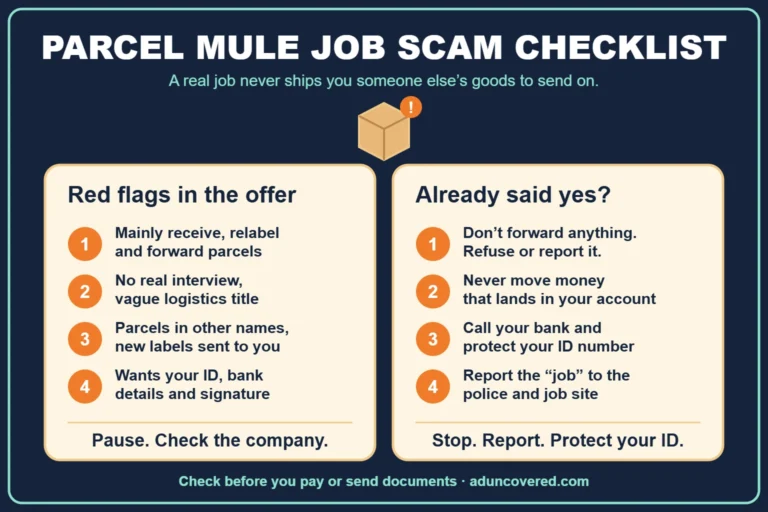
At the villages, bank scams usually start with one of three messages:
- An SMS: “Suspicious activity on your account. Click this link.” The link leads to a fake bank page that captures your login details.
- A phone call: “Your account was blocked because of a fraud attempt.” The caller then “helps” you fix it.
- A card “delivery”: “We need to deliver your new card.” This is a way to get to your door, take your old card, or get your PIN.
All three have the same trick: the scammer pretends to be the bank’s protection. You think you’re stopping fraud while it is happening to you. South Africa’s banking crime centre, SABRIC, reported R2.4 billion lost to digital banking crime in 2025, mostly through impersonation, phone calls and people being talked through transactions, rather than through banks being hacked. It found that in many cases the fraud began outside the banking app, with criminals posing as trusted organisations and creating urgency.
What to do:
- Never use a link or phone number from the message. Hang up, and call the number on the back of your bank card.
- Never give anyone your PIN or a one-time PIN (OTP), however official they sound.
- If someone says a new card is on its way and you didn’t ask for one, call your bank on the number on your card before you open the gate. Never hand your old card to someone at the door.
- If the caller says “don’t tell anyone,” that is the scam. Tell someone straight away.
The friend who is “just chatting”
Marie lives in a retirement village. One day she accepted a Facebook friend request from someone she didn’t know. He seemed friendly, and at first he was just someone to chat to. He never asked for money.
But the photos on Marie’s Facebook page showed where she lived. Soon a man arrived and tried to force his way into the village. Marie did exactly the right thing: she blocked him and told her children. The family reported it to the police, who said a network of scammers had sent the man to visit her in person.
Marie’s story ended well because she stopped it early and didn’t keep it to herself. Many romance scams in the villages start the same way, as a friendly chat, and end with savings gone.
What to do:
- Don’t accept friend requests from people you don’t know in real life.
- Set your Facebook posts and photos so only friends can see them, and don’t share where you live, your village’s name or photos of the gate.
- A new online friend who won’t meet you, avoids video calls, or starts talking about love, emergencies or investments: block them.
- Ask a family member or someone at the village office to check your privacy settings with you.
Our dating app scams guide covers the red flags of romance scams in more detail.
“Hi Mum, this is my new number”
A message arrives from an unknown number: your child has a new phone and needs help. South African parents are being targeted with exactly this “new number” WhatsApp scam. The “child” says their banking app isn’t working or they need money to get home.
If your child lives overseas, a new number sounds believable. If your child seldom calls, a message like this can feel like the call you’ve been waiting for. That is exactly why it works.
What to do: call your child on the number you already have, or ask a question only your real child could answer. Better still, agree on a family code word now, before you ever need it.
When the scammer moves in: Anna’s story
Not every scammer phones from far away. Some move in.
Anna worked well past retirement age and needed extra income. She has a soft heart and is very accommodating. She decided to rent out the empty rooms in her house, and probably mentioned it to someone at church or on the bus. Nobody knows exactly how the boarders found her.
Once they had moved in, the boarders took Anna to an ATM every month, made her draw her pension, and took the money from her. They threatened her and swore her to secrecy.
Her family noticed something was wrong when Anna started asking to borrow money for petrol, bus fare and food. They knew she had enough. The family stepped in and the boarders were removed. But it didn’t end there. The boarders found her again and started threatening and harassing her.
The family applied for a protection order, but it wasn’t granted: the court said there wasn’t enough evidence. They also opened an attempted assault case. In the family’s experience, going back to the police afterwards didn’t help much. What protected Anna in the end were practical steps: new locks, burglar bars, an alarm system and, finally, moving to a new home.
Looking back, the family says the warning signs were there. If they had been involved in the rental contract and had checked the boarders beforehand, this could have been prevented.
If you’re renting out a room:
- Ask a family member or trusted friend to meet the person and help you check them: ID, references, and where they live or work now.
- Sign a written lease, and have rent paid into your bank account, not in cash.
- Your bank card and PIN stay with you, always. Nobody goes to the ATM “with” you.
- Make sure someone outside the house checks in with you regularly.
If you are being threatened, keep a record from the start. Anna’s protection order failed for lack of evidence. Write down dates and times, save and back up threatening messages and voice notes, keep bank statements that show unusual withdrawals, and note the names of anyone who saw or heard something.
Under the Protection from Harassment Act, you can apply for a protection order at a magistrate’s court, and someone with a real interest in your wellbeing can apply on your behalf if you can’t. Abuse of older people, including financial abuse, is a crime under the Older Persons Act. The Association for the Aged (Tafta) runs a free elder abuse helpline on 0800 10 11 10, where you can get counselling and be referred to help near you.
Your checklist
The secret is the entry point
- Asked to keep a secret? Tell someone you trust, today.
- Never click a link in a bank SMS. Call the number on your card.
- “New number, it’s me”? Call your child’s old number first.
- A new online friend who never meets you and talks about money? Block.
- Renting a room? Family checks the person and the contract first.
- Your card and PIN never leave your hands.
For adult children: be the sober second opinion
Most children love their parents. Many simply live far away, in another city or another country. Distance doesn’t have to leave your parent exposed, but it does mean you need a plan:
- Be part of the big decisions: contracts, investments, and anyone moving into the house. Meet and check boarders before they move in, even if it’s by video call.
- Agree a family code word, and tell your parent you will never ask for money from a new number.
- Call on a regular schedule, so your parent isn’t waiting and wondering.
- Arrange a local person, such as a sibling, neighbour, church friend or the village office, who can be the second opinion in the room when you can’t be.
- Watch for the signs: a parent who should have enough suddenly asking to borrow money, new “friends” or boarders you haven’t met, nervousness about the phone, or secrecy.
Flying home for December? Use the visit to have this conversation, check your parent’s privacy settings and agree the code word. (And make sure the flight home is real.)
Now the harder part. Some parents in retirement villages haven’t heard from their children in years. They are short of clothing, food and company, and they are the people scammers find first. If that could be your parent, this is your call to pick up the phone.
Being involved doesn’t mean judging or taking over. It means being there when your parent needs a sober opinion or some direction, while the decisions stay theirs.
For retirement villages, neighbours and church friends
For many older people, the second opinion isn’t a child. It’s the matron, the village office, a neighbour or someone at church.
- Make “check with the office first” a habit for any unexpected call, message, delivery or visitor.
- Brief gate and security staff that online scams can turn into someone at the gate.
- Run a short scam talk using the checklist above. Residents can print it or keep a screenshot.
- Help with the basics. Many residents are short of clothing, food and toiletries, and many are simply bored. Contact a village near you and ask what they need, or offer to visit.
If it has already happened
It is not your fault, and you are not alone. Scammers are skilled at what they do, and they deliberately keep their victims quiet. Speaking up quickly gives you the best chance of limiting the damage.
- Call your bank immediately on the number on your card, and ask them to stop or block payments.
- Tell someone you trust, today.
- Keep everything: messages, voice notes, phone numbers, bank statements and names.
- Open a case at your local police station.
- For abuse or threats, call Tafta’s free helpline on 0800 10 11 10.
Our guide on how to report a scam in South Africa explains who to contact and what each can do.
Got a link? Check the website before you pay
Some of these scams come with a link: a “bank” SMS, or an investment site a new online friend recommends. Don’t open it. Copy the link into the free Quick Check below instead. It looks at the website behind the link, not at the person, their profile or the conversation, and a clean result is not proof that it’s safe. For more ways to check a business yourself, see how to check if a business is legit, and for fake celebrity investment adverts, our deepfake scams guide.
Check before you pay
About to pay a seller or business you don’t know? Start with a Free Quick Check of the advert link. It screens for common warning signs and shows where each result came from.
If you need the seller researched, a Quick Report or Comprehensive Report brings together source-linked Search Results on the seller and the offer. Neither gives a verdict: you check the sources and decide for yourself.
Remember: when they ask you to keep a secret, share it immediately with someone you trust. The secret is the entry point into your bank account.
This article provides general information about scams targeting older people in South Africa, not legal or financial advice. Sources are linked beside the claims they support and were checked in October 2026; grant amounts, helpline details and court procedures can change, so confirm them with the body concerned. Names in the stories have been changed, and no one described can be identified.