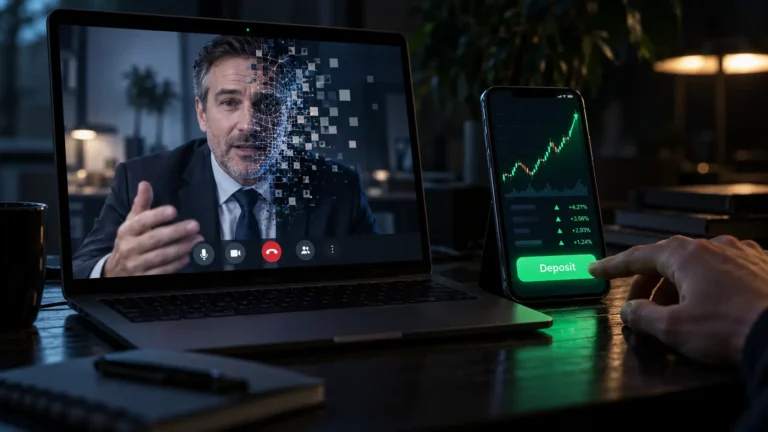

Your Profits Look Real. Can You Withdraw Them?
Fake investments, trading apps and WhatsApp groups: when a promising balance becomes a demand for more money.
Already sent money? Read our What to Do Immediately After Being Scammed guide.
Investment scams do not always begin with a request for your life savings. Sometimes the invitation sounds comfortably small: start with $20, no experience needed, and let an automated trading system do the work.
Twenty dollars feels like an experiment. If the account starts growing, perhaps you have finally found something that works.
Then comes the suggestion to deposit more. Later, when you want your money back, there is a problem. Your account needs verification. A tax must be paid. Another deposit will supposedly release the funds.
The balance looked like your money. But who controlled the numbers, and where did your actual payment go?
“Start With $20” Is Not a Safety Check
The $20 invitation here is an illustrative example, not a universal minimum or a claim about one particular platform. Legitimate services can also accept small deposits. The amount alone tells you little about who operates the business or what happens to your money.
A low starting amount can make an offer feel manageable. But it is worth asking a different question: what could this first payment lead you to trust?
The UK’s Financial Conduct Authority warns that online trading scams may initially provide returns, then encourage customers to invest more or introduce friends and family. Eventually, payments stop or the account becomes inaccessible. The FCA also notes that some fraudulent offers use realistic-looking returns rather than extraordinary promises. FCA online trading warning
A Dashboard Can Show Trades That Never Happened
Charts, trade histories and a growing account balance can make an app appear convincing. However, the operator may control everything you see.
Australia’s ASIC describes fake crypto-asset platforms that display profits and transactions even though no real trading takes place. Deposits go to the scammers, and demands for withdrawal fees extract further money without releasing assets. ASIC fake-platform warning
This is different from an ordinary investment losing value. With a genuine investment, market losses can occur. With a fabricated platform, the trades or assets you believe you own may never have existed.
A screenshot proves what a screen displayed. It does not independently prove ownership, custody or a completed trade.
Why WhatsApp Investment Groups Feel Convincing
An advertisement offers free investment lessons. Inside the group, a “professor”, analyst or mentor explains the markets. Other members post successful trades. An assistant patiently helps you open an account.
Belgium’s FSMA warned in March 2026 that it was receiving increasing reports about dubious WhatsApp groups promoting investment tips and fraudulent trading apps. It documented impersonation of prominent individuals and authorised financial firms. FSMA warning
The conversation may look educational, but its destination matters. Are you being encouraged to understand investments, or directed towards one particular app, payment recipient or supposedly exclusive opportunity?
Singapore Police described this route in a June 2026 warning: fake advertisements for investment education led to WhatsApp groups, purported mentors and screenshots of profits, followed by transfers to fraudulent platforms. Some victims received initial returns before finding they could not withdraw. Singapore Police advisory
A busy group is not independent verification. The SEC warns that investment-group leaders may be impersonated or entirely invented, sometimes supported by AI-generated material. SEC group-chat investor alert
“No Experience Needed. The AI Trades for You.”
Automated investment tools exist. So do legitimate digital investment advisers. Their existence does not validate every business advertising a trading bot.
The SEC and FINRA explain that automated tools have limitations: their assumptions may be unsuitable, their recommendations may not reflect your circumstances, and their fees and exit arrangements need examination. Automation does not remove investment risk. Automated investment tools guidance
The US Commodity Futures Trading Commission warns that fraudsters use AI claims to promote supposedly automatic profits and guaranteed returns. Its advisory describes Mirror Trading International, which marketed a proprietary trading bot with no trading experience required. According to the CFTC, the operation used fabricated balances and functioned as a Ponzi scheme rather than the advertised trading business. CFTC AI trading-bot advisory
“No experience needed” may describe a simple interface. It does not mean you need no understanding of the risks. Ask what is traded, where your assets are held, who can move them and what evidence supports the claimed performance.
A Recent Case Shows the Combination
On 29 September 2026, the SEC announced charges against entities behind two alleged investment-confidence schemes involving more than US$15 million. These are allegations in enforcement proceedings, not findings made by this article.
One complaint alleged that Cryptoaiml entities used WhatsApp groups, impersonated investment professionals, promoted supposed AI trading signals and directed investors to a fake platform. Displayed profits were allegedly fictitious, while withdrawal attempts triggered fraudulent advance-fee demands.
A second complaint alleged that TSAI entities sold participation in an AI trading-bot programme promising
Check before you pay
About to pay a seller or business you don’t know? Start with a Free Quick Check of the advert link. It screens for common warning signs and shows where each result came from.
If you need the seller researched, a Quick Report or Comprehensive Report brings together source-linked Search Results on the seller and the offer. Neither gives a verdict: you check the sources and decide for yourself.