
You Needed a Job. They Needed Your Money.
Job Scams: Spot Fake Offers and Online Task Traps
Job offers and “earn money doing tasks” scams: how they work, what to check and when to stop.
You have sent out applications. You keep checking your messages. The bills have not stopped while you wait.
Then an opportunity arrives. A recruiter says you have been selected. Or someone offers flexible online work you can do from your phone. No experience needed. Start today.
For a moment, it feels like relief.
But the conversation changes. Before you can start, you must pay a fee. Before you can withdraw your earnings, you must deposit money.
You were looking for an income. They were looking for access to your money, your personal information or your bank account.
Two Different Routes Into the Same Trap
A fake recruitment scam presents a supposed vacancy, interview or appointment, then asks for money or sensitive documents. A task scam presents an online earning platform where simple activities appear to generate commissions, before requiring you to fund the account yourself.
Both borrow the language of legitimate work. The important question is not whether the message sounds professional. It is whether the employer, vacancy and payment arrangements can be independently verified.
How “Earn Money Doing Tasks” Scams Work
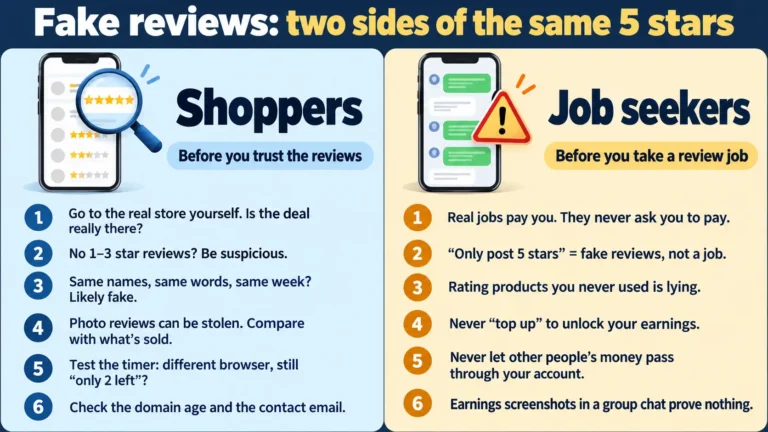
The approach often starts with an unexpected text or WhatsApp message offering activities described as “product boosting” or “app optimisation”. You are directed to a website or app where clicking through tasks appears to build a commission balance. The FTC describes this as an illusion of earning money, rather than genuine wages. FTC task-scam research
Sometimes you receive a small payment first. That matters: it gives you something tangible to trust. In its August 2025 warning, the FTC explains that scammers may make small initial payouts before demanding deposits to continue or withdraw. Being paid once does not establish that the platform is legitimate. FTC task-scam warning
Next comes a condition: complete another set, fund the account or pay to release the displayed earnings. Other supposed workers may encourage you with success stories in a group chat. The FTC has documented both deposit demands and fake group-chat reassurance. FTC research
At that point, the decision can feel different from the first payment. You are no longer thinking only about earning extra money. You are trying not to lose what you have already paid.
A number on a dashboard is not proof of money available to you. Paying again does not turn that number into a recoverable salary.
What the Research Shows
In research published in December 2024, the FTC estimated approximately 20,000 task-scam reports in the first half of 2024, compared with approximately 5,000 throughout 2023. Reported losses to the broader job-scam category exceeded US$220 million in the first half of 2024.
These are figures from the FTC’s reporting system, not South African totals or worldwide estimates. The task-scam counts were estimated from sampled complaint narratives; the broader loss figure should not be described as losses from task scams alone. FTC methodology and findings
Job Scams in South Africa: Fake Recruitment and Fees
In March 2025, the Department of Employment and Labour warned that unemployed people were being asked to pay to be shortlisted or employed under Project 20 000. The department said applications were free and that it had not appointed agents to manage the process. Department warning
In November 2025, Gauteng’s Department of Roads and Transport warned about a fabricated EPWP recruitment advertisement promising local placements and daily pay. It directed applicants to official recruitment channels and advised independent confirmation with the department. Gauteng warning
Fees can be dressed up as routine administration. In a separate warning, the Department of Health described fake appointment letters carrying its logo and demanding a supposedly refundable R250 background-check payment. Department of Health warning
An official-looking letter does not prove the organisation issued it. Calling a payment “refundable” does not prove you will receive it back.
Other Job Offers That Deserve Close Scrutiny
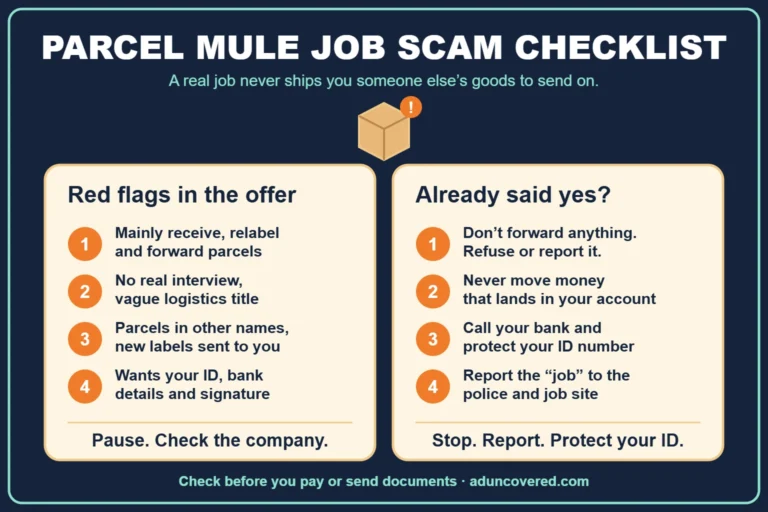
Some fake work-from-home offers demand payment for starter kits or worthless training. Others involve receiving and forwarding parcels purchased with stolen payment details; read how these parcel mule job scams work. The FTC also describes fake-cheque arrangements where an apparent employer sends money and instructs the applicant to forward part of it elsewhere. FTC job-scam guide
A separate danger is a role that asks you to receive customer payments into your personal bank account, keep a commission and transfer the rest. The FBI identifies this as a money-mule recruitment warning sign. You may be helping move criminal proceeds rather than performing an ordinary job. Receiving your own salary is different from passing other people’s money through your account. FBI money-mule guidance
Not every remote role, training course or unsolicited recruiter message is fraudulent. The warning lies in the arrangement: an unverifiable vacancy, payment for a promised appointment, deposits to release earnings or instructions to move unexplained money.
Before You Pay or Send Documents
Use these checks together. No single check proves an offer is safe.
- Confirm the vacancy independently. Find the employer’s website yourself and contact its recruitment department using independently sourced details. Ask whether the vacancy and recruiter are genuine.
- Check who is actually contacting you. A real company can be impersonated. Compare the exact email domain, website address and recruiter details with the organisation’s confirmed channels.
- Ask for clear written terms. Establish the work, employer, employment or contractor status, pay calculation and payment schedule. Vague promises are not a substitute for a defined role.
- Examine every payment demand. What are you buying, from whom and why? A separately verified qualification is different from paying an unknown recruiter to secure a position.
- Protect sensitive information. Verify the recipient and purpose before sending identity documents or banking details. Never provide a banking password, PIN or one-time code.
- Look beyond testimonials. Search the exact business name, domain and contact details for independent information. No complaints found does not mean no risk exists.
- Pause when the terms change. A new payment condition is a reason to reassess the offer, even after you have invested time or received a small payout.
The FTC recommends independent research, discussing the offer with someone you trust and refusing to pay for the promise of a job. It also cautions that an absence of complaints does not guarantee honesty. FTC verification advice
Overseas Offers Can Carry a Physical Risk
Some fake vacancies do more than take money. INTERPOL has documented people recruited through deceptive job advertisements, trafficked to scam centres and forced to commit online fraud. This does not mean every overseas opportunity is dangerous, but it makes independent checks of the employer, workplace, contract and travel arrangements essential. INTERPOL findings
Already Paid? Stop Before Paying Again
Contact your bank or payment provider immediately through its official channel. Explain the transaction accurately and ask what can be stopped, recalled or disputed. Recovery is not guaranteed. Do not wait for a research report before taking urgent action. FTC payment guidance
Save the advertisement, messages, website address, recruiter details, payment receipts and transaction references. Report the account or listing to the platform and suspected fraud to SAPS. Where a government recruitment programme was impersonated, notify the relevant department too.
If you supplied identity documents, seek guidance from your bank and SAFPS. Protective registration can help participating organisations identify impersonation risks, but it does not erase information already disclosed or guarantee protection everywhere.
Be cautious of anyone who then promises to recover your money for an upfront fee. Recovery scams target people who have already suffered a loss. FTC recovery-scam guidance
For a fuller response checklist, read What to Do Immediately After Being Scammed.
Where AdUncovered Can Help
Where an offer involves an identifiable recruitment agency, business or earning platform, AdUncovered can investigate its public background and claims and provide a research report to support your decision. Research is not a guarantee of employment, legitimacy or money recovery.
You do not need to be ashamed of wanting work. But you do not have to keep paying to prove you deserve it. Before you pay, check beyond the advert.
Check before you pay
About to pay a seller or business you don’t know? Start with a Free Quick Check of the advert link. It screens for common warning signs and shows where each result came from.
If you need the seller researched, a Quick Report or Comprehensive Report brings together source-linked Search Results on the seller and the offer. Neither gives a verdict: you check the sources and decide for yourself.