
Is This Online Store Legit? 12 Checks to Make Before You Buy
You find the product you want at a surprisingly good price. The website looks polished, the reviews are glowing and a countdown says the offer will end soon.
But one question keeps bothering you: Is this online store legit?
To check an online store before buying, compare the exact website address, the seller’s disclosed business details, independent Search Results, the full price, delivery promises, return terms and payment conditions. No single review, registration record or automated score guarantees that a seller will deliver or that an offer is right for you.
This checklist is for shoppers worldwide. Business registers, consumer rights and reporting routes differ by country. South African examples and resources are identified below; they are not universal rules.
South African example: In May 2026, South Africa’s National Consumer Commission added another 20 businesses to its list of untraceable suppliers. Its preliminary findings indicated that some suppliers had accepted payments, failed to deliver and then disappeared, closed their websites or changed their addresses. Some operated entirely online. National Consumer Commission
A professional website cannot answer the legitimacy question on its own. Fake shops can display product catalogues, shopping carts, security symbols, customer reviews and familiar payment screens. The safer approach is to check whether the information behind the shop holds together.
No single check provides certainty. These 12 checks help you identify unanswered questions, inconsistencies and warning signs before you buy.
1. Check the exact website address
Start with the address displayed in your browser.
Imitation websites often use addresses that resemble those of established retailers. The difference may be one letter, an added word, an unexpected hyphen or an unfamiliar domain ending.
Be particularly careful when you reach a shop through:
- a social-media advert
- a sponsored search result
- an email or text message
- a WhatsApp message
- a shortened link
- a competition or giveaway
If the offer claims to come from a known retailer, leave the advert and find the retailer’s official website independently. Compare the two addresses carefully.
Do not assume that appearing near the top of search results proves that a website is official. Paid adverts can lead to third-party or impersonation sites. The safest route is to type a known address yourself or use a link from a source you have independently confirmed.
2. Do not treat the padlock as proof
A padlock and an address beginning with https mean the connection between your browser and the website is encrypted. That is important when entering information, but it does not establish who operates the site or whether the offer is genuine.
Fraudulent websites can also use encryption.
Treat HTTPS as a minimum technical requirement, not a legitimacy certificate. The US Federal Trade Commission makes the same distinction: encryption protects information in transit, but scammers can encrypt their sites too. FTC online-shopping guidance
3. Identify the business behind the shop
A legitimate-looking store name may be only a trading name. Look for the legal business identity behind it.
Check the website’s:
- About page
- Contact page
- terms and conditions
- privacy policy
- returns policy
- invoice information
- footer
Look for a registered business name, registration number, physical address, working telephone number and an email address connected to the business’s domain.
Disclosure requirements differ by country. For an overseas seller, check the official consumer-protection guidance relevant to the transaction rather than assuming that your home country’s rules apply.
South Africa: Under section 43 of South Africa’s Electronic Communications and Transactions Act, an online supplier is expected to make specified information available to consumers. This includes information about the supplier, the goods or services, the full price, payment, terms, delivery and refund policy. The CGSO’s explanation of online consumer rights provides a useful summary.
Missing information does not automatically prove fraud. It does make the seller harder to identify and hold accountable if something goes wrong.
4. Verify the business details independently
Do not stop when you find a registration number or address on the website. Check whether the information corresponds with independent records.
For a South African company, use the Companies and Intellectual Property Commission’s BizPortal to check available company information.
United Kingdom: Companies House provides a public company-information service. Compare the disclosed company name and number with the available records.
Elsewhere, look for the official business register for the country or state where the seller claims to be registered. Check which business types the register covers. A matching entry does not establish that the person contacting you controls the company or its website, or that the offer is reliable.
Compare:
- the registered name with the name on the website
- the registration details with the invoice or quotation
- the address with the claimed place of business
- the seller’s name with the account receiving payment
A real company registration is useful information, but it is not a guarantee. A registration number can be copied from another company, or a registered business can still be the subject of unresolved complaints. The details must make sense together.
5. Check when the website was created
A newly registered domain is not automatically suspicious. Every genuine business was new once. However, the age of the domain matters when a website makes claims such as:
- “trusted for 15 years”
- “thousands of long-standing customers”
- “established since 2010”
- “South Africa’s leading supplier”
You can enter the domain into ICANN’s registration lookup tool to view available registration information, including creation and update dates where those details are public.
A recent registration does not prove that a shop is fraudulent. But a site created last month cannot, by itself, support a claim that the same website has traded for many years. That difference deserves an explanation.
Remember that privacy rules may hide the owner’s personal details. Hidden registration information is therefore not automatically suspicious.
6. Test the contact information
Before paying, check whether the seller can be reached.
Call the telephone number. Send a specific question about stock, delivery, returns or the product. Search the address independently and check whether it appears consistent with the type of business being presented.
Be cautious when:
- the telephone number never connects
- only WhatsApp communication is available
- the email address uses an unrelated free account
- the physical address belongs to another business
- responses avoid straightforward questions
- the seller becomes defensive when asked for details
- you are pushed to pay before your questions are answered
A functioning phone number does not prove legitimacy, but failed or inconsistent contact information weakens the offer.
7. Search for the seller outside its own website
Search the business name, website address, phone number and email address separately.
Add terms such as:
reviewscomplaintsscamrefundnon-deliverycontact details
Do not rely on the first result or on one review platform. Check several independent sources, including older results.
Look for patterns rather than expecting universal praise. Genuine businesses can have complaints. More useful questions are:
- Does the business respond to complaints?
- Are complaints about the same recurring problem?
- Do reviews describe specific purchases?
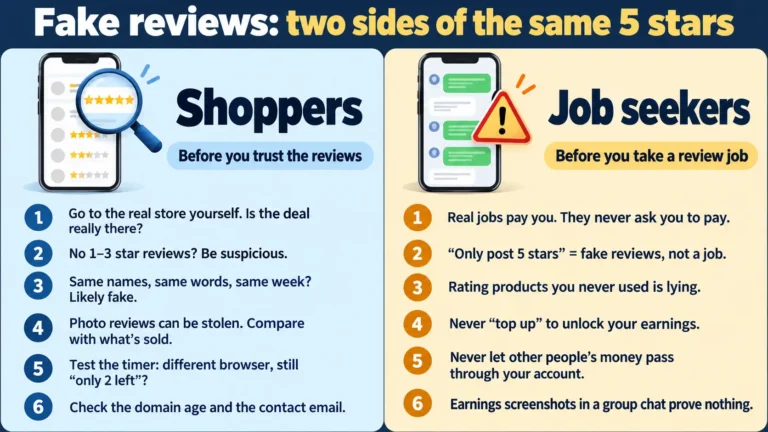
- Are all the reviews recent and unusually similar?
- Does the reviewer have a credible history?
- Are there reports of goods never arriving?
- Has the seller changed names or web addresses?
The FTC cautions consumers not to rely on star ratings alone because reviews may be fake, incentivised or manipulated. A sudden cluster of vague five-star reviews deserves closer attention. FTC review guidance
8. Examine the offer, not only the seller
Sometimes the business exists, but the specific offer still raises questions.
Compare the price with other suppliers. Check the model number, product specifications, warranty, delivery period and what is included.
Ask why the price is substantially lower. It may be clearance stock, refurbished goods, a parallel import, an older model or a product sold without the usual warranty. Those possibilities are not necessarily improper, but they should be disclosed clearly.
Look beyond the headline price for:
- delivery charges
- compulsory subscriptions
- administration fees
- import duties
- recurring payments
- limited warranties
- restocking fees
- exclusions hidden in the terms
A discount percentage means little if you do not know the ordinary selling price or the complete amount payable.
For an overseas order, also check the currency, shipping origin, any disclosed import charges, the return destination and who pays return postage. Compare these details with the advert. A low headline price may not be the complete cost of buying and, if necessary, returning the item.
9. Read the delivery, cancellation and refund terms
A legitimate seller should explain what happens after payment.
Check:
- when the order will be dispatched
- how delivery will be tracked
- who is responsible for delivery
- how cancellations are handled
- the period allowed for returns
- who pays return costs
- how refunds are processed
- where returned goods must be sent
- what happens if the product is unavailable
Marketplace purchases need an additional check: determine whether you are buying from the platform or from an independent third-party seller. South Africa’s Consumer Goods and Services Ombud (CGSO) advises consumers to establish who owns the goods, who must deliver them, who provides the receipt and whether the platform will assist with complaints, non-delivery or defective products. CGSO marketplace guidance
Terms copied from another website, references to the wrong country or conflicting business names are reasons to investigate further.
10. Examine how payment is requested
The payment method affects what may happen if the order is not delivered.
Be cautious when an unfamiliar seller insists on:
- an immediate electronic transfer
- payment to an individual’s account
- cryptocurrency
- gift cards or vouchers
- payment outside a marketplace
- a payment link sent through a message
- an unexpected change in banking details
Compare the account holder’s name with the supplier’s disclosed identity. If they differ, ask why and verify the explanation using contact details obtained independently.
Where possible, choose a payment method or established platform that offers a dispute process or buyer protection. Before relying on that protection, read its limits, exclusions and deadlines.
South Africa’s Financial Intelligence Centre advises consumers to use secure payment methods, consider virtual cards and exercise caution when crypto assets are required. FIC holiday-scam guidance
11. Scan the website, but understand the result
South African consumers can enter a website address into Yima’s free website scanner. Yima is a scam-prevention service operated by the Southern African Fraud Prevention Service and checks websites for known vulnerabilities and scam-related risks.
A warning is a reason to stop and investigate. A clean result is not a guarantee that a seller will deliver or honour its promises. Automated tools may not yet know about a new website, and they cannot independently confirm every statement made in an advert.
Use a website scan as one source of information, not a guarantee about the seller or the offer.
AdUncovered’s Free Quick Check works the same way: it checks a website address against known-threat lists and addresses other people have reported. Most new scam sites are not on any list yet, so a clear result is not reassurance. It is one check among the twelve.
12. Notice what the offer is asking you to feel
Pressure is often easier to recognise when you step away from the advert.
Common prompts include:
- “Only one left”
- “Offer ends in ten minutes”
- “Hundreds are buying now”
- “Pay today to secure your order”
- “You have been specially selected”
- “Do not miss this once-in-a-lifetime price”
These messages do not prove that an offer is false. They do make it harder to slow down and ask questions.
Pause the purchase. Take screenshots of the advert and terms. Compare the price elsewhere. Ask the seller for clarification in writing.
If the offer cannot survive a short, reasonable check, the urgency is deciding for you.
Shopping on Black Friday (27 November)? These checks matter most when a countdown is pushing you to pay. Black Friday Scams 2026: Spot Fake Shops and Deals covers the fake shops, cloned adverts and urgency tricks to watch for.
What if all 12 checks look fine?
You may still not have certainty.
A website can be old. A company can be registered. Reviews can be positive. Contact details can work. None of those facts guarantees that a particular product will arrive exactly as promised.
What you are looking for is consistency:
- Does the website identity match the business identity?
- Does the business history align with its claims?
- Does the payment destination make sense?
- Are the terms clear enough to understand what you are buying?
- Can the seller answer reasonable questions?
- Do independent sources support the important claims?
One weak point may have an innocent explanation. Several unresolved inconsistencies create a stronger reason to stop.
What to do if you have already paid
Contact the seller in writing and keep a record of the response. Save the advert, website address, product page, terms, order confirmation, invoice, messages and proof of payment.
If you believe your card or banking information may have been compromised, contact your bank immediately using its official number. Ask what steps are available for securing your account and disputing the transaction.
If the order is missing, different from the advert or otherwise disputed, check the marketplace’s and payment provider’s official complaint procedures and deadlines. Available protection depends on the country, provider and transaction; a refund is not guaranteed. The US Federal Trade Commission’s online-shopping guidance is a US-specific reference.
If you are outside South Africa, use the consumer-protection authority or reporting service relevant to your country. Obtain contact details independently from official websites.
South African reporting routes: Depending on the issue, you can also:
- report a suspicious website or incident through Yima
- submit a consumer complaint to the National Consumer Commission
- approach the Consumer Goods and Services Ombud after first raising the complaint with the supplier
- report suspected criminal conduct to SAPS
Be cautious if someone later offers to recover your money for an upfront fee. Fraud-recovery offers can become a second attempt to take money from someone who has already suffered a loss.
A polished website is only the front of the offer
The right question is not simply, “Does this website look real?”
Ask whether the seller, claims, price, website history, terms and payment details can be supported by information outside the advert.
AdUncovered researches commercial offers using the information you provide and relevant public sources. Your private report brings together source-linked Search Results, with source references, differences between published statements and research limitations.
AdUncovered provides Search Results, not a verdict, opinion, recommendation or trust score. It does not guarantee safety or promise recovery of lost money.
We provide these Search Results so you can review the sources and decide for yourself whether the offer is right for you.
Before you buy, take the time to look beyond the online store.
Want the research done for you? Start with a Free Quick Check of the website address, or order a Quick Report that researches one online store and its offer, with a link to every source. For a bigger purchase, a seller with several websites, or an order that has gone wrong, choose the Comprehensive Report.
Check before you pay
About to pay a seller or business you don’t know? Start with a Free Quick Check of the advert link. It screens for common warning signs and shows where each result came from.
If you need the seller researched, a Quick Report or Comprehensive Report brings together source-linked Search Results on the seller and the offer. Neither gives a verdict: you check the sources and decide for yourself.