
Christmas scams are usually familiar fraud methods adapted to seasonal behaviour. Criminals do not need to invent a completely new story. They place an old method inside an activity that already feels normal in November and December: ordering gifts, tracking parcels, booking travel, donating to charity, receiving a bonus, finding temporary work or sending money to family.
Online shopping and non-delivery fraud are among the most consistently documented festive-season threats. Fake shops, copied advertisements and dishonest marketplace sellers benefit from high demand, urgent delivery deadlines and the search for unusually good prices. Delivery-message phishing then benefits from the fact that many recipients really are waiting for parcels.
Other recurring schemes include gift-card payment demands, fake charity collections, travel and accommodation fraud, account takeovers, seasonal job offers, prize messages, refund impersonation and changed business-payment instructions.
There is no reliable worldwide table proving which Christmas scam will be the most successful in every country. Reporting categories differ and much fraud is never reported. However, official seasonal warnings repeatedly identify shopping, non-delivery, delivery phishing and impersonation because they fit the largest number of ordinary holiday transactions.
The FBI’s Internet Crime Complaint Center recorded reports from almost 12,000 victims of non-payment and non-delivery schemes during the 2022 holiday shopping season, with reported losses exceeding USD 73 million. That figure covers complaints submitted to the FBI and should not be treated as a global total, but it illustrates the scale one seasonal category can reach.
Source: FBI IC3, Holiday Shopping Scams
Why Christmas scams work during the festive season
The risk does not increase because people suddenly become careless. The environment changes in ways that make verification harder and fraudulent explanations more plausible.
More transactions
People buy from more sellers, use more payment pages and receive more order confirmations than usual. A fraudulent charge, email or delivery message has more legitimate activity to hide among.
Time pressure
Delivery deadlines, limited stock, flash sales and travel dates encourage quick decisions. A buyer who believes a gift must arrive before Christmas has less time to investigate an unfamiliar seller.
Bargain hunting
Popular electronics, toys, clothing, event tickets and travel may be expensive or scarce. A heavily discounted offer can feel like a fortunate discovery rather than a warning sign.
More parcels
A message claiming that a delivery fee, address confirmation or customs payment is required is more believable when the recipient is genuinely expecting several packages.
Bonuses and year-end payments
Some workers receive bonuses or other year-end payments. Businesses may also be processing supplier invoices, payroll changes and closing transactions before staff go on leave. Criminals can exploit both the available funds and the pressure to complete payments quickly.
Travel and reduced availability
People may be away from their normal routines, using mobile devices or unfamiliar networks. Colleagues, relatives, bank staff and suppliers can also be harder to reach for independent confirmation.
Generosity and social expectation
Christmas encourages gifts, donations and help for relatives or colleagues. A request involving a gift card, emergency payment or charity can therefore feel emotionally appropriate.
These conditions do not prove that festive fraud always rises by a fixed amount. They explain why certain stories become easier to believe and why criminals reuse them every year.
1. Fake online shops and social-media advertisements
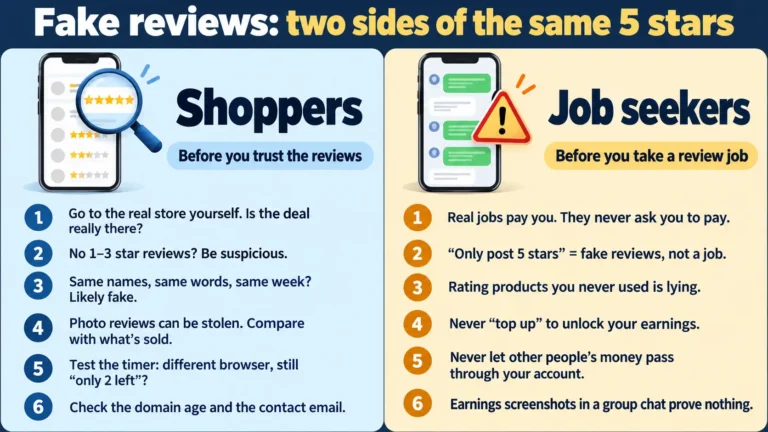
A fake shop can be built from copied product photographs, descriptions, customer reviews and policies. Paid social-media advertisements or search results direct buyers to the site, where popular products appear at unusually low prices. The buyer receives nothing, a counterfeit product or an item substantially different from the advertisement.
The United States Federal Trade Commission warns that fraudulent holiday advertisements often impersonate real companies and promote brand-name products at unrealistic prices. South Africa’s National Consumer Commission has similarly identified untraceable suppliers that accepted orders and payments before disappearing, closing websites or leaving their stated addresses.
Sources: FTC, Avoid an Online Shopping Scam This Holiday Season and NCC, Untraceable Suppliers
Common warning signs include:
- an expensive or scarce product offered far below its normal price;
- a domain with little history despite claims of an established business;
- contact details that cannot be confirmed outside the site;
- payment to an unrelated person or business;
- copied or contradictory refund and delivery terms;
- reviews posted within a short period or visible only on the seller’s pages; and
- pressure created by countdowns, low-stock notices or immediate-payment demands.
Black Friday on 27 November opens the festive shopping season. Black Friday Scams 2026: Spot Fake Shops and Deals explains how to check a deal before you pay.
Professional design and an encrypted connection do not establish that the seller is genuine. Before paying, identify the legal seller, compare the beneficiary, search the exact web address and examine how long the business has been visible through independent sources.
2. Marketplace non-delivery and fake-payment scams
Festive shopping increases activity on local marketplaces, resale groups and community pages. Buyers may be searching for sold-out products, while households and small businesses sell unused items to raise extra money.
Fraud can target either side. A dishonest seller requests a deposit for an item that does not exist. A dishonest buyer sends a false payment notification, claims that an account must be upgraded to receive the money or overpays and asks for the difference to be returned. In some cases, a meeting arranged for a high-value item creates a risk of physical robbery as well as financial loss.
SAPS has warned that marketplace criminals use unusually low prices, advance-payment requests and false profiles. It advises independently verifying the item and seller and not relying solely on an electronic proof-of-payment image.
Source: SAPS, Warning About Online Marketplace Scams
A seller should confirm cleared funds through their own banking channel before releasing an item. A buyer should verify the item and seller before paying a deposit. Meetings for valuable goods are safer in an appropriate public location with independent confirmation of the transaction.
3. Parcel delivery and customs-message phishing
Delivery phishing is particularly effective during the festive season because the recipient may not remember which courier is handling each parcel. A text or email claims that an address is incomplete, delivery was missed, customs duty is outstanding or a small redelivery fee must be paid.
The link may lead to a copied courier website that collects card details, banking credentials or personal information. The small initial fee makes the request appear low-risk, while the information collected can support larger unauthorised transactions or later impersonation.
A genuine-looking sender name or message thread is not conclusive. Open the retailer or courier’s official application independently and enter the tracking number from the original order confirmation. If no tracking number is supplied, contact the seller through the details used when placing the order.
The UK’s National Cyber Security Centre includes delivery scams among its recurring Christmas shopping warnings and encourages recipients to report suspicious messages and fake shop websites.
Source: NCSC, Holiday Shopping Cyber-Scam Warning
4. Gift-card scams and tampered cards
Gift cards are common presents, which makes two different forms of fraud easier to hide.
In the first, an impersonator claims to be an employer, relative, official or service provider and instructs the target to buy gift cards and send photographs of the numbers. The story may involve employee rewards, an urgent present, a fine, technical support or an emergency. Once the number and PIN are supplied, the value can be taken even though the victim still holds the physical card.
In the second, cards displayed in a shop may have been tampered with before purchase. The criminal has copied the identifying details and waits for the card to be activated.
The FTC’s guidance is direct: gift cards are for gifts, not payments demanded by a caller or message. Buyers should inspect physical cards, use trusted sellers and retain the card and receipt so the issuer can investigate if a problem appears.
Source: FTC, Avoiding and Reporting Gift Card Scams
5. Family, friend and account-takeover requests
Holiday plans make urgent personal requests sound plausible. A message may claim that a relative lost a telephone while travelling, needs help returning home or cannot access an account. Another version comes from a compromised social-media or messaging account and asks contacts to pay for a gift, meal, ticket or emergency.
Profile photographs, earlier messages and personal details can be copied. AI-generated audio can also imitate a familiar voice, although a convincing synthetic voice is not required when the target already recognises the account.
Confirm the request through a second channel. Call a number previously saved, contact another family member or ask a question based on private shared knowledge. The verification should not depend on contact information supplied in the same suspicious conversation.
6. Fake charities and seasonal donation appeals
End-of-year giving creates an opportunity for fabricated charities, copied crowdfunding pages and impersonation of established organisations. A request may refer to children, food parcels, disaster relief, animals, medical treatment or support for a local family.
The emotional story may be genuine while the payment destination is not. A social-media post shared by a friend can also originate from a compromised account or an appeal that was never independently checked.
The FTC recommends researching the charity separately, confirming text-donation numbers through the charity’s official website and reviewing how donations are used. Pressure for an immediate payment or insistence on cash, gift cards, wire transfer or cryptocurrency is a significant warning sign.
Source: FTC, Before Giving to a Charity
Where a tax deduction, registration or specific beneficiary is claimed, verify that fact with the appropriate official register or organisation. Donate through a channel reached independently rather than through the link in an unsolicited message.
7. Holiday travel, accommodation and ticket fraud
Flights, holiday accommodation, vehicle hire, events and popular attractions can be expensive or fully booked. A fraudulent listing offers the unavailable dates, preferred location or unusually low price that the traveller wants to find.
The property may not exist, may belong to someone else or may be available only through a legitimate agency that the advertiser is impersonating. Stolen photographs and copied reviews create a convincing listing. Payment is requested outside the booking platform to avoid fees or secure a special rate.
Event tickets present a similar problem: the same ticket can be sold repeatedly, or a fabricated confirmation can be delivered after payment.
Verify the address, operator and property through independent sources. Keep communication and payment inside a reputable platform where possible, and understand its refund and dispute procedures. A bank account in an unrelated name or pressure to leave the platform requires a credible explanation before money is sent.
8. Seasonal job and task scams
Retailers, couriers, restaurants, tourism businesses and warehouses often need temporary staff. Fraudulent recruiters use that expectation to advertise work that does not exist, collect identity documents or demand payment for training, uniforms, background checks, equipment or placement.
Task scams promise earnings for product reviews, social-media engagement or order processing. A small payment may be made initially. The participant is later required to deposit personal funds to unlock commissions or complete higher-value tasks.
Some fake jobs recruit money mules by asking the worker to receive and forward payments. This can expose the participant to serious consequences even when the job initially appeared legitimate.
Check the vacancy on the employer’s own website and contact its human-resources department through independently sourced details. Examine whether the email domain belongs to the employer and whether payment is required before work begins.
9. Holiday giveaways, surveys and voucher phishing
A free hamper, retailer voucher, airline ticket or Christmas competition encourages sharing and quick participation. The target is asked to complete a survey, forward the promotion to contacts or enter payment details for a small delivery charge.
The reward may not exist. The purpose can be to collect credentials, card information, personal data or permission for recurring charges. A message may appear to come from a friend because that person shared it without verification or because their account was compromised.
Find the company’s verified website or social account independently and look for the same promotion. Read the complete terms, including subscription language. A real brand logo inside a form does not show that the brand controls the page.
10. Refund, bank and payment-provider impersonation
High transaction volumes make an unexpected refund or fraud alert seem reasonable. A caller or message claims that a purchase was duplicated, a suspicious payment must be cancelled or an account needs verification before a refund can be processed.
The target may be asked for credentials, a one-time code, card details or approval of a banking notification. In another version, the person is told to transfer money to a “safe” account while the supposed investigation continues.
End the contact and use the bank or payment provider’s official application, a number printed on the card or a number obtained from its official website. An authentic employee can continue through the institution’s verified process. A caller’s knowledge of a recent purchase is not proof of identity because transaction-related information can be exposed through compromised email, merchant accounts or earlier phishing.
11. Year-end investment and bonus scams
A bonus, savings payout or year-end distribution can make an investment promotion feel well timed. Social-media advertisements and messaging groups offer cryptocurrency, forex, shares or automated trading with rapid returns. Fake dashboards display profits and persuasive representatives encourage increasingly large deposits.
The seasonal framing may include a limited December opportunity, special year-end rate or January withdrawal plan. When the victim asks for the money, the platform demands taxes, insurance, verification or release fees.
Verify the exact legal provider and whether it is authorised for the service offered. Then contact the registered entity through details obtained independently to confirm the website, representative and beneficiary. A genuine licence number can be copied by an impersonator, and a balance displayed on a private website does not prove that assets were purchased.
12. Business email compromise and year-end payment diversion
Businesses often try to settle invoices, bonuses, salaries and supplier accounts before offices close. Reduced staffing and rushed approvals can weaken normal checking procedures.
A criminal who has compromised or imitated an email account sends replacement bank details, an urgent invoice or an executive instruction. The message may arrive inside a genuine conversation and use the organisation’s normal wording. A false proof of payment may also be used to persuade a supplier to release goods before funds have cleared.
Every new or changed beneficiary should be confirmed through a trusted channel already on record. Higher-value or unusual payments should retain dual approval even when managers are travelling or on leave. Holiday urgency is a reason to preserve the process, not bypass it.
Which festive scams are most likely to succeed?
The answer depends on location, payment habits and what the target is doing. Nevertheless, three characteristics make a seasonal scheme especially persuasive.
It matches a real activity
A parcel message sent to someone expecting deliveries, a marketplace approach sent to an active seller or a bank alert sent after heavy shopping requires less invention. The recipient supplies much of the context themselves.
It requests a small first action
A modest delivery fee, short survey or low initial investment feels less dangerous than a large payment. The first action may instead expose card details, credentials or the willingness to continue.
It creates a deadline
The parcel will be returned, the gift will not arrive, the booking will expire or the discount will end. The deadline shifts attention away from verification.
For those reasons, fake shops, non-delivery offers and parcel phishing are likely to remain among the broadest festive threats. They can target almost anyone who shops online. Account impersonation, bank fraud and business payment diversion may reach fewer people in a particular campaign but can cause much larger individual losses.
A five-minute festive-season verification routine
The following checks apply across most of these schemes:
- Pause the transaction. Separate a genuine deadline from pressure created by the sender.
- Open a clean route. Find the retailer, courier, bank, charity, employer or booking platform independently.
- Identify the other party. Establish the legal seller or provider and compare its details with the payment beneficiary.
- Test the offer outside its own page. Check public records, domain history, addresses, official warnings and independent reporting.
- Review the payment method. Consider what dispute or recovery process exists if the item, booking or service is not supplied.
- Preserve the evidence. Keep the advertisement, full URL, messages, invoices, proof of payment and account details.
No individual check proves safety. The aim is to determine whether independent facts support the same story.
If payment or information has already been sent
Contact the bank, card issuer, gift-card company or payment service immediately using its official channel. Ask what can be blocked, recalled or disputed. Secure affected email, shopping, social-media and financial accounts from a trusted device, and review active sessions and recovery information.
Save the communications and transaction evidence before reporting the account or advertisement to the platform. Report suspected crime and use the appropriate consumer, financial or cybercrime reporting route in your country.
Be cautious of anyone who later promises guaranteed recovery for an upfront payment. Victims can be targeted again because the original network retained or sold their information.
What an AdUncovered report can and cannot establish
AdUncovered researches the seller or business behind an offer using available public information. Reports address your questions, highlight material warning signs and compare relevant claims with the evidence found. Customer complaints are distinguished from established facts, and conflicting or unavailable information is clearly explained.
Choose a Quick Report for a focused seller check covering serious warnings, scam reports, customer complaints and reviews, and the advert versus the published offer. Ordinary research covers the past year. Quick does not investigate your individual transaction or prepare a refund claim.
Choose a Comprehensive Report for broader research across the main concern areas, normally covering the past three years. Where supplied, it also examines your transaction details and relevant refund-related information. Research concerns one identified seller or business and its connected shops, websites and accounts.
Relevant court orders and trading restrictions have no age cutoff in either report. We include other material concerns discovered within the selected scope, not only those you selected.
Provide a usable public link identifying the seller, shop, profile, listing or offer, together with the relevant details in writing. A business does not need its own website, but we need enough public information to investigate the correct seller.
Neither report guarantees safety, determines criminal guilt, provides legal advice or recovers money. No negative findings does not establish that an offer is safe: records may be incomplete, publication may be delayed and new information may appear after the research date.
For the wider methods behind these schemes, read Old Scams, New Technology: How Fraud Methods Have Evolved and How Scam Networks Operate: Known Hubs, Methods and Specialisations.
Research limitations
Seasonal warnings identify recurring patterns, but they do not provide a complete worldwide ranking of Christmas scams. Reporting periods, offence definitions and payment systems differ between countries. Many incidents are never reported, while consumer disputes and deliberate fraud may initially appear similar.
The FBI holiday statistic cited above relates to complaints submitted in the United States during the 2022 holiday shopping season. It demonstrates the significance of non-payment and non-delivery fraud but should not be extrapolated into a global loss total. Other official sources are used to establish recurring methods rather than to claim that every country experiences them at the same rate.
Principal sources
- FBI IC3, Holiday Shopping Scams
- FTC, Avoid an Online Shopping Scam This Holiday Season
- FTC, Avoiding and Reporting Gift Card Scams
- FTC, Before Giving to a Charity
- NCSC, Holiday Shopping Cyber-Scam Warning
- SAPS, Warning About Online Marketplace Scams
- NCC, National Consumer Commission Uncovers More Untraceable Suppliers
- NCC and CGSO, Consumer Protection in E-commerce
Editorial note: This article provides general public-source research and practical guidance. It is not legal, financial or law-enforcement advice. A warning sign does not by itself establish wrongdoing, and the absence of an obvious warning sign does not establish safety.
Unsure about a festive season offer? Start with a Free Quick Check, or order a Quick Report to research the seller and the offer before you pay. If a holiday purchase hasn’t arrived or a refund is refused, the Comprehensive Report researches the seller and your purchase.
Check before you pay
About to pay a seller or business you don’t know? Start with a Free Quick Check of the advert link. It screens for common warning signs and shows where each result came from.
If you need the seller researched, a Quick Report or Comprehensive Report brings together source-linked Search Results on the seller and the offer. Neither gives a verdict: you check the sources and decide for yourself.