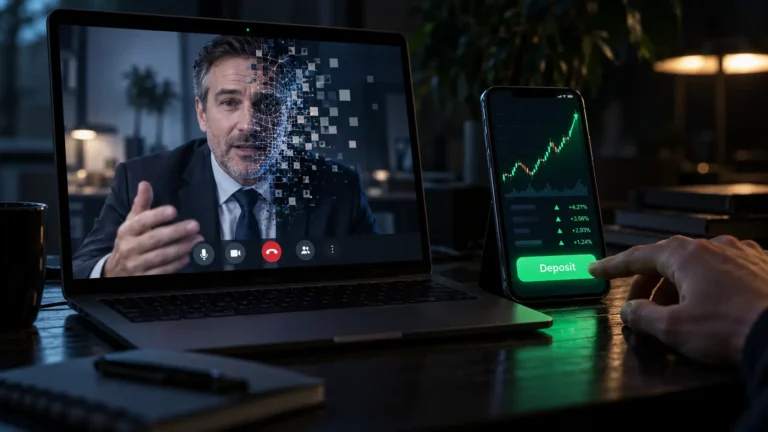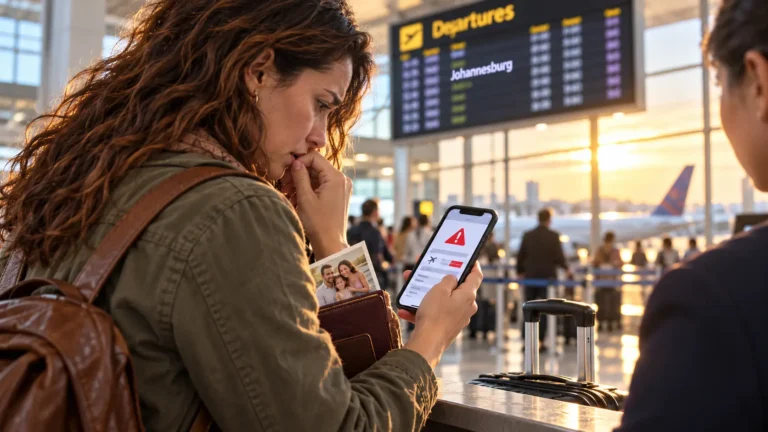
Before Black Friday, most of us do the same thing: we scroll down to the stars. Hundreds of five-star reviews feel like proof that a shop is real and a product is good. That is exactly why fake online reviews have become an industry, and why, in a country where millions of people are desperate for work, so many South Africans are being recruited to write them.
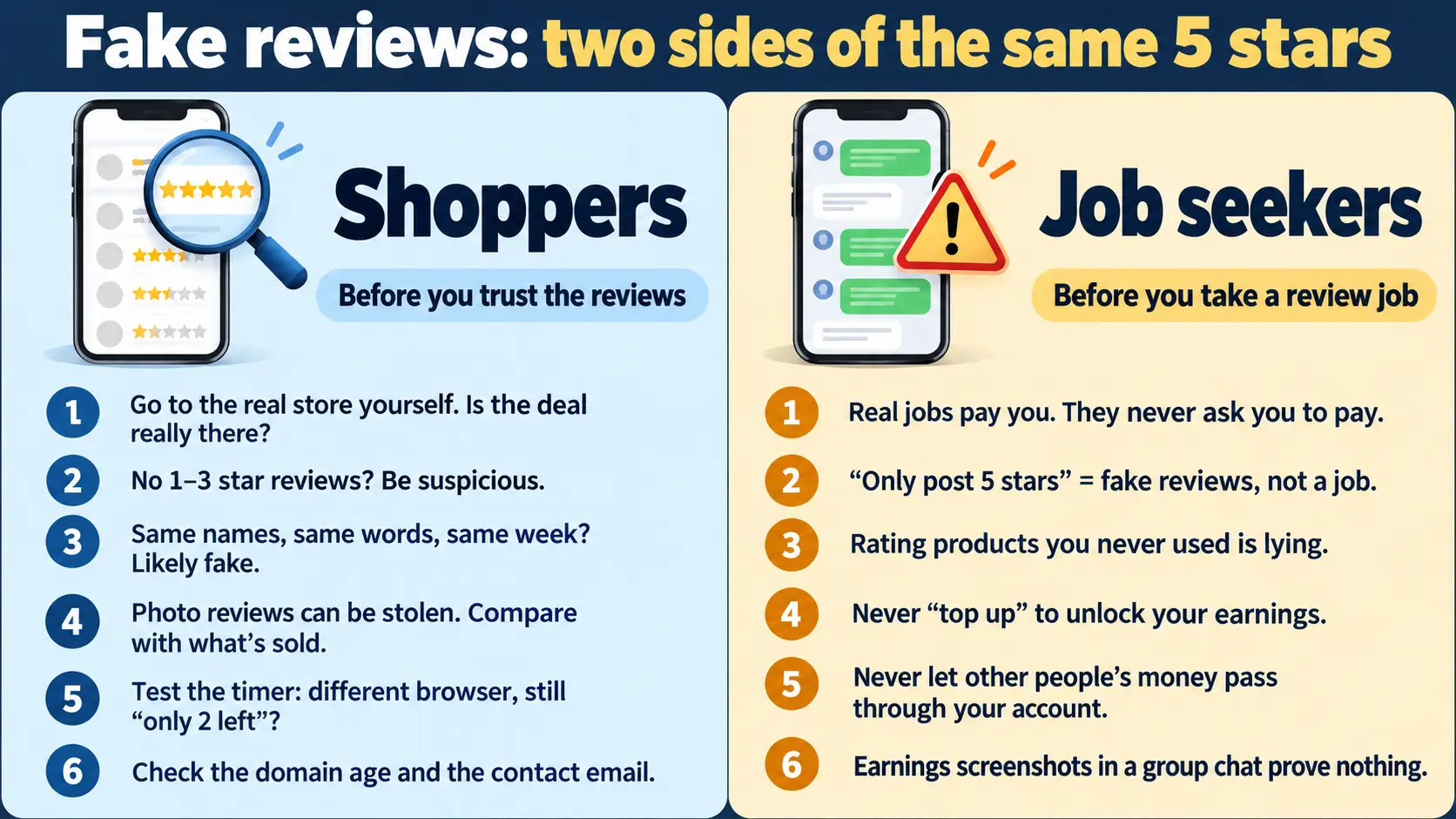
This guide looks at both sides of the same review. The shopper who trusts it, and the person who was paid, or promised payment, to write it. It includes first-hand experience from the person behind AdUncovered, who was approached to write reviews, a checklist for each side, and a simple routine to test reviews and “only 2 left” warnings before you pay.
Why fake online reviews work so well
Reviews are borrowed trust. When you can’t touch a product or visit a shop, other buyers stand in for you. Fake reviews exploit that, and the scale is enormous. Google says it blocked or removed more than 292 million policy-violating reviews on Maps in 2025, and removed over 13 million fake business profiles.
South Africa is not immune. In 2024, several well-known Cape Town restaurants complained about floods of fake Google reviews, positive and negative, some describing dishes that weren’t on the menu. One restaurant said 99% of its 203 Google reviews were fake.
Side 1: the shopper who trusts the stars
A case that fooled a careful buyer
The person behind AdUncovered describes herself as “way too analytical”, the kind of shopper who asks too many questions. She was still caught once.
While scrolling a large international shopping app, she found a seller offering shoes from a well-known comfort-shoe brand at a last-minute discount. The listing used the brand’s own product photos. Underneath were glowing reviews, including photos of people wearing the shoes. She bought two pairs by card.
What arrived were cheap copies. The review photos had shown the real shoes, not what the seller actually shipped. Sending them back would have cost more than they were worth. The app refunded her for other orders, but on these shoes she lost the email battle. Later, the seller had vanished from the app.
Two lessons stand out:
- Photo reviews can be stolen too. A photo proves that someone, somewhere, owns the real product. It doesn’t prove you will receive it.
- A big marketplace is not a guarantee. Copycat sellers operate inside large apps, collect sales and complaints, disappear, and come back under new names.
How fake reviews are made
- Bought in bulk. Sellers pay review brokers, often organised through social media. In the UK, consumer group Which? found 14 Facebook groups with more than 62,000 members trading fake reviews for free products or payment.
- Written by people who never used the product. Recruited “reviewers” are told what to write and how many stars to give. More on that below.
- Generated by AI. Polished, enthusiastic text in seconds, in any quantity.
- Borrowed. Reviews and photos copied from the genuine product’s listing, as in the shoe case.
- Faked urgency alongside them. A 2019 Princeton and University of Chicago study of 11,000 shopping sites found countdown timers that reset when the page was reloaded, and “low stock” messages that appeared on a schedule rather than reflecting real stock, along with fabricated testimonials.
A real shopper’s routine before buying
Here is the routine the person behind AdUncovered actually follows when an advert catches his eye:
- Go to the real store yourself. Don’t use the ad’s link. Check whether the special is really running there, and compare prices elsewhere.
- Check the social media links in the ad. Do they lead to the genuine brand, or to a lookalike page created last month?
- Check who owns the website. A WHOIS lookup shows when a domain was registered. Then compare the contact email with the company’s real domain. “If it’s not the same as the company, there’s a snake in the grass.”
- Search for independent reviews away from the shop’s own site: Hellopeter, Google, and simply “is [shop name] a scam?” in a search engine or AI assistant.
- Be suspicious when there are no 1 to 3 star reviews. Every real product gets some. A wall of five stars is a warning sign, not a recommendation.
- Research the product itself, not just the seller. Hundreds of happy reviews of a diet pill or supplement tell you nothing about whether it is safe for your health. Ask a pharmacist or doctor if you have a medical condition.
Test the urgency
Before you react to urgency, ask why it’s there. Is the shop clearing stock that’s about to expire? Making room for a new range? If you can’t find a real reason, the urgency is the sales pitch. Then test it: open the page in a different browser or a private window. If it still says “only 2 left”, or the countdown starts again from the top, it was never real.
Side 2: the people paid to write fake reviews
Fake reviews need writers, and South Africa has no shortage of people looking for any income at all. According to Stats SA, the official unemployment rate was 33.6% in the second quarter of 2026, with about 8.5 million people unemployed and youth unemployment (ages 15 to 34) at 47.4%. Retirees on small pensions are looking for extra income too. To scammers, that is a recruitment pool.
What happened when we were approached
While researching scams for AdUncovered, the person behind the site responded to a Facebook advert that moved quickly to WhatsApp. A recruiter, a South African woman, described the work: watch short YouTube videos and rate them, then rate products. The promise was up to $300 a day for a few hours’ work. Companies, she said, paid her to get as many reviews as possible, and names like YouTube, Takealot, Amazon, Temu and Shein were mentioned to make it sound legitimate.
- “Do I need to buy and test the products?” No. You rate things you have never used.
- “How will I be paid?” Review for a week first, then they would show what would be paid out. Nothing was arranged up front.
- The honest reviews. She posted a few honest, negative reviews of the videos. The recruiters were furious: the task was easy, just post positive reviews.
- The WhatsApp group. It was full of South Africans saying they were “earning big time”. That chat was itself a set of reviews, this time of the job.
- The ghosting. She asked too many questions. The recruiter stopped replying, and her login stopped working. She had used a separate number kept only for research, so nothing personal was exposed.
Her take: they were scanning for vulnerable candidates. A sceptic who asks questions and writes honest reviews is no use to them, so they move on.
Where review jobs usually lead
Even when review jobs start with small real payments, it rarely stays there. Three common endings:
- The task scam. Small payouts of R100 to R200 build trust. Then you’re asked to “top up” or “recharge” to unlock VIP or merchant tasks, and every withdrawal needs another fee. South African victims have reported losses from a few thousand rand to over R90,000. Our guide to job scams and online task traps explains how this unfolds.
- The money mule. The “job” becomes receiving payments into your account and forwarding them. That is how stolen money is laundered. Standard Bank and SABRIC warn that mules can face money-laundering and fraud charges and be held liable to repay victims, and Capitec notes syndicates may pay under R500 for someone’s banking login.
- The “real” review job. Even if you are paid, you are paid to lie to other shoppers, often to help sellers like the one who sold the fake shoes. Your name, phone number and accounts are attached to that work.
The same trick, aimed at retirees
During research, we also followed an Instagram account aimed at retired people. Its posts listed household names such as Airbnb, Disney, Google, Amazon and IKEA as companies that “will p@y you to work from home”. Note the spelling: symbols like “p@y” are often used to slip past platform filters on money claims.
The “Learn more” link didn’t lead to those companies’ careers pages. It led to a sign-up page, then a webinar, then a wealth-building course costing more than US$2,900. None of the jobs advertised matched what was being sold.
The rule that covers all of these: a real job pays you. It never asks you to pay first, whether that’s a course fee, a “top up”, an activation fee or a starter pack.
Making a living on lies works like a sandcastle. It will crumble when you really need the income. Your name is on the line and worth protecting.
Are fake reviews illegal in South Africa?
Other countries have made fake reviews explicitly illegal. In the US, a Federal Trade Commission rule that took effect in October 2024 bans fake and AI-generated reviews, buying positive or negative reviews, and undisclosed insider reviews, with civil penalties. In the UK, the Digital Markets, Competition and Consumer Act made publishing fake or misleading consumer reviews a banned practice from April 2025.
South Africa has no law aimed specifically at fake reviews. The Consumer Protection Act’s general rules against false, misleading or deceptive representations apply to businesses, and paid social media endorsements must be disclosed under the Advertising Regulatory Board’s Social Media Code. Legal researchers have pointed out gaps in how South African law handles online advertising. In practice, that means shoppers need to do their own checking. This is general information, not legal advice.
Checklist: before you trust the reviews
- Go to the real store yourself. Is the deal really there?
- No 1 to 3 star reviews? Be suspicious.
- Same names, same words, same week? Likely fake.
- Photo reviews can be stolen. Compare them with what is actually sold.
- Test the timer: different browser, still “only 2 left”?
- Check the domain age and that the contact email matches the company.
Checklist: before you take a review job
- Real jobs pay you. They never ask you to pay.
- “Only post 5 stars” means fake reviews, not a job.
- Rating products you never used is lying.
- Never “top up” to unlock your earnings.
- Never let other people’s money pass through your account.
- Earnings screenshots in a group chat prove nothing.
If you have already been caught
- Paid for fake or faulty goods? Ask the platform for a refund first. If that fails and you paid by card, ask your bank about a card dispute quickly, before time limits run out.
- Paid to unlock “earnings”? Stop paying. More payments never release the money. Contact your bank and report it.
- Shared banking details or let money pass through your account? Call your bank immediately and stop any further transfers.
- Report fake reviews to the platform, and warn others in the groups where you saw the ad.
Our guide on how to report a scam in South Africa explains who to contact for each situation, and why you should ignore anyone offering to recover your money for a fee.
Where AdUncovered fits
Reviews are only one signal, and the easiest to fake. Before you pay a shop you found through an advert, run its link through our free Quick Check. It is a quick, shallow screen, so a clear result is not a green light. For a bigger purchase, a Comprehensive Report looks at the business side: whether there is a registered business behind the shop, how long its website and social pages have existed, and where its details appear elsewhere, with every finding linked to its source. We don’t rate products or certify sellers. We give you the evidence so you can decide.
For more Black Friday preparation, see our guides to Black Friday scams and checking an online store.
Check before you pay
About to pay a seller or business you don’t know? Start with a Free Quick Check of the advert link. It screens for common warning signs and shows where each result came from.
If you need the seller researched, a Quick Report or Comprehensive Report brings together source-linked Search Results on the seller and the offer. Neither gives a verdict: you check the sources and decide for yourself.
This article provides general scam-awareness information, not legal or financial advice. Sources are linked beside the claims they support and were checked in October 2026. The first-hand accounts were shared with AdUncovered; brand, seller and account names have been left out because the underlying businesses were not independently investigated. Describing a pattern is not an accusation against any individual or business.