An AdUncovered guide | Updated 27 October 2026
Black Friday is Friday, 27 November 2026. Fake online shops and impersonation scams are already a concern in South Africa. In September, Capitec’s head of financial crime described fake online-store and brand-impersonation scams the bank had observed, and warned shoppers to expect scammers to imitate familiar retailers during the Black Friday period. Capitec’s warning, reported by MyBroadband
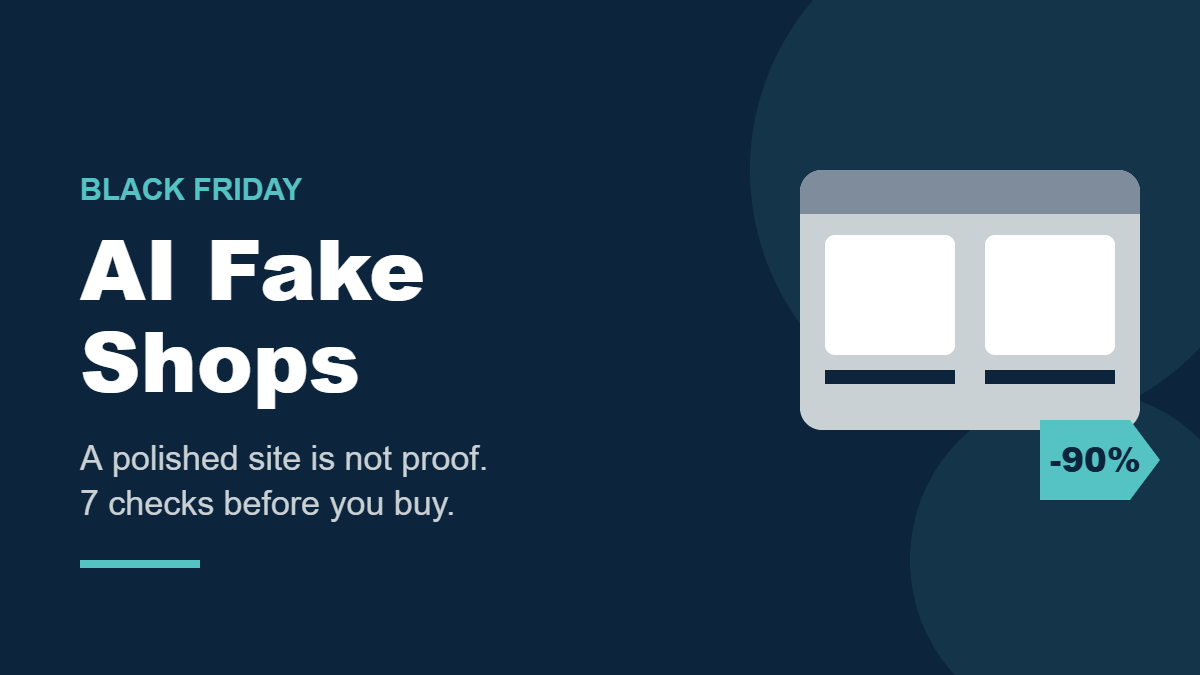
AI fake shops are the newest version of an old trick. A fake shop may copy a real retailer’s website, run a convincing ad and answer questions through a polished chat window. AI can help scammers produce professional-looking sites, ads, product descriptions, reviews and customer-service interactions. A professional appearance—or a paid ad—doesn’t prove that a seller is genuine. For the wider list of Black Friday traps, see our Black Friday Scams 2026 guide.
How AI fake shops work
A scam can start with an ad on social media or in search results. It offers a popular product at an unusually low price and links to a shop that looks like a known retailer or a convincing new brand.
The fake site may copy a real store’s logo, product photos, colours and layout. Its chat feature may answer questions about shipping and returns. The shop might also display countdown timers, customer reviews and trust badges.
The aim of AI fake shops is the same as any fake shop: to get you to pay or hand over personal and payment details. Some fake shops take the money and never send anything. Others collect card details or direct buyers to a payment route controlled by the scammer.
Why a paid ad can still be a scam
An ad’s presence on a familiar platform is not proof that the seller has been independently verified. In August 2026, the US Federal Trade Commission said social-media platforms don’t always thoroughly vet ads or the people behind them, and that scammers can pay to place ads impersonating real brands. That is US guidance, but it reinforces a useful rule for shoppers everywhere: check the seller outside the ad before buying. FTC guidance on social-media ads
In South Africa, Capitec has described people clicking ads and landing on fraudulent websites that seek card or financial details. The bank also warned that professional-looking ads, websites and social pages do not establish that a business is legitimate. Capitec warning, reported by MyBroadband
What AI changes about fake shops, and what it doesn’t
The Canadian Centre for Cyber Security’s October 2026 online-shopping guidance says scammers can use AI to create convincing websites, advertisements, product descriptions, reviews and customer-service interactions. Australia’s Scamwatch says AI tools can help create close copies of real websites, including working contact forms and customer-service features. Together, these are the building blocks of AI fake shops. Canadian Centre for Cyber Security Scamwatch
Not every fake shop uses AI, or that every business using AI is a scam. AI can make fake content more polished, but the important check is whether the seller, website and payment route are genuine. Spelling mistakes and clumsy design can still be clues, but their absence is no guarantee.
Is the website only a few weeks old?
Scamwatch notes that copied sites can go live within hours, so with AI fake shops a recently registered domain deserves extra scrutiny—especially if the site claims the retailer has been trading for years or advertises a dramatic “closing-down” sale. Australia’s Moneysmart guidance notes that scam websites may be short-lived and says a newly created domain is a warning sign. It suggests checking the registration date through ICANN’s lookup service. Moneysmart: how to spot a scam website
A new domain is a clue, not proof. Legitimate businesses launch new websites, and real retailers may use a separate domain for a regional store or campaign. Check the domain alongside other evidence: does the retailer’s established website link to it? Do the contact details match independent sources? Is the sale confirmed through the retailer’s official channels?
How to check a Black Friday deal
- Start from the retailer’s official site or app, which is the simplest way to sidestep AI fake shops. Type its known address yourself or use an app you already trust. Don’t assume a social-media or search ad takes you to the real shop.
- Check the web address. Look for extra words, misspellings or a domain that only resembles the retailer’s real one. Compare it with the address on the retailer’s established website.
- Look for independent confirmation. Search the shop’s name and web address with terms such as “scam,” “complaint” or “review.” Don’t rely only on reviews or testimonials displayed on the shop itself; scammers can copy or fabricate them (see how to spot fake online reviews).
- Check the business details. Look for a working phone number, physical address, delivery information and a clear returns policy. Verify those details outside the shop’s own website. A chat agent or contact form alone is not independent confirmation.
- Compare the price. AI fake shops often lead with a headline discount. Check the same product with the real retailer and other established stores. A price far below the going rate, combined with a countdown or “last chance” message, is a reason to slow down.
- Use a payment method with a dispute process. Be wary if the seller insists on a transfer to a personal account, instant money transfer, cryptocurrency, gift cards or a payment route outside its normal checkout. A padlock icon or “https” means the connection is encrypted; it does not certify the seller.
- Never share secrets with customer service. A shop should not need your banking password, card PIN or one-time PIN. Don’t give these to a chat agent, even if the conversation seems helpful.
Capitec also lists pressure messages such as “today only”, “limited stock” or “buy now before it sells out” as warning signs, along with shops that only accept real-time transfers, EFTs or money-send payments. Capitec’s warning, reported by MyBroadband
If you paid an AI fake shop or shared details
Contact your bank immediately through its official app or the number on your card. Explain what happened and ask whether it can block the card, stop a pending payment or secure your account. If you reused a password on the fake shop, change it on every account where you used it.
Save the ad, website address, chat messages, order confirmation and payment details. Report the ad or account to the platform where you saw it, and report the incident to SAPS. If your personal details were exposed, tell your bank what information you entered.
Be cautious of anyone who later promises to recover your money for an upfront fee. Recovery scams often target people who have already lost money.
Before you buy
A polished ad, a convincing chat and professional-looking website can all be part of a fake shop. Go to the retailer’s own verified website or app, check the exact domain, and confirm the deal independently before paying.
Check before you pay
About to pay a seller or business you don’t know? Start with a Free Quick Check of the advert link. It screens for common warning signs and shows where each result came from.
If you need the seller researched, a Quick Report or Comprehensive Report brings together source-linked Search Results on the seller and the offer. Neither gives a verdict: you check the sources and decide for yourself.