
If someone is threatening to share intimate photos or videos of you unless you pay or send more, you are being targeted by sextortion, and this guide is for you. Take a breath. You are not the first person this has happened to, you are not alone, and there is a way through.
If you feel unsafe or overwhelmed right now, talk to someone before you do anything else.
- South Africa: SADAG Suicide Crisis Helpline 0800 567 567 (SMS 31393). Under 18: Childline 116.
- USA: call or text 988.
- UK: Childline 0800 1111 (under 19).
- Australia: Lifeline 13 11 14.
- Canada: Kids Help Phone 1-800-668-6868 or text 686868.
- Anywhere: your local emergency number.
What is happening to you is a crime. It is not your fault, and it can be survived.
In this guide
What Is Sextortion?
Sextortion is blackmail. Someone gets intimate images or videos of you, often by pretending to be someone your age who likes you, and then threatens to send them to your family, friends, school or work unless you pay money or send more. Sometimes they claim to have images they don’t actually have.
It is happening on a huge scale, to teenagers and adults alike:
- In 2025 the FBI received more than 75,000 sextortion reports. The largest age group was 20 to 29, and people aged 60 and older lost the most money. FBI IC3 2025 report
- The US National Center for Missing & Exploited Children received more than 50,000 reports of financial sextortion involving children in 2025, an average of 137 a day. NCMEC
- In Australia, more than 2,000 sextortion complaints were made in the second half of 2025, and 85% of victims were men and boys. eSafety, via The Nightly
These are organised criminal groups running the same script on thousands of people. It is not personal, and you were not stupid.
What to Do Right Now if You’re Facing Sextortion
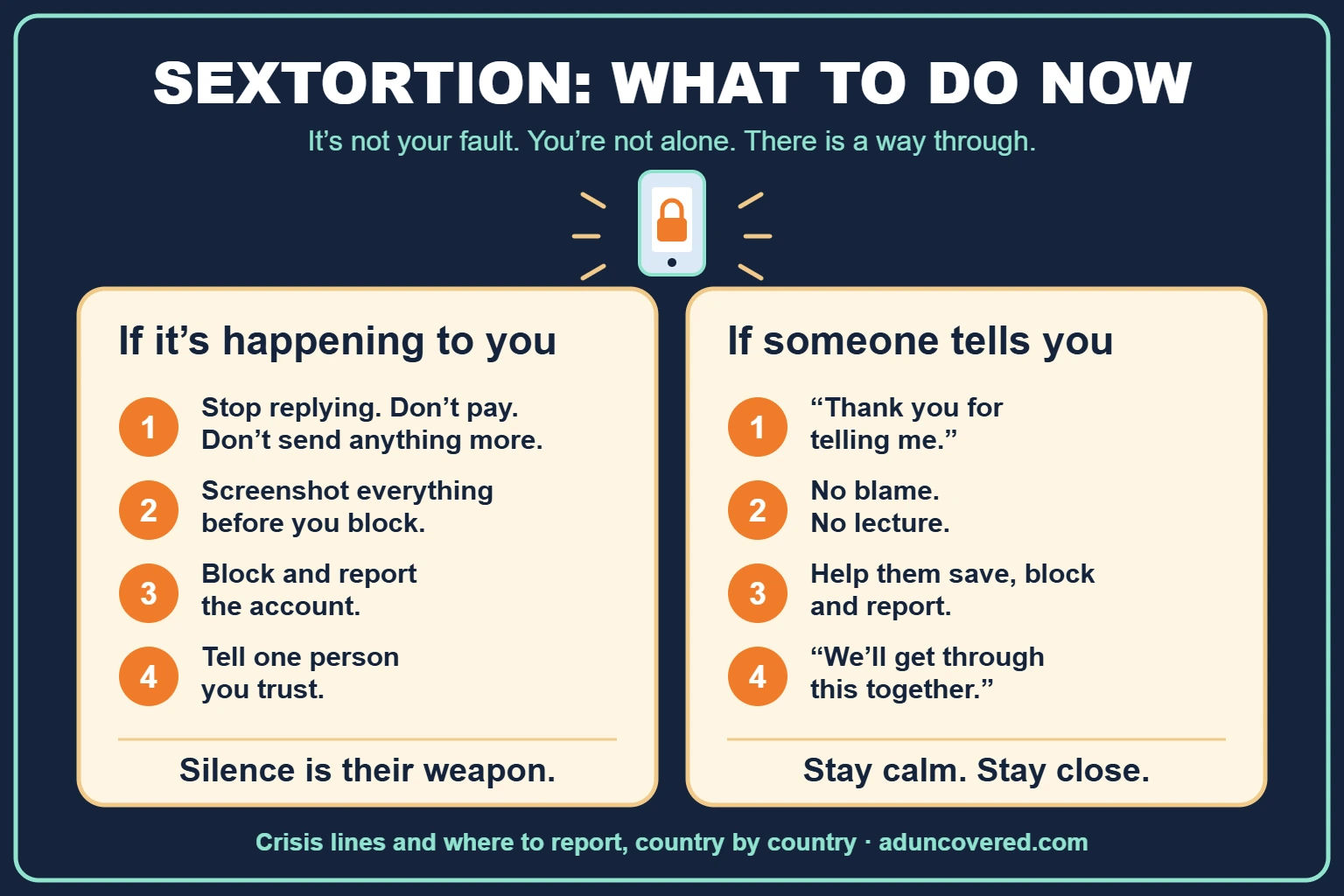
- Stop replying. Don’t argue, don’t beg, don’t negotiate. Anything you say gives them more to work with.
- Don’t pay, and don’t send anything more. Paying rarely ends it. It tells them you will pay again, and the demands usually keep coming.
- Save the evidence before you block. Screenshot their profile, username, profile link, the messages, the threats and any payment details they gave you (bank, gift card, crypto wallet, CashApp and so on). Keep everything in one folder.
- Block and report the account on every app they contacted you on. Choose the platform’s option for blackmail, sextortion or intimate image abuse.
- Lock down your accounts. Make your profiles and friend or follower lists private, so it’s harder for them to find your contacts. Consider deactivating (rather than deleting) accounts for a while, so evidence isn’t lost.
- Tell one person you trust. A parent, partner, friend, teacher or counsellor. This is the step that breaks their power. More on this below.
- Report it, using the list for your country below.
Get the Images Blocked or Taken Down
- Images taken when you were 18 or older: StopNCII.org creates a digital fingerprint (a “hash”) of your image on your own device. The image itself is never uploaded. Participating platforms then block matching copies. It only works on participating platforms, so keep your case number and PIN safe.
- Images taken when you were under 18: Take It Down, run by NCMEC, works the same way and is available worldwide. In the UK, under-18s can also use Report Remove from Childline and the IWF.
- In Australia, eSafety has legal powers to get intimate content removed and reports a 98% success rate. eSafety, via Region
Where to Report It, Country by Country
| Country | Report the crime | Help and image removal |
|---|---|---|
| South Africa | SAPS: open a case, get a case number and ask for it to go to the cybercrime unit. Child content can also be reported to the Film and Publication Board. | Childline 116 (under 18); StopNCII or Take It Down. The Cyber Helpline ZA guide |
| USA | FBI: ic3.gov. Under 18: NCMEC CyberTipline at report.cybertip.org | NCMEC: gethelp@ncmec.org or 1-800-THE-LOST; Take It Down |
| United Kingdom | Your local police. Under 18: CEOP Safety Centre. | Under 18: Report Remove (Childline and IWF). Adults: Revenge Porn Helpline and StopNCII. IWF |
| Australia | Under 18: ACCCE at accce.gov.au/report. Adults: eSafety. | eSafety at esafety.gov.au/report |
| Canada | Cybertip.ca or your local police | NeedHelpNow.ca (youth). RCMP |
| New Zealand | Police; Netsafe | Netsafe 0508 638 723 or help@netsafe.org.nz. Netsafe |
| India | cybercrime.gov.in (for children, choose the women and child crime option) or call 1930, 24/7 | CHILDLINE 1098. Cybersecify guide |
| Anywhere else | Your local police. Under 18: your national hotline via INHOPE | StopNCII and Take It Down work worldwide on participating platforms |
The police may not be able to catch someone overseas, but a report and a case number still matter. They help platforms act, help investigators link cases, and protect you if the blackmailer tries to cause trouble later.
Shame Can Cost You Far More Than Your Pride
The blackmailer’s whole plan depends on one thing: your silence. They count on you being too embarrassed to tell anyone, so you’ll keep paying and keep it secret. The FBI notes that shame, fear and confusion often stop victims from asking for help or reporting. FBI IC3 2025 report
Here is what shame can cost when it wins:
- Money, again and again. People pay once, then twice, then they borrow, because the threats never stop.
- Your peace of mind. Carrying it alone makes every message feel like the end of the world.
- Your life. Some victims, mostly young men, have taken their own lives. In Australia, eSafety has linked sextortion to 17 suicides in Victoria alone. The Nightly No photo is worth that. If you are having thoughts like this, please call one of the crisis lines at the top of this page now.
Pride heals. Embarrassment fades. The people who love you would far rather hear about this than lose you. Telling one person takes the blackmailer’s power away, because a secret that’s been shared can’t be used as a threat in the same way.
If Someone Tells You This Has Happened to Them
If you’re a parent, partner or friend and someone has just told you, your first reaction matters more than anything else you do. It decides whether they keep talking to you or go silent again.
- Stay calm and thank them for telling you. They were brave to speak up.
- Don’t blame, lecture or ask “why did you send it?” They were targeted by professional criminals. The lesson can wait. Right now they need to feel safe.
- Say clearly that it isn’t their fault and that you’ll get through it together.
- Don’t take their phone away or contact the blackmailer yourself. Help them save the evidence, block, and report instead.
- Check on how they’re feeling, today and over the next few days. If you’re worried about their safety, call a crisis line or emergency services.
- Go through the steps above together: evidence, block, report, and image removal.
Sextortion FAQ
Should I pay the person blackmailing me?
No. Paying rarely makes sextortion stop. It shows the blackmailer you will pay, and the demands usually continue. NCMEC advises young people to get help before deciding whether to pay or do anything the blackmailer asks.
Will they really share my images?
Nobody can promise either way. Many blackmailers move on when they get no response, but some do share images. That is why the steps in this guide matter: save the evidence, block, report, and use StopNCII or Take It Down so participating platforms can block copies.
I’m under 18. Will I get into trouble?
You are the victim of a crime. Services like Childline, NCMEC’s Take It Down and the UK’s Report Remove exist to help young people in exactly this situation. Telling a trusted adult and reporting it is how you get protection.
The blackmailer is in another country. Is there any point reporting sextortion?
Yes. Many sextortion groups operate from overseas, so an arrest may be unlikely, but a report and a case number help platforms remove accounts, help investigators link cases, and protect you if the blackmailer causes trouble later.
Can I get sextortion images removed from the internet?
Often, yes. StopNCII (adults) and Take It Down (images taken under 18) block copies on participating platforms, and some regulators, such as Australia’s eSafety, can order removal. You can also report the content directly on each platform.
What if they haven’t sent me anything yet and just claim to have images?
Treat it the same way: don’t reply, don’t pay, save the message and report it. Some sextortion emails claim to have hacked your webcam to scare you into paying, when they have nothing at all.
Beware of Anyone Who Offers to “Delete” Your Images
After you post or talk about this online, you may be contacted by “hackers” or “recovery experts” who say they can break into the blackmailer’s phone and delete your images, for a fee. They can’t. They are scammers too, and some ask for the blackmailer’s details only to get your images and blackmail you a second time. Never pay them and never share the blackmailer’s contact details with anyone except the police. If you have lost money to any scam, our guide on what to do immediately after being scammed walks you through the next steps.
If someone offers to “recover” or “delete” your images for a fee, check them first. Read Recovery Scams: Spot Fake Refund Promises.
Sextortion often starts on dating apps and social media, using the same grooming tactics as romance scams. In South Africa, our guide on how to report a scam lists SAPS and the other reporting channels.
Sources
- FBI Internet Crime Complaint Center: 2025 Internet Crime Report
- NCMEC: New sextortion data for 2025
- The Nightly: eSafety report on sextortion in Australia
- StopNCII.org
- NCMEC: Take It Down
- The Cyber Helpline: Dealing with sextortion (South Africa)
- Internet Watch Foundation: Report Remove figures for 2025
- RCMP: Just the facts – sextortion
If someone you met online sends you to a website, shop or investment platform, run it through our free Quick Check before you pay anything. For a larger amount, a Comprehensive Report looks at the business behind the website, with every finding linked to its source.
Check before you pay
About to pay a seller or business you don’t know? Start with a Free Quick Check of the advert link. It screens for common warning signs and shows where each result came from.
If you need the seller researched, a Quick Report or Comprehensive Report brings together source-linked Search Results on the seller and the offer. Neither gives a verdict: you check the sources and decide for yourself.
This article provides general safety information, not legal or psychological advice. If you are in danger, contact the police or a crisis helpline. Sources are linked beside the claims they support and were checked in October 2026.