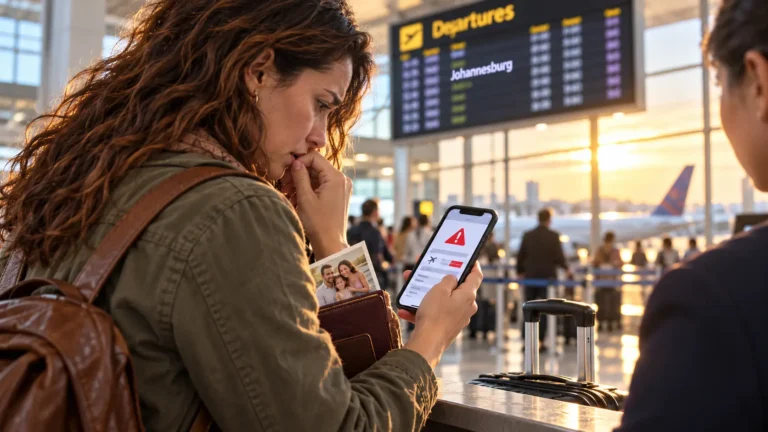

The bags are in the boot, the children are asleep in the back and the sea is finally in sight. You pull up at the holiday home you paid for weeks ago, and another family is already unpacking. They have a booking too. Theirs is real.
Holiday accommodation scams in South Africa, also called holiday rental scams, peak when we book our December and school-holiday stays, which is exactly now. This guide walks through a real case, the warning signs that matter, how to check an “agent” before you pay, safer ways to pay, and a deposit checklist you can screenshot. It’s written for everyone: families, grandparents booking for the whole clan, visitors from overseas, and people booking through community groups.
Why holiday bookings are such an easy target
December and January are among South Africa’s busiest tourism months, and scammers plan for it. Speaking to 702, travel journalist Iga Motylska singled out fake holiday listings on social media as one of the biggest problems, because advertising there costs almost nothing and needs no checks. Ahead of the 2025 Easter holidays, eThekwini Municipality warned visitors after tourists from Mpumalanga and Gauteng arrived in Durban to find their booking didn’t exist and were left stranded.
The Financial Intelligence Centre (FIC), which analyses suspicious transactions reported by banks, says holiday scams tend to peak ahead of and during the festive season and school holidays, and lists holiday rentals and accommodation among the main types. It is not only a South African problem: in the UK, Action Fraud received 6,066 holiday fraud reports in 2024, with losses of over £11 million, and more than half of those reports mentioned social media.
How one cloned listing played out
This case was shared with us by a property owner whose seaside holiday home was advertised without their knowledge. We’ve left out names and locations, but the sequence is exactly what happened, and it is a pattern we see described again and again.
- The copy. A fake “booking agent” found the owner’s genuine Airbnb listing and copied it into a holiday-rental group on Facebook. The photos were 100% identical. The price was the same as the real listing, or a little lower.
- The vouching. Group members commented to say the agent was reliable. The comments looked real. Looking back, the giveaway was that the same few people were praising the same agent across several different ads.
- The move off the platform. The agent gave a reasonable-sounding excuse for not using Airbnb, such as “I’m travelling, it’s easier on WhatsApp”, and moved the conversation to private messages.
- The pressure. “Someone else is also looking at it.” A deposit was needed as soon as possible.
- The bargain. A big discount was offered for paying the full amount up front.
- The deadline. The full balance had to be paid by EFT three days before departure. That timing is deliberate: the money arrives before anyone can discover the problem, and it is too late to rebook easily. EFT payments are almost impossible to reverse.
- The arrival. The guests drove to the house and found people already staying there with a valid booking. The agent had vanished.
What followed was confusion for everyone. The furious guests contacted the owner directly, assuming the owner was behind it. The scam was reported, but the guests had to find and pay for somewhere else at the last minute, and, in cases like this, the money is seldom recovered.
Two details are worth noting. The “agent” had no mandate from the owner and no registered business: asking for a company registration number would have exposed it immediately. And when the owner reported the fake ad, Airbnb acted on the report, Facebook did not, and it was the group’s own admin who finally removed the post.
Why it works: everyone wants a bargain
If we had to name the single biggest mistake, it is falling for the last-minute bargain under pressure. Everyone wants a good deal, especially in a December when everything costs more, and scammers know it. The discount for paying in full, the “other family” who is also interested, and the deadline are there to stop you thinking long enough to check.
The FIC warns specifically about holiday deals that seem too good to be true, especially where money must be paid up front, and notes that scammers rely on urgency to make people commit.
Red flags of holiday accommodation scams
- An “agent” or “manager” rather than the owner or a known agency, with no company name, registration number or office.
- Photos that appear elsewhere, often on Airbnb, Booking.com or LekkeSlaap under a different name or contact.
- A request to move to WhatsApp or pay outside the platform, with a convenient reason. Airbnb’s own help pages say it is against its policy for hosts to ask you to take a booking off Airbnb, and that a request to pay by bank transfer may mean the reservation is fraudulent.
- EFT to a personal account, crypto or vouchers instead of a card or platform payment.
- Different business names on the advert and the invoice. Motylska describes this bait-and-switch, along with WhatsApp-only “businesses” with no traceable landline or address.
- Claims of membership of bodies such as SATSA or FEDHASA that you can’t confirm with the body itself.
- Full payment demanded long before you arrive, often with a discount for paying it all now.
- Glowing comments or reviews that come from the same handful of people, or a sudden flood of brand-new five-star reviewers.
Vouches that look real are not proof
In community groups, a comment saying “I stayed there, he’s great” carries a lot of weight. In our case the comments looked genuine, which is the point. Before you trust a vouch, click on the people giving it: do the same names appear under every ad from this agent? Did they join the group recently? Would you lend that stranger money? A recommendation from someone you actually know, who booked and stayed, is worth far more than ten comments from strangers.
The flight-and-accommodation “package”
Fake accommodation and fake flights often go hand in hand. The same “agent” offers a bundle, flights plus a holiday home, at a price that undercuts everything else. The accommodation turns out to be someone else’s house, and the “tickets” turn out to be reservations that were never paid for. If you are offered a package, check each part separately, directly with the airline and the property. Our guide to flight ticket scams explains what to check before paying for flights.
Scams inside the real booking apps
Booking on a big platform is much safer, but not foolproof. Criminals have taken over hotels’ and hosts’ accounts on Booking.com and used them to message guests. According to the Swiss National Cyber Security Centre, these messages can come from inside the real platform and include correct booking details, then ask guests to “reconfirm” their card through a link to a copied payment page. In the UK, hundreds of Booking.com customers lost a combined £370,000 in one such wave.
The rule is simple: Booking.com has said it will never require a guest to give card details by phone, email, text or WhatsApp, and its own advice is that if the listing has no prepayment or deposit policy but you are asked to pay in advance to secure the booking, it is likely a scam. If a message asks for payment or card details, don’t use the link. Open the app yourself and check, or contact the platform directly.
How to check an “agent” before you pay, in this order
- Ask for the company registration number and check it on CIPC’s BizPortal. South African company numbers look like 2019/123456/07. Check that the registered name matches the name on the advert, the invoice and the bank account. You may need a free account to search. A registered company is not proof of honesty, but no registration at all, from someone claiming to be a business, is a serious warning sign.
- Check that the bank account name matches. Your banking app often shows the account holder’s name when you add a new beneficiary. If the name is a private person rather than the business, or a business with a different name, stop.
- Phone the property, complex or estate directly, on a number you found yourself, not one in the ad. Ask whether this agent is authorised to let the unit for your dates. Many estates and lodges have a reception or managing agent who will know.
- If they say they are a letting agent or estate agency, ask for their PPRA Fidelity Fund Certificate. The Property Practitioners Regulatory Authority urges consumers to confirm that a practitioner and their firm are registered and hold a valid certificate for the current year, and that money goes into a registered trust account, before paying. You can check on the PPRA website or by calling the PPRA on 087 285 3222. A private owner letting their own home won’t have one, so this check applies to people presenting themselves as agents.
- Check any association claims with the association itself, not via a logo on the website.
If asking for proof feels rude, remember this: being shy, ashamed or awkward can be a very expensive emotion. A genuine host or agency expects these questions and answers them in minutes. Someone who gets offended, goes quiet or suddenly “has another booking” has answered your question for you.
Safer ways to pay a holiday deposit
From safest to riskiest:
- Pay through the platform where you found the listing, such as Airbnb, Booking.com or LekkeSlaap, and keep every message on the platform. Airbnb states that guests who pay outside the platform lose its AirCover protection.
- Pay a registered business by credit card. If the service is never delivered, you can ask your bank for a chargeback. In South Africa this is a card-scheme process rather than a legal right: a University of Pretoria study notes that neither the Consumer Protection Act nor the National Credit Act compels banks to reverse card payments. Act quickly. Banks have quoted a 120-day limit from the date of non-delivery for card disputes, so ask your bank as soon as you suspect a problem. The FIC also recommends secure payment methods such as credit cards and virtual cards.
- Debit card. Weaker than a credit card, but a dispute is often still possible. Ask your bank what applies to your card.
- EFT only to a verified business account, after the checks above, and never to a personal account. Treat EFT as money you cannot get back.
- Avoid crypto, vouchers, cash-send services and “friends and family” payment app transfers entirely.
Wherever possible, pay a deposit rather than the full amount, and be very wary of anyone who insists on the full balance weeks before you arrive, or who offers a discount for doing so.
The holiday deposit checklist (screenshot this)
- I found this listing on a booking platform and I am paying on that platform, or
- I have the business’s registration number and it checks out on BizPortal
- The bank account name matches the business, not a private person
- I phoned the property, complex or estate on a number I found myself, and they confirmed the agent and my dates
- I reverse-image-searched the photos and they don’t appear elsewhere under a different name or contact
- The address exists and matches the photos on Google Maps or Street View
- The price is in line with similar places for the same dates
- I have the terms in writing: total price, deposit, balance date, cancellation and refund rules
- I am paying by card, or by EFT to a verified business account only
- Nobody is rushing me, and I am not paying extra-early for a discount
- I ran the listing link through the free Quick Check
If this is you
- Booking a family December holiday: start early, so you never need a last-minute “deal”. The best bargains in mid-December are often the fake ones.
- Booking for older parents, or an older person booking for the family: ask a family member to do the checks with you before any money moves. Scammers deliberately target people who are less used to online booking, and a second pair of eyes is not an insult.
- Visiting South Africa from overseas: you can’t easily drive past the property or phone a local number. Book through a platform or a registered agency, and pay by credit card.
- Booking through a church, school, stokvel or community group: trust within the group is exactly what scammers borrow. A post in a group you trust is still just a post. Do the checks.
- Running a holiday or community group: consider a rule that “agents” must post their registration number, and remove ads you can’t verify. We know most admins are volunteers without time to check everything, which is why bookers still have to check for themselves.
If you own a holiday home: protect your listing
Most owners do nothing, and frankly most protection is only partly effective. A few things do help:
- Search for your own property now and then: reverse-image-search your main photos and search your property name on Facebook, Gumtree and other platforms.
- Add a watermark that says “Book only via Airbnb” (or wherever you list). A plain logo watermark is easily cropped; a booking instruction warns would-be guests even on a copied photo.
- Say it in your listing: “We never take bookings or payments through Facebook or WhatsApp agents.”
- Report copies quickly, to the platform and directly to the group admin. In our case the group admin acted when the platform didn’t.
Already paid? Act fast
- Call your bank immediately. Ask them to try to stop or recall the payment and, for card payments, to open a dispute.
- Open a case with SAPS and give the case number to your bank. The FIC also suggests reporting to the National Consumer Commission.
- Report the listing to the platform and the group admin, and warn others in the group.
- Keep everything: screenshots of the ad, the comments, chats, the invoice, bank details and proof of payment.
- Ignore anyone offering to get your money back for a fee. These recovery scams often follow the first scam.
Our guide on what to do immediately after being scammed goes through each step in more detail.
Where AdUncovered fits
Before you pay a deposit, run the listing or agent’s website link through our free Quick Check. It is a quick, shallow screen, so a clear result is not a green light. For a larger amount, a Quick Report or Comprehensive Report looks at the business side: whether there is a registered business behind the name, where the website, details and photos appear elsewhere, and how long the online presence has existed, with every finding linked to its source.
If you have already paid, a Comprehensive Report can document what is publicly known about the business behind the listing, which you can attach to your bank, SAPS or platform complaint. We don’t certify anyone as safe, give verdicts, or recover money. We give you the evidence so you can decide.
Planning more festive spending? Our festive season scams in South Africa guide covers the other tricks to watch for this December.
Check before you pay
About to pay a seller or business you don’t know? Start with a Free Quick Check of the advert link. It screens for common warning signs and shows where each result came from.
If you need the seller researched, a Quick Report or Comprehensive Report brings together source-linked Search Results on the seller and the offer. Neither gives a verdict: you check the sources and decide for yourself.
This article provides general scam-awareness information, not legal or financial advice. Sources are linked beside the claims they support and were checked in October 2026. The case study is based on a first-hand account shared with AdUncovered; names and locations have been removed. Describing a pattern is not an accusation against any individual or business.