
How municipal scams and other urgent-needs scams work in South Africa
A message says your electricity will be cut off unless you pay now. Someone promises a municipal job if you pay a “processing fee.” A social media post claims it can secure you a subsidised house, for a price.
Municipal scams and the job and housing scams that follow them exploit three urgent needs: keeping essential services, finding work and securing a home. They are being reported in different parts of South Africa. The details vary, but the tactics repeat: impersonate an official, create pressure, and demand money or personal information through unofficial channels.
There is another serious concern: some South Africans have been recruited for overseas scam operations under false job offers, while international fraud networks have also operated from South Africa. These documented cases deserve attention, but they do not prove that foreign groups are widely recruiting unemployed South Africans as local agents in municipal or housing scams. It is important to distinguish what authorities have established from what remains a question.
Municipal disconnection scams
In the most common municipal scams, a fraudster contacts a resident by phone, SMS or WhatsApp, claiming to be a municipal official, contractor or debt collector. They say a water or electricity account is overdue and threaten immediate disconnection unless the resident pays.
The demand may be for an instant EFT, CashSend, e-wallet payment or transfer to a personal bank account. In some versions, the scammer arrives at the property, uses a fake job card or uniform, demands an on-the-spot payment, or tries to gain access to the home.
The City of Johannesburg has warned about fake disconnection threats, false debt messages, phishing emails using City branding, and people impersonating technicians or revenue officials. It says disconnection teams carry identification and job cards, use branded vehicles, and do not request on-the-spot payments. City of Johannesburg warning
More recent alerts show that municipal scams are not confined to Johannesburg or Cape Town:
- In Gauteng, Johannesburg warned in September 2026 of increasingly sophisticated impersonation attempts, including fake emails, calls and door-to-door visits. City of Johannesburg alert
- In the Western Cape, Drakenstein Municipality warned in June 2026 about WhatsApp and phone messages threatening disconnection and demanding urgent payment. It said reports indicated the scam was targeting communities across South Africa. Drakenstein Municipality alert
- In KwaZulu-Natal, eThekwini warned in October 2026 about people impersonating municipal officials to solicit money for jobs, debt reductions and municipal services. eThekwini Municipality warning
- In George, the municipality has also warned residents about water and electricity disconnection scams. George Municipality alert
These alerts confirm that municipal scams have been reported in multiple areas. They do not tell us how many victims there are nationwide or which province has the highest rate.
How to protect yourself from municipal scams
- Check your account through the municipality’s official website, app or verified customer-service number. Find the contact details yourself.
- Don’t pay a caller, WhatsApp contact or person at your gate to prevent disconnection.
- Never transfer money to a personal account or use an informal payment method because someone says the matter is urgent.
- Don’t let someone into your property until you have independently confirmed the appointment and their identity.
- Save messages, numbers, bank details, photographs and job cards if you report the incident.
Fake municipal and government jobs: municipal scams that target work seekers
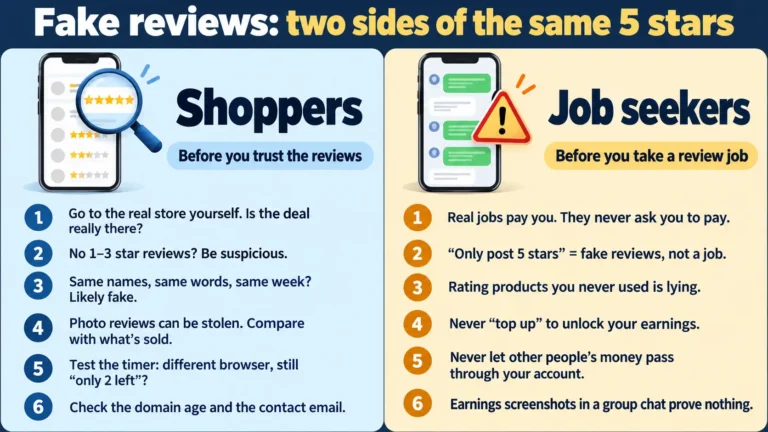
Job scams exploit the hope of stable work. A fraudster may pretend to be a municipal employee or government recruiter, offer a guaranteed job or interview, and ask for a fee for an application, background check, uniform, training, placement or “preference” on a list.
Municipalities and government departments have issued warnings in several provinces:
- Tshwane warned that scammers posed as municipal representatives, promised jobs and requested money or meetings in public places. City of Tshwane warning
- George warned of a scammer demanding R3,500 for an interview and possible municipal employment, and of fraudsters impersonating Expanded Public Works Programme personnel. George Municipality job-scam alert
- Ekurhuleni warned about social-media offers promising placement in employment and learnership programmes for payment. City of Ekurhuleni alert
- The Eastern Cape SAPS has warned about people falsely promising jobs in the police service in return for money or personal information. SAPS warning
- eThekwini says no municipal official may request payment for employment and that vacancies are advertised through its official website. eThekwini warning
The Department of Employment and Labour has stated that private employment agencies may not charge work seekers for employment services or require payment for placement. It has warned that fake job offers can ask for fees and personal information. Department of Employment and Labour guidance
Online versions of these offers work the same way. Our guide to job scams and online task scams explains the warning signs.
How to protect yourself
- Check vacancies on the employer’s official website or verified recruitment channel.
- Contact the employer through details you find independently, not just a phone number or email in the offer.
- Treat requests for application, interview, placement or “refundable” fees as a major warning sign.
- Don’t send identity documents, banking details or OTPs to an unverified recruiter.
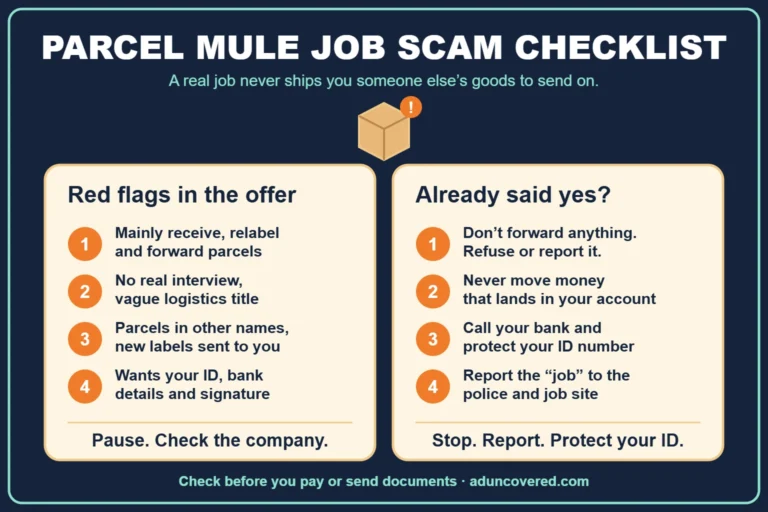
- Never allow a supposed employer to use your bank account to receive or transfer money (see parcel mule job scams).
Fake housing and subsidised-home offers
Housing scammers claim they can secure an RDP/BNG house, move an applicant up a waiting list or arrange an allocation for a fee. They may use WhatsApp, Facebook, fake letters, social-media pages or the name and photograph of a real official.
The National Department of Human Settlements has warned that fake offers for government-subsidised houses circulate on social media and target people across the country. It says applications are processed through provincial departments and municipalities, and that people should verify offers directly with those authorities. Department of Human Settlements warning
Rental scams use the same pressure on people who urgently need a home. See rental scams and deposit traps.
Cape Town has separately warned about WhatsApp messages claiming residents can secure housing by making a payment. The City says it does not charge for registration, placement or allocation of housing opportunities. City of Cape Town housing alert
How to protect yourself
- Ask the provincial department or municipality responsible for your housing application to verify the process.
- Don’t pay anyone who promises to secure or speed up a subsidised housing allocation.
- Don’t rely on a letter, screenshot, social-media account or “inside contact” without checking through official channels.
- Keep records of legitimate application details and use official offices or portals to update them.
Are overseas groups recruiting South Africans to work as local fraud agents?
There is evidence of international links to fraud, but “recruited as local agents” can describe several different things. The distinctions matter.
1. People in South Africa recruited to move money
The Financial Intelligence Centre (FIC) has documented how criminals recruit money mules: people whose bank accounts or transactions are used to move or disguise criminal proceeds. Recruitment can be presented as a job or can begin through an investment, romance or impersonation scam. The FIC’s analysis of reported cases found that most people implicated in the money-mule activity it examined were South African. Much of the activity in that dataset was identified in Gauteng and the Western Cape. These are findings from analysed reports, not a complete national count. FIC money-mule report
A person might be asked to receive money, withdraw it, forward it, or hand over their bank card or account access. Calling this a “job” does not make it legitimate. The person may be knowingly involved, deceived about the money’s origin, or pressured into continuing.
2. South Africans lured overseas and forced to scam others
South African government statements document people recruited with false overseas job offers and then taken to scam compounds. In one reported case, 23 South Africans were rescued and repatriated from Myanmar after being lured to Thailand with promises of lucrative jobs. They were taken across the border, held in a cybercrime compound and forced to participate in online scams. Department of Justice statement
In July 2026, the Department of Social Development warned that young South Africans were being lured by online job offers to Thailand and forced to work in scam compounds after being transported to the Thailand–Myanmar border. The department said victims may be forced to recruit friends or family. SAnews report on the warning
These people may be victims of trafficking and forced criminality, not voluntary “fraud agents.” The scam can harm two groups at once: the trafficked person forced to operate it and the people they are forced to target.
3. International networks operating from South Africa
Authorities have also reported alleged international investment-fraud operations based in South Africa. In January 2026, 23 suspects appeared in court in connection with an alleged international syndicate operating call centres in Gauteng and targeting victims abroad. The allegations remain before the courts. SAnews report
In September 2026, the NPA reported a provisional restraint order against suspects linked to an alleged global syndicate that operated bogus call-centre agencies in Bryanston, Johannesburg. The NPA said the operation allegedly targeted people overseas with fake investment products. This, too, is an ongoing case, not a final finding of guilt. NPA announcement
What these cases do and do not show
The evidence supports the following conclusions:
- South Africans have been recruited as money mules.
- South Africans have been deceived and trafficked overseas, then forced to conduct online fraud.
- Authorities have investigated alleged international scam operations based in South Africa.
- Local authorities have reported municipal, job and housing scams in multiple parts of the country.
The evidence reviewed does not establish that foreign groups are broadly recruiting unemployed South Africans to act as local agents in municipal disconnection or housing scams. That may be a concern worth investigating, but it should not be presented as proven without specific police, court or financial-intelligence evidence.
Unemployment can make fake job offers more persuasive. The Department of Employment and Labour has explicitly warned that scammers exploit people seeking work. That does not mean unemployed people are predisposed to commit fraud; the focus should be on how criminals exploit financial need and trust.
A simple rule against municipal scams
Pause. Verify independently. Don’t pay for a job, a housing allocation or protection from a sudden disconnection threat. Don’t let anyone use your bank account to move money.
Use the municipality, employer or housing authority’s official contact details found independently. If you have already paid or shared financial information, contact your bank immediately and report the matter to the relevant municipality and SAPS. Our guide on how to report a scam in South Africa lists the right channels. Preserve the messages, payment records and contact details.
Sources and scope
This article on municipal scams draws on warnings from municipalities and national departments, the FIC’s money-mule analysis, and government reporting on human trafficking and alleged international scam operations. These sources document real cases and warning patterns, but they do not provide a single, comparable nationwide dataset for the prevalence of each scam type. Verify municipality-specific payment rules and reporting contacts locally, as procedures differ by area.
Municipal scams usually end with a payment to an account, a link or a “company” you have never dealt with. If a job advert, housing “agent” or payment page sends you to a website or business you don’t know, run its link through our free Quick Check before you pay. It is a quick, shallow screen, so a clear result is not a green light. For a wider overview, see the latest scams in 2026.
Check before you pay
About to pay a seller or business you don’t know? Start with a Free Quick Check of the advert link. It screens for common warning signs and shows where each result came from.
If you need the seller researched, a Quick Report or Comprehensive Report brings together source-linked Search Results on the seller and the offer. Neither gives a verdict: you check the sources and decide for yourself.