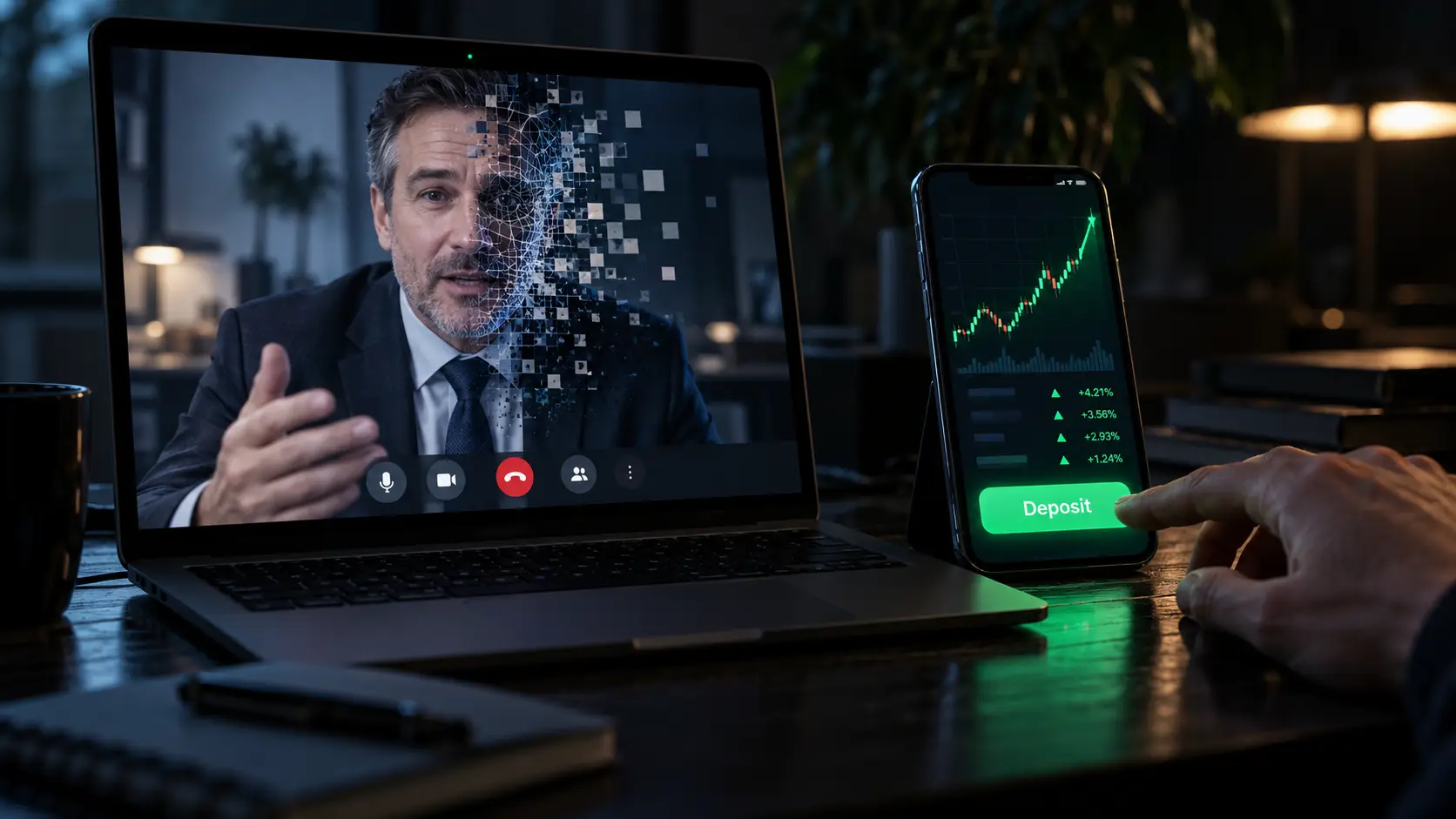
The video looks real. A famous South African, sitting in a familiar studio, says he made R80,000 a month with a new trading app, and that you can too with as little as R4,500. The voice is right. The face is right. It is completely fake.
Deepfake scams, and the celebrity scam ads built on them, use AI to clone the faces and voices of trusted people and put words in their mouths. They are now good enough to fool people who look for scams for a living. That is why this guide takes a different approach: don’t try to spot the fake face. Check the business behind it. That check works no matter how convincing the video is.
Deepfake scams in South Africa: the people being impersonated
Almost every well-known South African face has been used. Some confirmed cases:
- Johann Rupert and Elon Musk. The Financial Sector Conduct Authority (FSCA) found that the trading platform Banxso was involved in, or benefited from, deepfake ads of Rupert and Musk promising profits of up to R300,000 a month from an R4,700 investment. The FSCA said about R1 billion was taken from South African investors. It imposed a R2 billion fine and 30-year debarments, and referred the matter to the Hawks. Banxso denies involvement and says it was hacked.
- Patrice Motsepe. In January 2025, the FSCA warned about deepfake videos of Motsepe used by unauthorised entities promising 46% returns.
- Maya Fisher-French and Bruce Whitfield. In June 2026, AI-generated videos of the two finance journalists promoted “Quantum AI”, falsely linked to Elon Musk, promising up to R60,000 a week from R4,200.
- Trevor Manuel. Old Mutual warned about deepfake investment pitches using the former finance minister.
- Steve Hofmeyr and Kallie Kriel. In April 2025, the FSCA warned that the unauthorised schemes AfriInvest and MutualWealth falsely linked the singer and the AfriForum CEO to their offers, using fake news stories and Maroela Media’s branding to promise up to R10,000 a day. All three denied any connection.
- Ernst Roets. The commentator posted a video on his verified Facebook page warning followers about fake ads using his face.
The pattern matters more than the names. The scammers choose people their target audience already trusts: business leaders for investors, finance journalists for savers, and cultural figures for Afrikaans-speaking communities. The product is almost always the same: a trading app scam dressed up as an “AI” or “crypto” platform.
How deepfake celebrity scams take your money
Someone close to AdUncovered lost money this way. The steps are the same in most cases:
- The bait. A deepfake video of a famous person, often in a fake news article, on Facebook, Instagram or YouTube.
- A tiny start. In this case, just $20.
- A real payout. Small, but enough to prove the app “works”.
- “Add more.” The app or an “account manager” encourages a bigger deposit. More payouts follow, each a little bigger, and the loop repeats.
- The big day. The promised large payout never comes. The account value suddenly “drops”, a withdrawal fee is demanded, and then the app disappears or reappears under a new name.
Looking back, it wasn’t one thing that built the trust. It was everything together: a very real-looking video, a professional app, and payouts that grew. The small payouts are the bait. Scammers will happily return a little of your own money to win a lot more of it.
Because the app wasn’t South African, it was never reported. That is understandable, but report it anyway. Your bank may be able to trace or dispute the payment, a SAPS case number is needed for most follow-up, and the FSCA publishes warnings about foreign platforms targeting South Africans. Our guide on how to report a scam in South Africa covers who to contact.
Why spotting the fake is no longer enough
Older advice tells you to look for odd blinking, mismatched lips or a robotic voice. Today’s deepfakes often have none of those flaws, and that advice can give false confidence.
A man in his eighties was certain one of these videos was real. He had seen it with his own eyes. He sent it to a younger relative, who spotted the fake within seconds. Even then, the person who spotted it had experience. Most people don’t, and the videos keep improving.
The comments are curated too
Under these ads you will see people praising the platform and posting about their payouts. Warnings tend to disappear. When AdUncovered’s researcher replied to scam ads to warn others, people responded, and then the scammers hid the comments. A comment section full of happy “investors” proves nothing, just like fake online reviews.
Reporting the ad rarely works
In our experience, reporting these ads to Facebook seldom got them removed. Larger investigations point the same way. A Reuters investigation in November 2025, based on leaked internal Meta documents, reported that Meta projected about 10% of its 2024 revenue, around US$16 billion, would come from scam ads and ads for banned goods, and that users saw an estimated 15 billion higher-risk scam ads a day. Meta called its estimate “rough and overly-inclusive” and says it has removed more than 134 million pieces of scam ad content in 2025. Report the ads anyway, but don’t rely on the platform to protect you.
How to check a deepfake scam in three minutes
This is the routine the person behind AdUncovered uses when a celebrity ad appears:
- Search the claim. Type “Did [celebrity] launch [app name]?” into Google.
- Search for the scam. Then “[app name] scam”.
- Ask an AI assistant the same two questions. A word of caution: AI tools can be out of date on brand-new apps, and scam apps rename themselves often, so “no results” doesn’t mean safe.
- Check the person’s own channels. Real launches are announced on the person’s verified accounts or company website. Often you will find them warning people about fakes instead, as Ernst Roets did.
- Check the FSCA register. This is the step that settles it. Anyone offering investments or trading to South Africans must be authorised by the FSCA. Search the FSP register on the FSCA website, or call 0800 110 443. Not listed means don’t invest. Report unauthorised operators to the FSCA’s fraud hotline on 0800 313 626, as listed in its warnings.
Celebrity scam ads: red flags, whoever is on the screen
- A famous person promising you a fixed income: R10,000 a day, R80,000 a month.
- A small starting amount, usually R4,000 to R5,000, with an “account manager” who phones or WhatsApps you.
- A fake news article or “leaked interview” as the landing page.
- Payouts that start small and grow, followed by pressure to deposit more.
- A fee, tax or “verification” charge before you can withdraw your own money.
- The app vanishes or changes its name.
Checklist: before you trust a celebrity ad
- Celebrities don’t sell trading apps in ads.
- Search: “Did [name] launch [app]?” and “[app] scam”.
- Check the person’s own verified accounts.
- Not on the FSCA register? Don’t invest.
- Small payouts are bait, not proof.
- Never pay a fee to withdraw your own money.
- Show the video to someone tech-savvy first.
Before you act on a video that looks real, show it to someone who knows tech and ask what they think. A second pair of eyes takes a minute, and it can save your savings.
If you have already invested
- Stop paying. No fee, tax or upgrade will release your money.
- Call your bank immediately to stop or dispute payments, and cancel any card linked to the app.
- Open a SAPS case and report the platform to the FSCA, even if it’s based overseas.
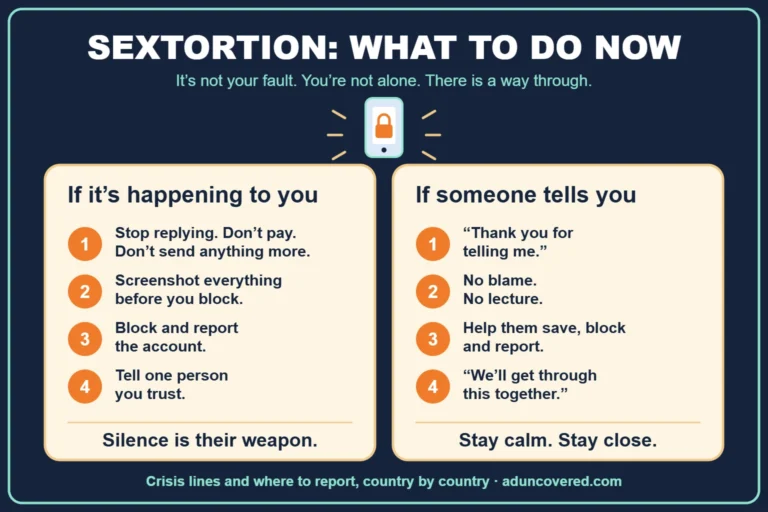
- Save evidence: the ad, the video link, the app name and screenshots, chats with the “account manager”, and proof of payment.
- Expect a second scam. People who have lost money are targeted by fake “recovery agents” who charge a fee to get it back. See our guide to recovery scams.
For how these platforms work more broadly, see our guide to fake investments and trading apps.
Where AdUncovered fits
A deepfake can copy a face, but it can’t give a fake platform a real history. Before you send money to an investment app or website you found through an ad, run its link through our free Quick Check. It is a quick, shallow screen, so a clear result is not a green light. For a larger amount, a Comprehensive Report looks at the business behind the ad: whether it is registered, how long its website has existed, and whether regulators have issued warnings about it, with every finding linked to its source. We don’t judge videos, certify platforms or recover money. We check the business, so you can decide.
Check before you pay
About to pay a seller or business you don’t know? Start with a Free Quick Check of the advert link. It screens for common warning signs and shows where each result came from.
If you need the seller researched, a Quick Report or Comprehensive Report brings together source-linked Search Results on the seller and the offer. Neither gives a verdict: you check the sources and decide for yourself.
This article provides general scam-awareness information, not financial or legal advice. Sources are linked beside the claims they support and were checked in October 2026. Public figures named here were impersonated without their consent; they are victims of these scams, not promoters. Where a company disputes regulatory findings, we have said so. The first-hand accounts were shared with AdUncovered, with identifying details removed.