A remote “logistics” job that pays well, needs no experience and lets you work from home sounds like a lifeline, especially before the festive season. But if the job is mainly receiving parcels at your address, relabelling them and sending them on, it’s almost certainly a parcel mule scam, also called a reshipping scam. You won’t be paid, you may lose money, and you could end up in trouble for handling stolen goods.
The short version: No real company ships expensive goods to a new hire’s home so they can repack them and send them abroad. If a job asks you to forward parcels, don’t. If you’ve already said yes, stop forwarding, don’t move any money that arrives in your account, call your bank and protect your ID number.
In this guide
What Is a Parcel Mule Scam?
In a parcel mule scam, criminals buy goods (often electronics, phones, trainers or designer items) with stolen card details and have them delivered to your address. Your “job” is to repack them and post them on, often to another country, so the goods are harder to trace back to the criminals. The US Postal Inspection Service says the scam can also come disguised as a favour for an online sweetheart or a charity, and that the criminals may give you counterfeit postage to use. USPIS
The US Federal Trade Commission describes the typical job titles: “delivery operations specialist” or “quality control manager”. Some scammers falsely claim links to companies like Amazon or FedEx, and your task is to throw away the original box and receipt before sending the goods on. In the FTC’s words, reshipping goods is never a real job. FTC, December 2025
How a Parcel Mule Scam Usually Works
- The offer. A message on a job site, social media or email offers a remote role such as “parcel expert”, “package inspector” or “freight forwarder”, with a generous salary. One offer reported in June 2026 promised a $4,400 base salary for receiving, checking and forwarding parcels from home. Malwarebytes
- Quick “onboarding”. There’s no real interview, but they ask for your ID number, bank details, date of birth and sometimes a signed contract.
- A dashboard. You get a login showing incoming parcels, shipping labels and a salary that grows with every package.
- A cheap test parcel first, then more valuable goods.
- Payday never comes. In one 2026 US case, people hired as remote “parcel experts” for $4,200 a month reshipped items including Tiffany earrings and laptops, then were locked out of the company system just before payday. Hoodline
Why a Parcel Mule Scam Is Dangerous for You
- Legal risk. The US Postal Inspection Service warns that you may be held civilly and/or criminally responsible for taking part. USPIS UK police describe parcel mules as handling stolen goods. Action Fraud, via Alton Herald
- Money. You aren’t paid, you may pay postage yourself, and if the “employer” sends you a cheque or money order to deposit, you may have to repay it when it turns out to be fake. USPIS
- Identity theft. By the time you realise, they have your ID number, bank details and signature. FTC
- From parcel mule to money mule. The next request is often to receive money into your account and pass it on. In South Africa, the banking ombud says account holders remain responsible for every transaction through their accounts, and banks must report suspicious activity to the Financial Intelligence Centre, which can lead to money-laundering charges. National Financial Ombud
How Big Is the Problem?
- United States, 2025: the FBI received 24,688 complaints about employment scams, the category reshipping scams fall under, with $362.9 million lost. FBI IC3 2025 report
- South Africa, 2025: the National Financial Ombud’s banking division finalised 8,325 cases. Account freezes and restrictions linked to suspected mule activity rose by 300 cases, about 8% of finalised cases. Pretoria News FA News
- Seasonal timing: reshipping job scams become more common in the busy shopping season, when parcel volumes spike and people look for extra income. Bitdefender, December 2025
8 Red Flags of a Parcel Mule Scam
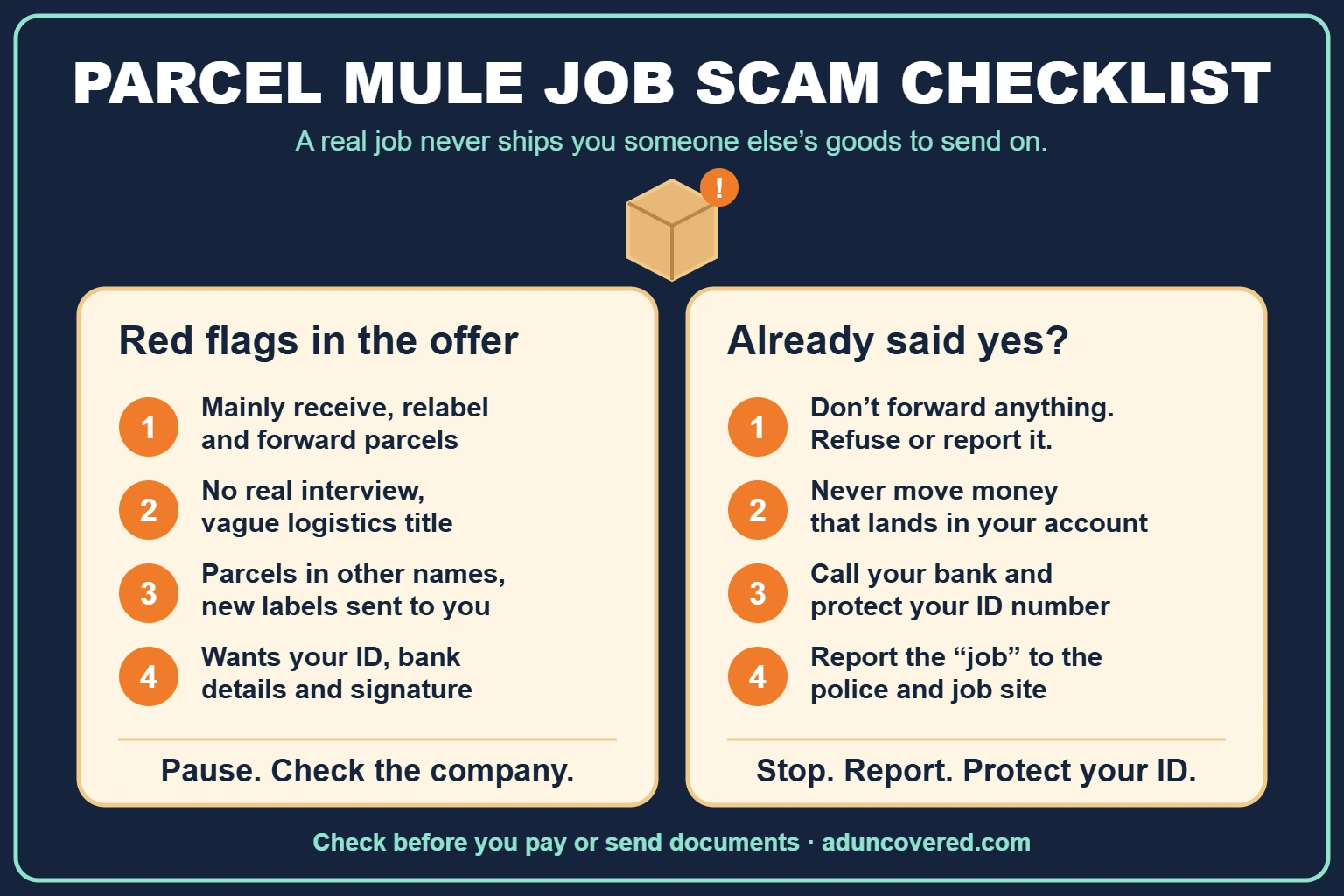
- The job is mainly receiving, inspecting, relabelling and forwarding parcels from your home.
- No proper interview, no experience needed, and a salary that’s high for the work.
- A vague logistics title: “parcel expert”, “quality control inspector”, “shipping coordinator”.
- Parcels arrive in someone else’s name, or from shops you’ve never dealt with.
- They send you new shipping labels, often to overseas addresses.
- You’re told to remove receipts and original packaging.
- They want your ID number, bank details and signature before you can verify they’re a real employer.
- They send you a cheque or money order, or ask you to receive money and pass it on.
I Applied and Gave Them Everything. Now What?
Many people only realise after they’ve handed over their documents. If that’s you, don’t panic, and don’t blame yourself. These schemes are designed to look like a normal hiring process. Act on these steps today:
- Don’t forward any parcel. Refuse it or return it to sender, and tell the courier or post office it may be linked to fraud. USPIS
- Don’t move any money that arrives in your account unexpectedly, even if they say it’s your salary or “for supplies”. Call your bank’s fraud line and explain what happened.
- Protect your identity. In South Africa, apply for free SAFPS Protective Registration (011 867 2234 or protection@safps.org.za). It alerts banks and shops to do extra checks before anyone uses your details. Sowetan In the US, go to IdentityTheft.gov/steps and consider credit freezes. FTC
- Report it. In South Africa, open a case with SAPS. In the US, report to the Postal Inspection Service at uspis.gov/report or 1-877-876-2455, and to ReportFraud.ftc.gov. USPIS In the UK, report to the police or Report Fraud. Also report the advert to the job site or platform.
- Change passwords for any email or accounts you created or used for the “job”, and keep screenshots of every message, label and payment in an evidence folder.
For more on reporting in South Africa, see How to Report a Scam in South Africa. If you lost money, read what to do immediately after being scammed, and be wary of anyone who then offers to recover your money for a fee.
Parcel Mule Scams in South Africa
We found no South African reports specifically about parcel-forwarding jobs. But the ingredients are all here: fake job adverts spread widely on Facebook and WhatsApp (in February 2026, Africa Check debunked fake “general worker” adverts misusing Prasa’s name) Africa Check, via AllAfrica, and banks and the ombud report more people being drawn into moving money for criminals. A parcel job is the same trap with boxes instead of cash, and international scam networks recruit across borders.
Other Job Offers to Watch For
- Task and “click” jobs that ask you to top up before you can withdraw your earnings. See our job scams guide.
- “Payment processing” or “funds transfer agent” roles, which are money mule recruitment.
- “Make money online” programmes: a relatable success story in a social media reel leads to a free webinar, then an expensive “done-for-you” programme. Check the seller, the refund terms and independent reviews before you pay.
Check the Company Before You Send Your Documents
A parcel mule scam depends on a fake company looking real. Before you send your ID, bank details or signature to any new employer, check the business: how old its website is, whether it’s registered, whether its address is real, and what independent sources say about it. Our guide How to Check if a Business Is Legit shows you the free tools. If you’d like help, AdUncovered can research the company behind a job offer and give you a source-linked report, so you can decide before you share anything. We don’t give verdicts; we show you what the public evidence says.
Parcel Mule Scam FAQ
Is it illegal to reship packages for a job?
Reshipping itself isn’t illegal, but reshipping goods bought with stolen cards can be. The US Postal Inspection Service warns that people who take part in reshipping scams may be held civilly and/or criminally responsible, and UK police describe parcel mules as handling stolen goods.
Can a reshipping job ever be real?
Genuine logistics work happens in warehouses and depots with verified employers, not by sending a new remote hire’s home address a stream of goods to repack and post abroad. The FTC says reshipping goods is never a real job.
What should I do with a parcel that has already arrived?
Don’t open or forward it. Refuse it or return it to sender, tell the courier or post office it may be linked to fraud, and report the “job” to the police.
They have my ID number and bank details. What now?
Call your bank’s fraud line, don’t move any money that arrives unexpectedly, and protect your identity. In South Africa, apply for free SAFPS Protective Registration; in the US, use IdentityTheft.gov and consider credit freezes.
Why do scammers need my address?
Shops and card issuers are more likely to approve an order delivered to a real local address. Your address hides the criminals and helps the stolen goods leave the country.
Check before you pay
About to pay a seller or business you don’t know? Start with a Free Quick Check of the advert link. It screens for common warning signs and shows where each result came from.
If you need the seller researched, a Quick Report or Comprehensive Report brings together source-linked Search Results on the seller and the offer. Neither gives a verdict: you check the sources and decide for yourself.
Sources
- US Postal Inspection Service: Reshipping scams
- FTC: Can you unbox the signs of a reshipping scam? (December 2025)
- FBI Internet Crime Complaint Center: 2025 Internet Crime Report
- National Financial Ombud: rising threat of mule accounts
- Pretoria News: NFO warns of increasing mule accounts
- Alton Herald: Action Fraud parcel mule warning
- Malwarebytes: Beware of “Parcel Expert” job offers
- Hoodline: “Logistics” company ghosts remote hires
- Sowetan: SAFPS Protective Registration
- Africa Check via AllAfrica: fake Prasa job adverts