Retirement scams target the moment your savings become cash: a pension payout, a two-pot withdrawal or a lump sum sitting in a bank account. Fraudsters pose as your fund, your bank or a trading platform, ask for a fee to “release” money, steal your one-time PINs (OTPs) through a SIM swap, or rush you to move money to a “safe” account. No genuine fund charges a fee to pay out your own savings.
These checks are for readers in South Africa and worldwide. Funds, banks and reporting routes differ by country, but the tricks are the same.
R800,000 paid out, R150,750 gone in three days
In July 2025 TimesLIVE reported the case of Tsietsi Mokgapa, a retired mineworker in the Free State. In January he received a pension payout of about R800,000 and invested most of it, leaving about R200,000 in his account. In February, while he was in Lesotho, someone performed an unauthorised SIM swap on his phone number. Over three days, eight online purchases totalling R150,750 went through his account, approved with one-time PINs sent to the swapped number.
His bank rejected his claim because the payments were authorised by OTPs sent to his registered number. A fraud case was opened with the police and, when the story was published, the National Financial Ombud Scheme was reviewing his complaint. His case shows the pattern: a large payout, a phone number that controls the money, and criminals who move fast.
Why retirement money is a target
- Large sums arrive at once. A lump sum, a resignation benefit or a two-pot withdrawal can be the biggest balance someone has ever held.
- Your phone is the key. Banking apps and OTPs are tied to your cellphone number, so a SIM swap can hand control to someone else.
- Fraud is moving to apps. SABRIC, South Africa’s banking risk centre, reported R2.4 billion in digital banking fraud claims in 2025, across 110,074 incidents. About 89% of cases involved banking apps, and most relied on tricking customers rather than breaking into bank systems.
- Leaked data makes scammers sound real. Criminals often know your name, fund or bank before they call.
The pattern is global. The FBI received reports of US$7.7 billion in losses from people aged 60 and over in 2025, about 60% more than in 2024, according to AARP.
Six retirement scams to recognise
1. The “release fee”
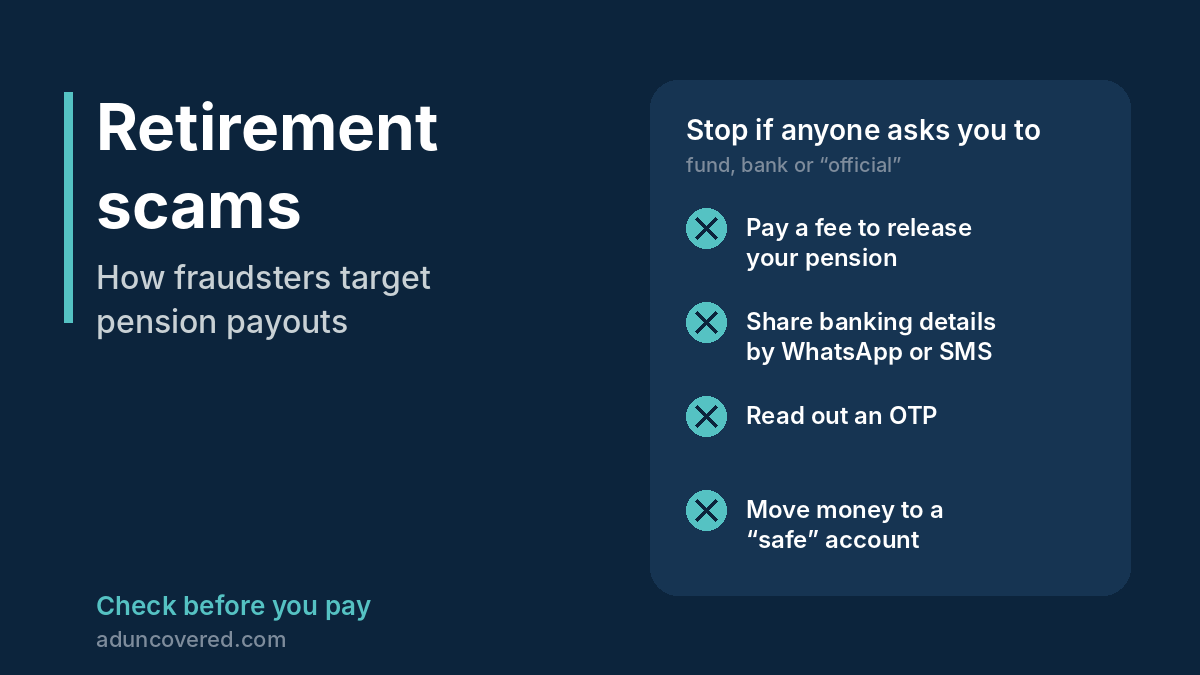
Someone claiming to be from your pension fund says your payout is ready but a fee must be paid first to “process”, “unlock” or “fast-track” it. In December 2025 the Government Employees Pension Fund (GEPF) warned members about exactly this, and said it “will NEVER ask for money to release benefits and will NEVER request your banking details via WhatsApp or SMS.”
2. “Update your details” before a two-pot withdrawal
A message asks you to click a link and update your personal or banking details so your withdrawal can be paid. The link leads to a fake fund website or app that captures your login, or the criminals use your details to change the bank account the fund pays into.
3. The SIM swap after a payout
Your phone suddenly loses signal. By the time you notice, your OTPs are going to someone else and money is leaving your account, as in Mr Mokgapa’s case.
4. The fake security alert from your bank or trading platform
A message says there has been an unusual login or withdrawal and gives you a number to call. In 2026 criminals impersonated the US trading app Robinhood in this way. In one campaign they abused Robinhood’s genuine account emails to send a fake security alert. Robinhood fixed the flaw on 28 April 2026 and said no accounts were breached. In another, fake texts warned of a withdrawal and pushed people to call fake support lines, where some victims were persuaded to move cryptocurrency to the criminals’ wallets.
5. The “safe account”
A caller claiming to be from your bank, a regulator or the police says your money is at risk and must be moved to a “safe” account. There is no such thing. Our guide to digital arrest scams explains how fake officials use fear to make people pay.
6. Investments and loans aimed at pensioners
The GEPF also warned about investment and loan scams aimed at pensioners, and about funeral benefit and death notification scams. A guaranteed high return on your payout, or pressure to decide today, is a reason to stop.
How to protect your pension payout
- Withdraw only through your fund’s official channels: its app, member website or office, using contact details from your statement or official website. Never use a link or number from a message.
- Never pay a fee to receive your own money.
- Never share an OTP, PIN or password, not even with someone who says they are from your bank or fund.
- If your phone suddenly has no signal, call your bank at once from another phone and ask them to check for a SIM swap and block your banking app.
- Turn on transaction notifications and set lower daily limits on your banking app and card.
- Ask your bank about safer places to keep a lump sum than your everyday account, where a fraudster with your app cannot move it in minutes.
- Take a day before any big decision, and talk to someone you trust first. Our guide to scams targeting older South Africans explains why secrecy helps scammers.
If it has already happened
- Call your bank’s fraud line immediately to block your cards, app and accounts.
- Contact your fund through its official number. GEPF members can use the GEPF fraud helpline: 0800 203 900.
- Open a case with SAPS and keep the case number.
- Escalate to the National Financial Ombud Scheme if your bank rejects your claim and you disagree.
- Do not pay anyone who promises to recover your money. Read how recovery scams work, and see How to Report a Scam in South Africa.
Where AdUncovered fits
Before you hand your retirement money to an investment, a loan offer or an “agent” who promises to speed up your payout, check the business behind it. A Quick Report researches the company and its offer, with a link to every source. Our guide How to Check if a Business Is Legit in South Africa shows the free registers you can search yourself.
Check before you pay
About to pay a seller or business you don’t know? Start with a Free Quick Check of the advert link. It screens for common warning signs and shows where each result came from.
If you need the seller researched, a Quick Report or Comprehensive Report brings together source-linked Search Results on the seller and the offer. Neither gives a verdict: you check the sources and decide for yourself.
Sources
- TimesLIVE: Pensioner loses more than R150k in three days (7 Jul 2025)
- Business Report: GEPF warns public sector workers this festive season (11 Dec 2025)
- BusinessTech: SABRIC 2025 digital banking crime statistics (Aug 2026)
- Discovery: Protect your members from two-pot withdrawal scams
- Trend Micro: The Robinhood impersonation scam (13 May 2026)
- Rankiteo: Fake Robinhood sign-in alerts (July 2026)
- AARP: FBI and FTC 2025 fraud loss reports (16 Apr 2026)