
Romance Scams: When You Want So Much for It to Be Real
Romance scams can be difficult to recognise when you want an online relationship to be real.
This guide explains how affection becomes financial pressure, what you can check yourself, and how to examine investment offers and businesses introduced by someone you trust.
How an online relationship can become a financial trap, what you can check yourself, and where independent research can help.
At first, it was just a message.
Then it became the message you looked forward to every morning.
They remember what you told them. They ask whether you slept well. They notice when something is wrong. They talk about visiting, travelling together and building a future.
You begin to feel that someone finally understands you.
So when the visit is cancelled, you accept the explanation. When an emergency happens, you want to help. When a friend raises concerns, you defend the relationship.
Your friend hasn’t read the conversations. They haven’t heard the promises. They don’t know this person the way you do.
Then another request for money comes.
Something feels wrong. But admitting that means questioning more than a payment. It means questioning the affection, the attention and the future you have started to imagine.
That is what makes romance fraud so difficult to recognise from inside the relationship. You may see the warning signs and still desperately want another explanation.
You do not have to resolve every question about the relationship today. You can stop sending money while you check the story independently.
If You Have Already Paid, Start Here
Contact your bank or payment provider immediately through its official app or contact number. Explain what happened and ask whether payments can be stopped, recalled or disputed. Recovery is not guaranteed, but delaying can reduce the options available.
Do not send another payment to resolve an emergency, unlock an investment or recover an earlier loss. Preserve messages, receipts and account details, and secure any accounts whose credentials you shared.
You do not need to finish researching the person before contacting your bank. FTC: What to Do if You Were Scammed.
Why Believing Can Feel Easier Than Questioning
From the outside, someone may ask: “How could you send money to a person you haven’t met?”
From the inside, it does not feel like sending money to a stranger. It feels like helping someone who has become part of your daily life.
The conversations may have continued for weeks or months. You have shared worries, family problems and personal hopes. You may already have imagined what life together would look like.
A scammer can use that attachment to make a financial request feel like a test of the relationship:
- “I thought you trusted me.”
- “You’re the only person I can ask.”
- “Once this is sorted out, we can finally be together.”
- “Your family doesn’t want you to be happy.”
These are illustrative examples, not proof that any individual using similar words is committing fraud. The concern is the pattern: affection becomes tied to payment, secrecy or compliance.
Official guidance describes relationships built through repeated contact, rapid affection, isolation and eventual requests for money or investment. Some approaches develop slowly; there is no fixed timetable. Scamwatch: Relationship Scams.
When a Small Act of Kindness Becomes the Foundation of Trust
A romance scam does not always begin with declarations of love or promises of marriage.
Sometimes it begins with something much smaller: attention at precisely the moment someone needs it.
Take Sue, a recently widowed woman who met a man on Tinder. When she was distressed after discovering upsetting information about her late husband, he insisted on being there for her. He suggested a FaceTime call, even though she initially declined.
The call lasted less than five minutes. He did not need to say very much. His willingness to sit with her during a difficult moment made her feel that he genuinely cared.
Looking back, she recognised that this was the moment trust began.
This illustrates an important manipulation technique: the scammer does not necessarily manufacture affection immediately. He can first establish himself as someone emotionally dependable.

Why You Might Be Chosen
Romance scammers rarely choose people at random. They look for moments when someone may be more open to attention, and for signs that someone has money they could be persuaded to part with.
Timing matters
Contact often arrives during a lonely or unsettled period: the festive season, a birthday, a divorce or break-up, a bereavement, retirement, a move to a new city or the loss of a job. None of these make you foolish. They simply make kind, attentive messages feel more welcome.
What your posts can reveal
Public posts can tell a stranger far more than you intend. A home renovation, a new car, an overseas holiday, a property sale or a retirement celebration can all suggest that you have savings. Scammers may also use online people-search and property records to learn what you own.
- Review who can see your posts, photographs and friends list.
- Avoid publicly announcing property sales, inheritances or large purchases.
- Be cautious when a new contact already seems to know about your finances.

How a Romance Scam Can Escalate Over Time
Many people picture a romance scam as a single request for money. In reality, it can unfold in stages over months or even years, with each stage making the next one harder to refuse.
- Attention. Warm, frequent messages arrive at a time when you may welcome them.
- Intensity. The relationship moves quickly. You hear about a shared future, travel and plans to meet.
- The first request. An emergency, a frozen account or an investment opportunity appears, often after weeks of trust-building.
- Fees to unlock money. If you invested, you are told to pay tax, a release fee or a penalty before you can withdraw.
- Using your accounts. When your own money runs out, you may be asked to receive and forward funds for them.
- Pressure and threats. If you question them or stop paying, affection can turn into guilt, insults or threats.
Some victims describe a contact who first appears on social media around the festive season, then draws them into a cryptocurrency “investment” whose balance keeps growing on screen, until a supposed manager says taxes must be paid before anything can be released. When they question inconsistencies in the story, the contact may turn to insults and disappear, and new contacts with fresh stories can follow months later.
This pattern is not unusual. The FBI warns that romance scammers often use invented emergencies, investments and claims of being stuck overseas to keep money moving.
How Romance Scams Become Financial Traps
A romance scam does not always begin on a dating application. Contact can start through social media, a gaming community or an apparently friendly conversation even a mail order bride app.
The person may present a believable identity, explain why they are far away and gradually become emotionally important. The request for money comes after trust has developed.
Common explanations include medical treatment, travel costs, visas or an unexpected problem preventing a visit. Sometimes the approach is not a request for help at all. It is an offer to help you make money.
The promise changes, but the underlying pressure remains: doing what they ask will supposedly bring you closer to the future they described. FTC: What to Know About Romance Scams.

How One Emergency Becomes Another
A victim may initially be asked for what appears to be a relatively straightforward payment.
In Sue’s case, the man claimed to be a petroleum engineer working on an offshore oil rig.
The first request was for $15,000 to purchase equipment because he supposedly could not access his offshore bank account.
The requests then escalated:
| Stage | Explanation given |
|---|---|
| 1 | Money for offshore equipment |
| 2 | Money to pay employees |
| 3 | Arrest in Mexico and legal expenses |
| 4 | Release fees and flight expenses |
| 5 | Food and internet access through Apple gift cards |
| 6 | Expenses relating to his supposedly ill mother |
| 7 | A supposed heart attack and hospitalisation |
Sue eventually sent approximately $180,000.
Even the ending was staged. A man claiming to be a cardiologist phoned Sue to say her partner had suffered a heart attack on the road, and later called back to say he had died. Two days later, the same profile, with the same photographs, was back on Tinder.
The important feature was not any individual emergency. It was the continuous creation of new problems that supposedly required immediate financial assistance.
Every payment was presented as the final obstacle before the situation could be resolved.
The promised repayment never materialised.
This is Sue’s own account, from her interview with Dating to Win (June 2026). The amounts are as she reported them.
When Romance Becomes an Investment Scam
The person may not appear to need your money.
They may describe themselves as successful and financially secure. They show trading results, mention an expert relative or offer to teach you a method they use themselves.
You are encouraged to open an account on a platform. The dashboard displays profits. A small withdrawal may work.
That successful withdrawal can feel like the reassurance you needed.
But the FBI documents schemes in which early withdrawals are allowed to encourage larger deposits. When the person tries to withdraw a substantial amount, new taxes, verification charges or release fees appear.
A working website and a displayed balance do not establish that investments exist or that the funds are available. FBI: Cryptocurrency Investment Fraud.
The important question is not whether your online partner seems knowledgeable. It is whether the investment provider and its claims can be independently verified.
If You Must Pay to Withdraw Your Own Money, Stop
A dashboard may show your investment growing quickly. When you try to withdraw, you are told to pay tax, a release charge, an anti-money-laundering fee or a penalty first. This is one of the clearest signs of an investment fraud. Paying usually leads to another fee, not to your money.
Introduced to a trading platform, broker or investment website? Paste the link into our free check before you send anything, or order a Quick Report for source-linked research on the business behind it.
Other Scams Can Run Alongside the Relationship
The relationship may introduce businesses, websites and supposed professionals that appear to support the story.
A travel agent may arrange the promised visit. A courier may claim to hold a parcel. A lawyer may need a payment to resolve a problem. An investment adviser may offer access to a profitable opportunity.
Those supporting contacts are not independent evidence merely because they have different names. They may be part of the same operation.
Military impersonation is another established variation. The US Army warns about invented charges for leave, transportation and other supposed service-related needs. These warnings concern US military impersonation and should not be generalised into rules for every country’s armed forces. US Army: Social-Media Scams.
Once money has been lost, an unexpected “investigator”, “hacker” or recovery company may offer to retrieve it for an upfront fee. Knowing details of your loss does not prove they are genuine. FTC: Refund and Recovery Scams.

The Warning Signs You May Be Explaining Away
One unusual detail does not establish fraud. Several connected concerns deserve attention.
Every Meeting Has Another Obstacle
A cancelled visit can have an innocent explanation. Repeated cancellations, changing accounts of what happened and requests for money to overcome each new obstacle create a more concerning pattern.
Ask yourself: Has the relationship progressed through verifiable events, or mainly through promises?
Questions Become Disloyalty
You ask about an invoice, a payment account or an investment platform. Instead of answering, they become upset or accuse you of not trusting them.
A reasonable question about money should not require you to prove your affection.
You Are Encouraged to Keep It Secret
Privacy in a relationship is normal. Pressure to hide payments, investments or repeated emergencies from everyone who could help you think clearly is different.
The Payment Story Keeps Changing
You are asked to pay another person, a different company or a cryptocurrency wallet. An explanation is provided, but it cannot be independently confirmed.
They Show You Proof of Their Wealth
You may be sent a bank statement showing millions, photographs of job sites, contracts or identity documents. A “manager”, lawyer or business partner may contact you to confirm the story. Documents and supporting voices can be fabricated, and they are not independent simply because they come from someone with a different name.
They Act as if Your Decisions Are Theirs
They may call you their husband or wife before you have met, and react with hurt or anger when you make a financial decision without consulting them. Questions about your trust and love can be used to make you share information you would otherwise keep private.
They Know Things You Did Not Tell Them
If they mention something you never shared, such as a property sale or a new account, treat it as a warning sign. Information can be gathered from public records, people-search websites and social media.
You Are Asked to Move Money for Them
They want to use your account because theirs is supposedly inaccessible. You are asked to receive funds and forward them elsewhere.
Do not treat this as an ordinary favour. It can expose you to financial loss and involvement in money laundering. FBI: Romance Scams.
When Money You Did Not Expect Arrives
When someone has taken what they can from you directly, they may try to use your bank accounts instead. You may be told that friends will send money to you, that a repayment is on its way, or that you need to convert funds into cryptocurrency and send them on.
Money arriving in your account is not proof that the relationship is genuine, or that your losses are being repaid. In one reported case, a large deposit that appeared to be returned money had in fact been diverted from someone else’s property sale through intercepted emails.
- Do not forward, convert or withdraw money you did not expect.
- Contact your bank immediately through its official app or number and explain what happened.
- Expect that your bank may freeze or close accounts used to move suspicious funds.
- Get legal advice if you have already moved money for someone else. Acting as a money mule can have serious consequences, even if you were deceived.
If Threats Begin
When a victim stops paying or blocks contact, some scam groups turn to intimidation. Threats may target you, your family or your reputation, and may arrive from many different numbers.
- Do not pay and do not negotiate.
- Keep the messages, numbers, recordings and images as evidence, but stop replying.
- If you or your family may be in danger, contact the police immediately. In South Africa, call 10111 in an emergency.
- Tell the people who have been named in the threats, so that they can take precautions.
If Intimate Images Become Leverage
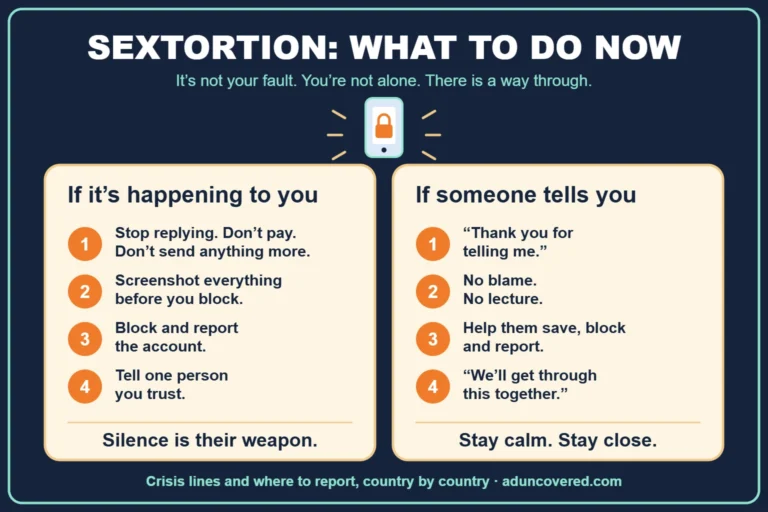
If someone threatens to share intimate images, do not send more content or pay to keep them quiet. Payment does not guarantee the threats will stop.
Preserve threatening messages and account details, seek support, and report through the platform and appropriate authorities. Do not upload intimate material publicly to demonstrate what happened. eSafety: Dealing With Sexual Extortion.
Eligible adults can use StopNCII to create a digital fingerprint of intimate content on their own device. The image itself is not uploaded. Participating platforms use the fingerprint to help identify matching content that violates their policies.
It cannot remove material from the whole internet, and eligibility requirements apply.
How to Check Photographs Used in Romance Scams
A reverse-image search uses a photograph to look for matching or related images online.
It can reveal that a profile photograph also appears under another name, on a stock-image website or in a context inconsistent with the person’s story.
How to Search
- Save a non-intimate photograph from the profile or conversation. Keep the original unchanged.
- Open Google Images.
- Select the camera or search-by-image control and upload the photograph.
- Review websites using the same image. Do not rely only on visually similar faces.
- Repeat with other photographs.
- Try a second service, such as TinEye.
- Save relevant page addresses and screenshots, with the date you checked them.
Google provides image-upload searches that can return websites containing the same or similar image. TinEye searches its image index for matches, including some modified versions. Google’s instructions, TinEye’s explanation.
What the Results Do—and Do Not—Mean
No results does not mean the person is genuine. It means the searches did not return a relevant match.
The photograph may not be indexed. It may come from a private account, be substantially altered or have been newly created. This is a limitation of the search, not evidence supporting the identity.
Finding a photograph under another name is important, but it does not establish that the person pictured is the scammer. Their photographs may have been stolen.
Do not publish accusations against the person in a search result. Preserve the evidence and use appropriate reporting channels.
Avoid uploading intimate photographs, identity documents or sensitive paperwork to general image-search tools.
Check the Story, Not Just the Face
Photographs are only one part of the assessment.
Search Names and Distinctive Wording
Search the names, usernames and businesses involved. Try a distinctive sentence from a financial request in quotation marks.
A matching story may provide useful context. No matching story does not establish safety.
Build a Simple Timeline
Record what was promised, what happened and when money was requested.
| Date | Promise or explanation | Payment requested | What actually happened |
|---|---|---|---|
| First planned visit | Travel supposedly arranged | Ticket or visa cost | Visit cancelled |
| Later request | Unexpected emergency | Further payment | New explanation |
| Investment offer | Profits supposedly available | Deposit or release fee | Withdrawal restricted |
This is an illustrative format, not a description of every scam. Keep original messages and receipts alongside it.
Verify Supporting Organisations Independently
If the story involves an employer, agency, financial provider or professional, locate its contact details separately. Do not depend on a link or number supplied in the conversation.
A genuine organisation may exist while the person contacting you falsely claims a connection to it.
For investment offers in South Africa, check the provider through the FSCA’s official search. Registration must relate to the correct entity and service. A copied licence number is not enough. FSCA impersonation warning.
Screenshots, Bank Balances and Official-Looking Documents
A person may provide screenshots showing millions in a bank account, transaction errors, employment documents, newspaper articles, hospital photographs or cryptocurrency balances.
These images can appear convincing without establishing that the underlying events are real.
Remember:
- A screenshot is not independent bank verification.
- A photograph of someone in a hospital does not establish why they are there.
- A newspaper article may be fabricated or misrepresented.
- A displayed cryptocurrency balance does not establish ownership of actual funds.
- A legitimate company’s name and branding can be copied by a fraudulent website.
Where possible, verify the underlying information independently rather than relying on material supplied by the person requesting money.
Why a Video Call Does Not Settle It
A video call may contribute information, but it cannot establish honest intentions or validate a financial offer.
The FBI documents manipulated video and real people participating in fraudulent investment approaches. A person appearing on camera does not prove that every claim attached to the relationship is true.
Likewise, photographs of passports, bank statements or certificates should be treated as claims requiring confirmation, not independent proof. FBI investment-fraud guidance.
You do not need to become an expert at detecting synthetic media. The more useful boundary is refusing to base a financial decision solely on material controlled by the person requesting it.
Sue did have a FaceTime conversation with the man she believed she was dating. However, the call lasted less than five minutes, and his face was partly obscured by a hat pulled low over his forehead.
Later, when he supposedly started working offshore, he claimed he could no longer make video or telephone calls. Communication became almost entirely text-based.
The lesson is important: having a video call is not the same as independently establishing someone’s identity.
A brief, controlled interaction should not override other inconsistencies in the person’s story.
Why You May Be Targeted Again
People who have lost money to a scam are often approached again. A new admirer may appear on a dating app, or someone may offer to recover your money for a fee. These recovery scams are common, and they may come from the same people who took your money.
- Treat any offer to recover lost funds for an upfront payment as a warning sign.
- Be cautious of new contacts who move quickly, especially soon after a loss.
- Report what happened, even if it feels embarrassing. Reports can help investigators connect cases.
Being scammed is not a measure of intelligence. Romance scams exploit trust, kindness and hope, which are qualities worth keeping.

The Second Scam: When Romance Scam Victims Are Targeted Again
Losing money to a romance scam does not necessarily mean the fraud is over.
In some cases, victims are approached again by people claiming they can recover the money.
These are known as recovery scams, and they can be particularly devastating because they target people who are already financially and emotionally vulnerable.
Consider what happened next to Sue, who had already lost approximately $180,000 in the romance scam.
After joining an online victim-support group, she was contacted by someone claiming to know an IT specialist connected to the FBI’s Internet Crime Complaint Center (IC3).
The supposed specialist claimed to have access to scammers’ accounts and offered to recover her stolen money.
The operation appeared convincing.
There were five other supposed victims. They communicated in a separate WhatsApp group and regularly shared updates showing their cryptocurrency balances increasing.
The woman initially refused to participate because she suspected another scam.
Eventually, after seeing what appeared to be successful recoveries by the other participants, she agreed.
The supposed recovery specialist requested an initial $5,000 investment to begin the process.
What followed was another elaborate deception.
How the recovery fraud worked
1. Borrowed authority
The individual claimed to have connections to FBI cybercrime investigators and access to criminal accounts.
2. Social proof
Five other supposed victims appeared to be recovering their money. Their progress encouraged the woman to participate.
3. A convincing cryptocurrency platform
She was directed to a website imitating a recognised cryptocurrency company. The account displayed an increasing balance.
4. Artificial withdrawal problems
When she attempted to withdraw, she was told that the cryptocurrency had been sent to an incorrect wallet address because of an additional character.
5. Advance-fee demands
She was told to pay 20% of the account balance to investigate the missing transaction. That came to $59,000. To find it, Sue sold her shares, drew on her retirement savings and took out loans. Further deposits were then demanded to resolve additional supposed problems.
6. False reassurance
The supposed IT specialist even claimed to contribute $20,000 of his own money to help complete the recovery.
Eventually, she could no longer raise the required funds. The supposed specialist disappeared.
By the time Sue told her story in June 2026, she had lost about $500,000 across both schemes. A US Senate investigation published in October 2026 put her total losses at more than $700,000.
Why this recovery scam was so effective
The perpetrators used several psychological techniques:
- Authority: claiming an association with the FBI.
- Social proof: creating the impression that other victims had successfully recovered their money.
- Reciprocity: suggesting that the specialist was personally contributing money.
- Scarcity and urgency: implying that the recovery opportunity could be lost.
- Sunk-cost manipulation: encouraging further payments because so much had already been invested.
- False evidence: displaying balances on a fraudulent cryptocurrency platform.
There is no independent evidence in this account that the five other participants were genuine victims or that they recovered money.
They may have been accomplices or fabricated identities.
The important lesson is that a recovery operation can be just as carefully constructed as the original romance scam.
A genuine recovery process does not require you to pay an unknown individual to access stolen funds, release a cryptocurrency balance or unlock a supposed investigation.
No one should be trusted simply because they know details about your original scam.
This is a reported case study. The claimed FBI connection, account access and recovery activity were not independently established.
When Scammers Follow Victims into Support Communities
Online support groups can provide valuable emotional support and practical information to people who have experienced fraud.
However, they can also create opportunities for further exploitation.
People who have lost money may openly discuss their experiences, the amounts involved, the platforms used and their attempts to recover funds.
This information can make them attractive targets for recovery scammers.
Be cautious when someone:
- Contacts you privately after you disclose a financial loss.
- Claims to have inside information about the criminals.
- Introduces an investigator, hacker or cryptocurrency specialist.
- Offers to recover funds from a scammer’s wallet.
- Introduces other supposed victims who have successfully recovered their money.
- Encourages you to join another group where recovery progress is displayed.
- Requests personal information, wallet details or an upfront payment.
Even if someone appears to be a fellow victim, their identity and intentions remain unverified.
A support group is not a verification service.
Never assume that someone is legitimate simply because they know the details of your experience.
Never pay someone to recover money you have already lost.
If someone contacts you claiming to be an investigator, hacker, law-enforcement contact, cryptocurrency expert or recovery specialist, independently verify their identity and organisation.
Be particularly suspicious of anyone who:
- Guarantees recovery.
- Claims access to criminals’ cryptocurrency wallets.
- Requests an upfront payment or deposit.
- Requires additional money to release recovered funds.
- Displays a growing balance that cannot be withdrawn.
- Claims that a tax, verification fee or technical problem must be resolved before payment.
You may already have lost money. Do not let the promise of getting it back become the reason you lose more.

Why Letting Go Can Feel Like Grief
Accepting that a relationship was a scam is not only about money. It means saying goodbye to the person you thought you knew, the morning messages, the plans to travel and the future you had already begun to picture.
That is why so many people refuse to believe it, even when the evidence is clear. Daily attention, affection and shared dreams can trigger the same reward and bonding responses as a genuine relationship. The feelings are real, even though the person was not.
This is not an accident. Research by Schokkenbroek and Snaphaan (2025) found that some organised romance-scam groups use training and written scripts or playbooks, with suggested opening messages, ready-made stories and instructions on how to respond. Intense early affection, shared future plans, secrecy and carefully timed requests are designed to make letting go feel impossible.
The more you have invested, emotionally and financially, the harder it becomes to accept that it was not real. If you are struggling to let go, that is not weakness. It is grief, and it deserves the same kindness as any other loss.
How to Support Someone Facing a Romance Scam
Do not begin with “I told you so.”
The person may be facing two losses: their money and the relationship they believed they had. Ridicule can make them withdraw and leave the scammer as their main source of reassurance.
Try:
“I can see this relationship matters to you. I’m worried about the payment requests. Can we check those together before any more money goes?”
Discuss a specific claim or transaction rather than demanding that they immediately reject the whole relationship.
Help them record promises, review evidence and contact their bank. Keep your support available even if they are not ready to accept your interpretation. Scamwatch: Helping Someone Who Is Being Scammed.
Sue initially concealed her losses because she was ashamed and feared disappointing her children.
Eventually, she told her sons. Although they were initially angry, they reassured her that they would face the situation together.
Why Victims Sometimes Hide What Happened
People who have been defrauded may delay telling their families because they feel embarrassed, ashamed or afraid of being judged.
They may be intelligent, financially experienced and accustomed to making important decisions independently.
Admitting that they have been manipulated can feel like admitting that they have lost control.
This silence can make the situation worse. It leaves victims isolated and can make them more susceptible to subsequent recovery scams.
If someone tells you they have been defrauded, resist the temptation to ask why they didn’t see the warning signs.
They need support, not humiliation.
One of the most important things you can say is:
You are not dealing with this alone. We will work through it together.
Where AdUncovered Can Help—and Where We Cannot
AdUncovered does not currently offer a dedicated romance-partner investigation service.
We cannot certify someone’s identity, establish their private intentions or determine whether their feelings are genuine. We do not provide access to private messages, confidential banking records or private-person background investigations.
We can research an identifiable business or offer introduced through the relationship.
That may include an investment platform, online shop, travel or accommodation offer, or purported recovery business, where there is sufficient public information and the concern falls within our research scope.
We examine relevant claims and available public evidence, then send you a report explaining what we found, material contradictions and what remains unknown. Complaints are distinguished from established facts.
A Quick Report provides focused research into one identified seller or business and its advertised offer, ordinarily covering the past year. It does not investigate your individual transaction or prepare a refund claim.
A Comprehensive Report provides broader research, normally covering the past three years, including relevant transaction details and refund-related information you supply. Relevant court orders and trading restrictions have no age cutoff in either report.
Neither report guarantees safety, determines criminal guilt, provides legal advice or recovers money. No negative findings does not establish that an offer is safe.
If money has already been sent, contact your bank first. Do not wait for a research report.
Before you pay anyone you met online, or a business they introduced, check first. Our free check gives a first look in seconds. A report researches the seller or platform and emails you the findings with every source linked.
You Can Pause Without Deciding Everything Today
You may still want the relationship to be real.
You may still miss the messages. You may still hope there is an explanation that makes everything fit.
Those feelings do not prevent you from setting a boundary.
Do not send more money while important claims remain unverified. Do not let affection replace independent checks of an investment, invoice or business. Speak to someone who will help without humiliating you.
Wanting companionship was not a failure. Someone exploiting that trust is responsible for the deception.
You do not have to stop wanting love to stop funding a story you cannot verify.
Visit AdUncovered for practical scam-awareness guides and research into the businesses and offers that may sit alongside a relationship.
Many of these relationships now begin on a dating app. Our guide to dating app scams covers how they start, the red flags before money is requested, and how faith and age are used to build trust.
Check before you pay
About to pay a seller or business you don’t know? Start with a Free Quick Check of the advert link. It screens for common warning signs and shows where each result came from.
If you need the seller researched, a Quick Report or Comprehensive Report brings together source-linked Search Results on the seller and the offer. Neither gives a verdict: you check the sources and decide for yourself.
Frequently Asked Questions About Romance Scams
How can I tell if I am talking to a romance scammer?
Common signs include a relationship that moves very quickly, repeated reasons for not meeting or video-calling, requests for secrecy, and any request for money, gift cards, cryptocurrency or help moving funds. One sign alone may not be conclusive, but a pattern should prompt careful checks.
Why am I being asked to pay tax or a fee before I can withdraw my investment?
Legitimate platforms do not usually require an upfront payment before releasing your own funds. Requests for taxes, release fees or penalties are a common feature of investment fraud linked to romance scams.
Someone I met online sent money into my account. What should I do?
Do not move, convert or spend it. Contact your bank immediately and explain the situation. The money may have been taken from another victim, and forwarding it could expose you to legal risk.
Can I get my money back from a romance scam?
Recovery is not guaranteed. Contact your bank or payment provider as quickly as possible and report the matter to the police. Be wary of anyone who promises to recover your money for a fee.
Can AdUncovered tell me whether my online partner is real?
No. We do not investigate private individuals or confirm anyone’s identity or intentions. We can research an identifiable business, website, platform or offer introduced through the relationship, so you can review the public information before you decide. Start with a free check.
Editorial note: This article provides general public-source research and practical guidance. It is not legal, financial or law-enforcement advice. A warning sign alone does not establish wrongdoing, and an unsuccessful search does not establish safety. Research checked on 7 October 2026.