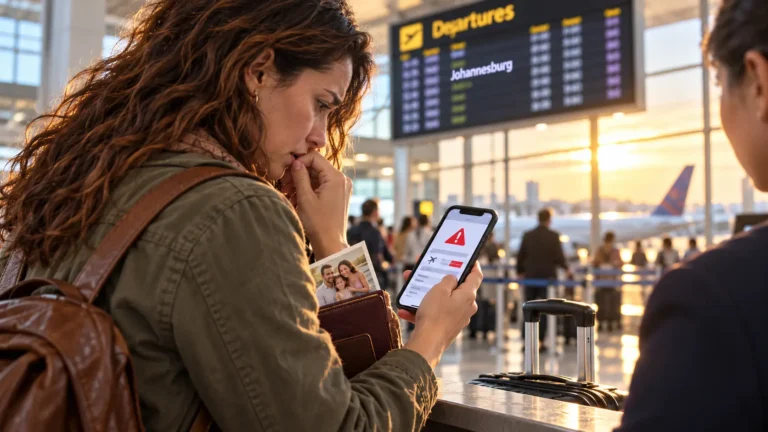
A courier SMS scam often starts with a text saying your parcel is on hold. Your address is incomplete. Pay a small redelivery fee now, it says, or your package will be returned.
It can look like an ordinary delivery update, especially if you are expecting an order. But scammers impersonate couriers and postal services around the world. Their messages may arrive by SMS, email or WhatsApp, and their links can lead to fake tracking or payment pages designed to steal card details, banking credentials or one-time passwords (OTPs).
In South Africa, banks warn about fake parcel messages that impersonate courier companies or the Post Office and direct people to pages requesting card or online banking details. Nedbank’s parcel-scam guidance
How the courier SMS scam works
The message may claim that:
- a delivery failed because your address is wrong;
- a small fee is due before the courier can redeliver;
- a parcel is being held until you pay customs charges; or
- you must confirm personal details to receive the package.
In a typical courier SMS scam, the link opens a convincing copy of a courier or postal service website. It might ask for a small card payment, then request additional details such as your card number, online banking password or OTP. The supposed fee is a lure; the real objective may be to take over an account or make unauthorised payments.
This pattern appears internationally, but the details vary. In September 2026, the Philippine Postal Corporation warned about texts claiming an address problem or demanding an urgent redelivery fee. In March, Singapore Police described a related scam using WhatsApp messages impersonating SingPost. Victims were directed to fake sites asking for banking credentials, card details and OTPs; police reported unauthorised foreign-currency transactions. PHLPost’s alert · Singapore Police Force advisory
Scams can also escalate after the fake payment page. In May 2026, Switzerland’s National Cyber Security Centre described “double phishing”: after victims entered card details on a fake parcel site, a scammer called pretending to be from the bank. The caller asked for a security code or urged the victim to approve an app notification to “stop” a suspicious charge. The code or approval actually authorised the payment. Swiss National Cyber Security Centre guidance
Messages can look more legitimate than they are
A familiar company name, logo or sender label is not proof that a message is genuine. The UK communications regulator Ofcom warned in July 2026 that scammers may use business messaging services to impersonate companies such as parcel couriers, or manipulate sender names to make messages appear trustworthy. Ofcom’s July 2026 announcement
The timing of a courier SMS scam is not proof either. A recent South African report quotes The Courier Guy saying fake parcel-fee messages can be sent in bulk to random numbers. If one arrives while you are waiting for a delivery, that coincidence can make the message feel targeted. MyBroadband’s October 2026 report
Not every courier payment request is fake
Some genuine international shipments incur customs duties, import VAT or related charges. These are separate from ordinary shipping charges, and the amount and payment process depend on the shipment, destination and courier.
For example, DHL says that for applicable shipments entering South Africa where the receiver is responsible for duties and taxes, it sends a payment link by email, and may also send an SMS if a mobile number was included in the shipment details. The parcel is released once payment is allocated and customs processing is complete. DHL also advises checking that an unusual payment request came through an official DHL channel. DHL’s South Africa guide to tracking and paying duties
Courier policies differ. Fastway, for example, says it does not ask parcel recipients to pay its delivery fees or customs charges. The Courier Guy told MyBroadband the same: recipients never pay extra to receive a parcel, because the sender pays for shipping. These are those couriers’ policies; it should not be treated as a rule for every courier or country. Fastway’s scam alert
The safest test is to verify the parcel and the specific charge through a channel you find yourself. Don’t assume a payment request is real just because you are expecting a parcel, or fake just because it asks about a fee.
How to check a courier SMS safely
- Open the retailer’s app or website yourself. If you’re not sure the shop itself is genuine, see our guide to AI fake shops. Check your order and delivery details there.
- Find your tracking number in a trusted place. Use the number in your order history or original retailer confirmation. Enter it manually on the courier’s official website or app. Don’t rely only on a tracking number included in the suspicious message.
- Verify any fee independently. Contact the retailer or courier using details from its official website. Ask whether the parcel is actually held and whether the amount is due for that shipment.
- Check the full web address. Look for misspellings, extra words, unusual endings or shortened links. A convincing logo or page design can be copied.
- Treat urgency as a reason to pause. Almost every courier SMS scam sets a short deadline. Threats that a parcel will be destroyed, returned or held unless you pay immediately do not prove the request is genuine.
- Never share an OTP or approve a bank prompt to “stop” a charge. Read the full message accompanying a code or payment notification. If a caller asks you to reveal a code or approve a transaction, hang up and call your bank on a number you find independently.
If you clicked, entered details or installed an app
If you opened a courier SMS scam link but did not enter information, approve a payment or download anything, close the page. Clicking alone does not prove your accounts have been compromised.
If you entered card details, call your bank immediately using the number on your card or its official app. Ask it to block the card and check for unauthorised transactions. If you gave away online banking credentials, contact the bank and change them through its official app or website. Change reused passwords on other accounts, especially your email account.
If you shared an OTP or approved a transaction, tell the bank exactly what happened and when. Don’t wait to see whether money disappears.
If you downloaded or installed an app from the message, disconnect the device from the internet if you suspect it is behaving unusually. Don’t open the app again. Use a separate, trusted device to contact your bank and change passwords. Get help removing the app or checking the phone before using it for banking again.
Save the message, link, screenshots and transaction records. Report the message to the courier through its official channel. If money was taken, report it to your bank and the police. Our guide How to Report a Scam in South Africa lists who else to contact.
A parcel message may be genuine, while a courier SMS scam is built to look exactly like one, and legitimate customs charges do exist. Verify both the delivery and any fee through the retailer or courier independently before you click, share details or pay.
Check before you pay
About to pay a seller or business you don’t know? Start with a Free Quick Check of the advert link. It screens for common warning signs and shows where each result came from.
If you need the seller researched, a Quick Report or Comprehensive Report brings together source-linked Search Results on the seller and the offer. Neither gives a verdict: you check the sources and decide for yourself.