
Money Mule Scams: How Fake Jobs, Romance and Festive Offers Recruit You
Last reviewed: 25 October 2026
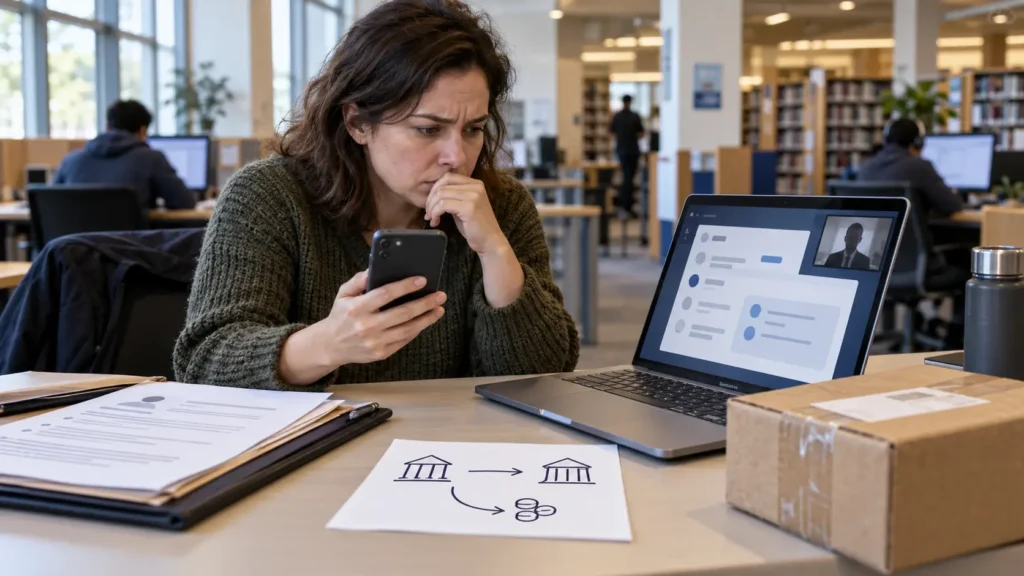
A message offers easy remote work: receive payments, keep a commission and forward the balance. Someone you have been dating online asks to use your account because theirs is “temporarily unavailable.” A festive-season delivery job asks you to accept parcels at home and send them overseas.
These offers may appear unrelated. They can all put you in the middle of moving money or goods connected to crime.
A money mule is someone who receives, transfers, withdraws or otherwise moves money on behalf of another person or group. Criminals use mules to put distance between themselves and the original victim, making it harder to trace stolen funds. Some people know what they are doing; others are deceived into believing they are helping a partner, employer or business. The FBI describes unwitting, witting and complicit mules, while warning that even someone who was initially deceived can face serious consequences if they continue after warning signs become clear. FBI: Money Mules
This guide explains how mule schemes work, how they overlap with romance, job and seasonal scams, and what to do if you have already received or sent money.
How a money mule scheme works
The simplest version follows this pattern:
- A criminal gets money or goods through fraud. The original victim might have paid a fake invoice, fallen for an investment or romance scam, or had money stolen from an account.
- The criminal recruits someone to handle the next step. They may call it payment processing, bookkeeping, receiving client funds, helping a partner or forwarding parcels.
- The mule receives the money or goods. This may happen through a bank account, payment app, cheque, cryptocurrency account, prepaid card or money-transfer service.
- The mule sends them onward. The next step could be a transfer to another account, a cash withdrawal, cryptocurrency, gift cards or a parcel shipment.
- The criminal keeps the proceeds. The mule may receive a small commission—or nothing at all—while the trail points toward the mule’s account, address or identity.
The money can pass through several accounts and countries before the original victim or authorities can follow it. Europol describes money mules as people who receive money from a third party and transfer it onward or withdraw it, often for a commission. Europol: Money muling
A mule does not always move cash. Someone asked to receive and reship phones, computers or luxury goods bought with stolen payment details may be acting as a reshipping mule. The goods can be the proceeds or the means of fraud, even if no money passes through the person’s bank account.
Who becomes a mule?
There is no single profile. Criminals look for people whose circumstances make an offer feel credible or hard to refuse: job seekers, people seeking extra income, students, people who are financially stretched, and people who have formed a trusting online relationship.
A person can also become involved without answering a direct “money mule” advert. The request may be presented as one small, ordinary task within a larger story: “help with payroll,” “receive a client refund,” “pay a supplier,” “accept my package,” or “use your account because mine is frozen.”
A person’s intent matters, but not knowing the full story does not make the situation safe. Banks may investigate suspicious transactions, restrict accounts or ask where money came from. Authorities may also investigate the account holder. Whether someone is criminally liable depends on the facts and local law; the consequences and legal definitions vary by country.
Fake jobs: when “payment processing” is the job
Money-mule recruitment often hides inside a job offer. A supposed employer may advertise roles such as:
- Remote cashier
- Finance or payment agent
- Bookkeeper
- Accounts assistant
- Payroll assistant
- Administrative assistant
- “Local representative” for an overseas company
The job may be posted on social media, messaging apps, email, pop-up ads or even a legitimate job board. A listing on a real platform does not, by itself, prove that the employer or offer is genuine.
The Australian Competition and Consumer Commission’s job-scam taskforce documented roles with titles such as “finance agent,” “remote cashier” and “bookkeeper.” Applicants were sometimes asked to use an existing personal account or open another account, receive money and send it to accounts, cryptocurrency wallets or gift-card sellers. Some were offered a commission. ACCC: Job Scam Fusion Cell final report
The recruiter may describe the transfers as routine business activity, claim that local banking rules make the process necessary or say that the company cannot open an account in your country. That does not make it legitimate. A company asking a new employee to receive unexplained funds in a personal account and forward them elsewhere is asking the employee to take on financial risk that belongs to the business.
Do not confuse every fake job with money muling
Some scams use the appearance of work but do not involve moving other victims’ money.
In a task scam, a message offers online work such as “product boosting,” ratings or “optimization.” The app shows imaginary earnings, sometimes after making a small initial payment to build trust. Later, the worker is told to deposit their own money—often cryptocurrency—to unlock tasks or withdraw the supposed balance. The FTC warns that the displayed earnings are fake and paying the requested deposit does not release them. This is generally a scam that takes money from the recruit; it is not necessarily a money-mule scheme. FTC: How to spot and avoid task scams
Other fake jobs ask for an upfront recruitment, training or equipment fee, or request sensitive banking or identity details before there has been a credible hiring process. Those are serious warning signs, but they are not automatically evidence that the applicant is being recruited to launder money.

Romance scams: trust becomes the route to your account
Romance scammers often spend time building a relationship before asking for money. Some ask the person they are courting to send funds directly. Others ask them to receive money and forward it, describing this as temporary help for a partner, a business payment, an investment or a problem with an account.
A person who agrees may believe the money belongs to their online partner. In reality, it may have come from another victim of fraud. The romance victim can then be used to move money for the criminal. The U.S. Treasury’s 2026 National Money Laundering Risk Assessment describes romance scammers using U.S.-based mules and notes that romance-scam victims may also be used to launder proceeds from other scams. This is a U.S. assessment, so it illustrates a documented method rather than measuring how often it happens worldwide. U.S. Treasury: 2026 National Money Laundering Risk Assessment
Romance scams may also turn into investment scams. A new partner may suggest a trading platform, show apparent profits or encourage the victim to move money into cryptocurrency. A request to use your account to receive or forward funds is a separate danger: do not accept money for someone you know only online and do not pass it on.
The scale of social-media fraud is significant in U.S. reports. The FTC says nearly 30% of people reporting a scam loss in 2025 said it began on social media, and nearly 60% of people who reported losing money to a romance scam said that the contact began there. Those are U.S. consumer reports, not a measure of global prevalence, and they do not mean that every romance scam involves a mule. FTC: New data on social-media scams
Q4 and the post-festive period: more opportunities for deception
Holiday and year-end periods can create conditions scammers exploit: more online shopping and deliveries, more temporary work adverts, more travel bookings and charitable appeals, and more people looking for extra income. The U.S. Office of the Comptroller of the Currency lists fake seasonal jobs, delivery messages, shopping offers, travel deals and charity appeals among holiday-season scam risks. OCC: Holiday and gift-card scams
Some of these scams can generate money or goods that criminals then move through mules. But the evidence needs to be described carefully: the sources reviewed do not establish that money-mule recruitment itself rises every Q4 worldwide. Seasonal warnings show that certain scams and opportunities become more visible during holidays; they do not prove a global seasonal peak in mule recruitment.
The FBI reports that complaints about holiday shopping scams often arrive in the early months of the following year, suggesting a link to the previous shopping season. That finding concerns non-payment and non-delivery shopping scams, not a measured rise in money-mule recruitment. The FBI reported more than US$503 million in 2025 losses from non-payment and non-delivery scams in the United States. FBI: Holiday scams
Seasonal offers to treat with extra care
Temporary retail, delivery and warehouse work. A scammer may advertise a job that requires you to receive customer payments, pay “suppliers” from your own account, or handle parcels at home. Check the company and the role independently. Do not accept responsibility for moving money or reshipping goods for an unverified employer.
Fake delivery or missed-parcel messages. A message may ask for a small fee or personal details to release a parcel. Go to the retailer’s or courier’s official website or app yourself. If the offer evolves into receiving and forwarding parcels as a job, stop and verify the employer.
Shopping, marketplace and refund scams. A buyer or seller may send a fake payment notice, overpay by cheque or ask you to return an “excess” payment to a different account. A payment appearing in your account does not prove that it is final or legitimate. Contact your bank through a known channel before touching disputed funds.
Charity and emergency appeals. A genuine desire to help can be exploited through a fake fundraiser or an urgent request to collect and forward donations. Donate directly through an organization you have independently verified. Do not let a stranger route other people’s donations through your personal account.
Post-holiday side jobs. After the festive period, some people look for extra work to cover bills or replace seasonal income. The FTC has warned about unexpected side-gig offers involving reshipping, data entry and other work-from-home tasks that seek money or personal information. A genuine-looking “side hustle” can still be a fake job, an identity-theft attempt or a mule-recruitment route. FTC: How to avoid a side-hustle scam
Refunds and tax messages can also be used in scams, but tax calendars differ by country. Check a refund or tax notice through the relevant authority’s official website or app—not through a link in an unexpected message. There is no single international post-festive tax-refund season.

Fake overseas jobs can involve human trafficking—not just financial fraud
Some fraudulent job offers lead to a far more dangerous situation than having money pass through a bank account. INTERPOL’s 2026 threat assessment reports that people from nearly 80 countries have been trafficked into online scam centres, where many are forced to carry out fraud. It describes a cross-border model in which people coerced into committing fraud and the people targeted by that fraud are both victims of the criminal operation. INTERPOL: Global Financial Fraud Threat Assessment 2026
This forced criminality is not the same thing as ordinary money-mule recruitment. A mule is generally recruited to move money or goods through their own account or address. A person trafficked to a scam compound may be controlled through threats, violence, debt bondage or restrictions on movement and forced to operate scams directly.
In July 2026, South Africa’s Department of Social Development warned that young South Africans had been lured by apparently legitimate jobs in Thailand and trafficked to scam compounds in Myanmar, where they were forced to participate in cyber-enabled financial crime. The department said survivors reported attractive salaries, free travel, long working hours, intimidation, violence and debt bondage. This is an important South African example, not proof that all overseas job offers—or all scams—follow the same route. South African Department of Social Development: Fake job scams and trafficking
For an overseas offer, independently verify the employer, recruiter, job location, contract, visa requirements and travel arrangements. Share the details with someone you trust. Treat a high salary, free travel and pressure to leave quickly as reasons to check more carefully—not as proof of a crime by themselves.
Warning signs: pause if someone asks you to move money or goods
Be particularly cautious if a job contact, online partner or stranger:
- Asks you to receive money into a personal account and transfer it onward.
- Says you can keep a percentage for each payment.
- Wants you to withdraw cash, buy cryptocurrency or gift cards, or send money through a transfer service.
- Tells you to open another account or form a company to handle payments.
- Asks you to receive and reship parcels as a “local representative.”
- Gives vague duties but emphasizes quick pay, no experience or minimal effort.
- Says the process must be secret, urgent or handled outside normal company systems.
- Sends a cheque or transfer and asks you to return part of it or pay another person.
- Insists that you use their instructions to “verify” a payment rather than checking with your bank or the named business directly.
A legitimate job may involve handling company payments as part of a formal role, using company systems and controls. That is different from being asked to route unexplained third-party funds through your personal account. If you cannot independently establish who owns the money, why it is being sent and who is entitled to receive it, do not move it.
How to check a job or request safely
- Pause before accepting or transferring anything. Urgency is often part of the pressure.
- Find the organization independently. Type its known web address yourself, use a verified phone number, or contact it through a channel listed on its official site. Do not rely on the recruiter’s link or phone number.
- Confirm the role with the organization. Ask whether the named recruiter works there and whether the job actually requires handling money or goods. Contact the company using details you found independently.
- Read the duties and payment terms. If the role is vague, the pay is unusually high for the work, or the main task is to transfer funds, walk away.
- Do not pay to get paid. A request for an upfront fee or a deposit to unlock supposed earnings is a strong warning sign.
- Do not use your personal account as a payment channel for someone else. Do not open an account at another person’s direction or let them use your login, card or identity documents.
- Check independently with your bank if unexpected funds arrive. Use the number on your bank card or official website. Do not forward or refund the money based on the sender’s instructions.
- Ask someone you trust to review the offer. A second opinion can help when a recruiter or partner is applying pressure.
What if money has already arrived—or you have already sent it?
Act quickly, and be honest with your bank. Do not move the money again, withdraw it, convert it to cryptocurrency or send a “refund” to a different account just because the sender asks. Contact your bank using a verified number and explain what happened. The bank can tell you how to handle funds in the account and whether it needs to restrict transactions or secure your access.
Then:
- Save messages, emails, phone numbers, job adverts, payment records, account details, parcel labels and receipts. Do not delete the conversation.
- Stop communicating with the recruiter or online partner while you verify what happened. Do not share passwords, one-time codes or additional identity documents.
- Change exposed passwords from a trusted device, especially if you shared login details or installed software at someone’s request. Ask your bank whether cards, accounts or other credentials should be replaced.
- Report the incident to your local police or national fraud-reporting service. Report the account or listing to the job board, social platform, payment provider or courier involved.
- If you were threatened, coerced or recruited to travel for work, prioritize your physical safety. Contact local emergency services or an anti-trafficking organization. If you are abroad and in danger, contact local authorities and your country’s embassy or consulate.
- Be wary of “recovery agents” who promise to get the money back for an upfront fee. People who have already been scammed can be targeted again.
The exact reporting route and legal position vary by country. A bank or law-enforcement agency can give advice based on the local circumstances. If you are worried about possible legal exposure, seek independent legal advice in your jurisdiction.
Frequently asked questions
Is a money mule always aware of the crime?
No. Some people are deceived by a fake job or romance. Others suspect what is happening or knowingly take part. The circumstances matter, and continuing to move money after a bank or another trusted source raises concerns can make the situation more serious. Do not rely on a recruiter’s assurance that “it is all legal”; verify independently.
If I receive money by mistake, should I send it back?
Do not follow the sender’s instructions or transfer it to a different account. Contact your bank using a verified number and explain that you received an unexpected payment. The bank can guide you through the appropriate process.
Is every fake job a money-mule scam?
No. Some fake jobs steal application fees or identity information. Task scams may display fake earnings and then demand the applicant’s own money. A money-mule job specifically involves being asked to receive or move money or goods connected to someone else’s activity. Different scams can overlap.
Can a romance scammer use a victim as a mule?
Yes. A person may be told they are helping a partner, business or investment but actually be forwarding money from another victim. Do not receive or transfer funds for someone you know only online.
Do money-mule scams peak during the festive season?
The research reviewed for this article does not establish a worldwide Q4 peak in money-mule recruitment. Official sources document seasonal shopping, delivery, charity, travel and temporary-job scams, some of which can create funds or goods criminals try to move. That supports extra caution during busy periods, but it is not the same as proving that mule recruitment rises everywhere at that time.
The rule to remember
Do not let someone you have not independently verified use your bank account, payment app, crypto wallet, identity or home address to receive and move money or goods. A convincing job title, a romantic relationship, a small commission or a festive-season deadline does not change who bears the risk when the transaction is traced back to you.
Sources and scope
This article draws on guidance and reports from the FBI, Europol, the U.S. Federal Trade Commission, the U.S. Office of the Comptroller of the Currency, Australia’s ACCC, INTERPOL and South Africa’s Department of Social Development. Statistics and examples cited above are identified by country or source; they should not be read as global prevalence estimates. The seasonal discussion distinguishes documented holiday scam activity from the less-established question of whether money-mule recruitment itself rises during Q4.
Resources
Money mules and financial crime
- FBI: Money Mules — How mule schemes work, common recruitment methods, warning signs and reporting in the United States.
- Europol: Money muling — European guidance on how mules move funds and how criminals recruit them.
- INTERPOL: Global Financial Fraud Threat Assessment 2026 — International analysis of fraud networks, scam centres, trafficking and forced criminality.
- U.S. Treasury: National Money Laundering Risk Assessment 2026 — U.S. assessment covering romance scams and money laundering through mules.
Job and task scams
- ACCC: National Anti-Scam Centre Job Scam Fusion Cell final report — Australian findings on fake job offers, including money-mule recruitment.
- ACCC: Job Scam Fusion Cell report page — Summary of the report and groups particularly affected by job scams.
- FTC: How to spot and avoid task scams — Explains fake online tasks, fabricated earnings and demands for deposits.
- FTC: How to avoid a side-hustle scam — Guidance on fake reshipping, data-entry and work-from-home offers.
Romance and social-media scams
- FBI: Romance Scams — Warning signs and advice for people targeted by online romance fraud.
- FTC: Social-media scam data — U.S. data on reported losses involving social media, including romance scams.
Seasonal and festive-period scams
- U.S. OCC: Holiday and Gift Card Scams — Seasonal job, delivery, shopping, travel and charity scam warnings.
- FBI: Holiday Scams — U.S. guidance on non-delivery, non-payment, auction and gift-card scams.
South African trafficking and reporting
- South African Department of Social Development: Fake job scams and trafficking — Official warning about South Africans lured overseas by fake jobs and forced into scam compounds. The statement lists SAPS on 10111 and the GBV Command Centre on 0800 428 428 for reporting suspected trafficking or exploitation.
Reporting routes differ by country. Contact your bank promptly if money has passed through your account, and report the incident to your local police or national fraud-reporting service.
Check before you pay
About to pay a seller or business you don’t know? Start with a Free Quick Check of the advert link. It screens for common warning signs and shows where each result came from.
If you need the seller researched, a Quick Report or Comprehensive Report brings together source-linked Search Results on the seller and the offer. Neither gives a verdict: you check the sources and decide for yourself.