You don’t have to decide today whether this relationship is real. You only have to decide not to send money until you are sure.
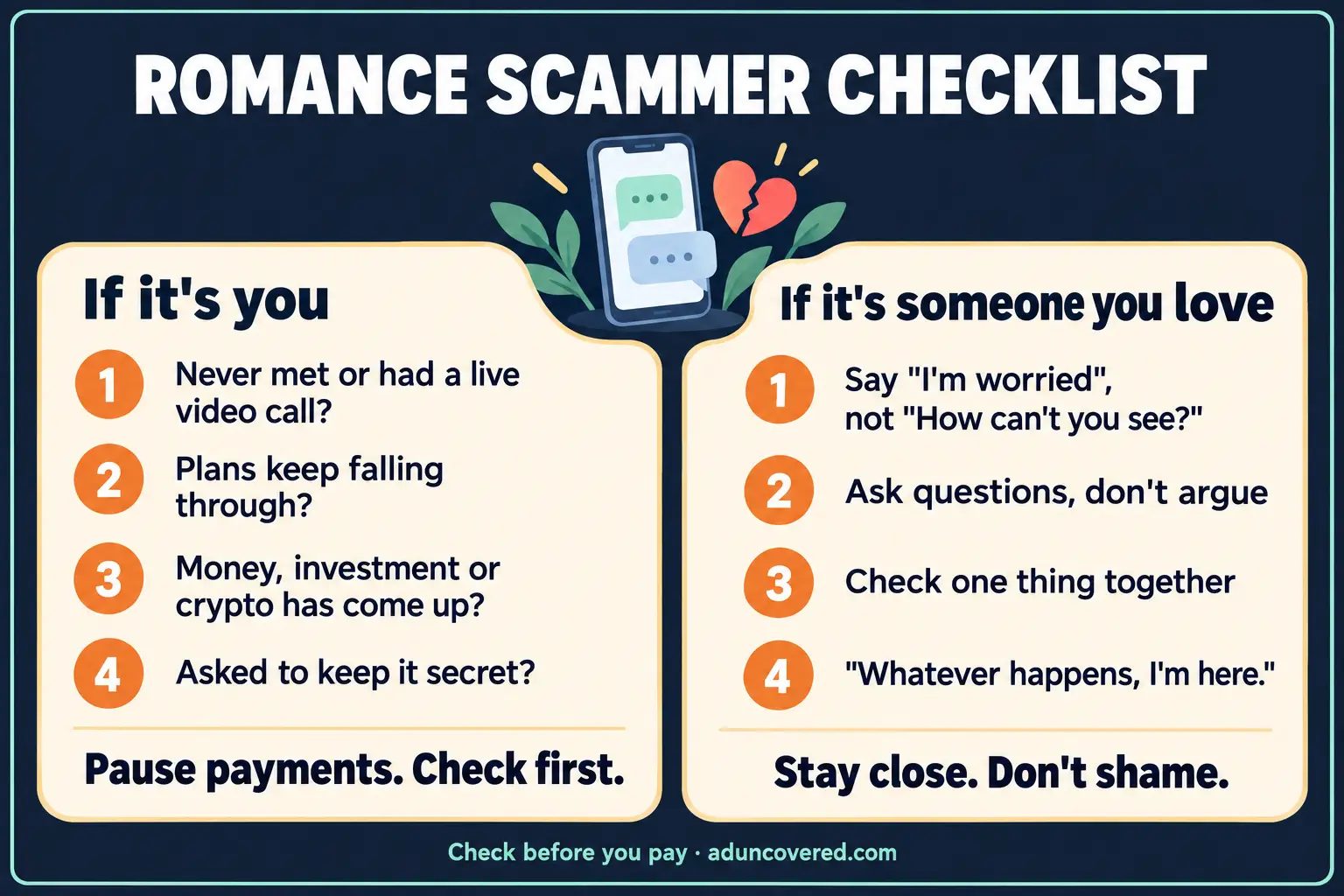
This romance scammer checklist has two parts. Part 1 is for you if you are in an online relationship and something has started to feel uncomfortable. Part 2 is for family and friends who are worried about someone they love. Read the part that fits, or both.
Romance scams are run by organised groups who are good at what they do. They fool careful, intelligent people of every age, in South Africa and around the world. In the UK alone, police received 10,784 romance-fraud reports in 2025, with losses of £102 million, and almost half of the money was lost by people aged 55 to 74 (The Register, reporting City of London Police figures). For almost a third of people targeted, it goes on for more than a year (Report Fraud).
Part 1: For you, if something doesn’t feel right
If you are reading this, part of you may already have a question. That question deserves an answer, and you deserve to feel safe while you look for it. Nobody needs to know you are reading this.
Researchers have found that many people in these relationships did feel uneasy when money was first mentioned, but by then they cared so much that the doubts were pushed aside (Whitty and Buchanan, reported by ScienceDaily). That is not a weakness. It is exactly what these schemes are designed to do.
The romance scammer checklist: answer yes or no
About the relationship
- Have you never met in person, or never had a live video call that wasn’t planned by them?
- Have planned calls or visits fallen through, each time for a new reason?
- Did it become serious very quickly, with talk of love, marriage or a future together within days or weeks?
- Did they ask to move from the dating app or social media site to WhatsApp, Telegram or another private chat?
- Do details of their story, such as their job, where they live or their family, change or not quite add up?
About money and secrecy
- Has money come up, for example an emergency, medical bills, travel costs, or a fee to release a parcel, an inheritance or frozen funds?
- Have they offered to help you make money through an investment, a trading app or cryptocurrency?
- Have they asked you to receive money or goods and send them on to someone else?
- Have they asked you to keep the relationship, or the money, private from family and friends?
- Do you feel guilty, anxious or pressured when you hesitate to help them?
What your answers mean
Any “yes” in the money and secrecy section: pause every payment now, before anything else. You can keep talking to the person while you check. Pausing is not an accusation; it is protecting yourself.
Several “yes” answers in the first section, with none about money yet: these are the same patterns that come before money requests in many romance scams (An Garda Síochána; FTC). Be alert for the moment money comes up.
No “yes” answers: that is good, but it is not proof that someone is who they say they are. Keep your money and personal documents to yourself until you have met in person.
Whatever your answers, your feelings were real. If the person turns out not to be who they said, the shame belongs to the people who deceived you, not to you.
Three things you can check privately
- Search their photos. Save one of their profile photos to your phone or computer first. Then:
• Google Images: click the camera icon (“Search by image”) in the search box and upload the photo. On a phone, the same search is in the Google app as Google Lens.
• TinEye: click the upload arrow and choose the photo, or paste the photo’s web address. TinEye can sort results by date, which shows where the photo appeared first.
If the same face appears under another name, on a stock-photo site or on someone else’s social media, that matters. No match proves nothing either way, because many photos are not indexed. Never upload intimate photos or ID documents to search tools. - Write “promises made, promises kept”. In two columns, list what they promised (a visit, a call, repayment) and what actually happened. Scamwatch suggests this simple record because the gap speaks for itself (Scamwatch).
- Ask for an unplanned live video call today. A real person who loves you will find a way. Repeated excuses about cameras, signal or work are a pattern worth noticing.
If there is an investment or trading website in the story, you can check the website itself with our free Quick Check, and in South Africa you can search the FSCA for the company. We check the business side, the website or platform, not the person you are talking to.
If the checklist rang true
- Stop sending money, gift cards or crypto, and don’t take a loan or use retirement savings for them.
- Contact your bank’s fraud line using the number on the back of your card. Tell them what has been paid and ask whether anything can be stopped.
- Keep the messages, photos and payment records. Don’t delete the chat yet.
- Tell one person you trust. You don’t have to tell everyone.
- Report it. Our guide on how to report a scam in South Africa explains the steps; elsewhere, use your country’s fraud reporting service.
- Be careful of anyone who later offers to “recover” your money for a fee. Recovery scams often target people who have just lost money.
Part 2: For family and friends who are worried
You have probably already seen the signs. The hardest part is that the person you love may not see them yet, and may defend the relationship when you raise it. That is normal. These schemes are designed to make outside voices sound like jealousy or interference, and some fraudsters deliberately pull people away from family and friends (Report Fraud).
Facts on their own rarely end a romance scam, because it is an emotional deception, not a misunderstanding. Your relationship with the person matters more than winning the argument.
What tends to backfire
- Arriving with a pile of proof. A stack of screenshots and articles all at once usually makes people shut down or defend the relationship harder.
- Shame or disbelief. “How can you not see it?” pushes people into secrecy, and the next payment happens without your knowledge.
- Ultimatums. “Block them now or else” can confirm what the scammer has told them: that family will try to tear them apart.
What helps
The bystander checklist
- Lead with worry, not judgement. Say “I’m worried about you”, not “How can you not see what’s going on?” (Scamwatch).
- Ask curious questions. “How many times has the visit been cancelled now?” “Have you two had a video call yet?” Let them notice the pattern themselves.
- Talk about the money method, not the love. “I’m worried about why they need it in crypto or gift cards” is easier to hear than “they don’t love you”.
- Check one thing together. Search their job title or story with the word “scam”, or reverse-search one photo. Then leave the result with them to think about in their own time.
- Build the “promises made, promises kept” list together, calmly and without comment.
- Give them a safe landing. Say it out loud: “Whatever happens, I’m here, and I won’t say I told you so.”
- Stay in touch. Regular, ordinary contact fills the gap the scammer is filling, and keeps you close when they are ready.
When to act urgently
Step in more firmly, and consider your bank or the police, if they are about to send a large amount, plan to travel to meet the person, have shared ID documents or passwords, are taking out a loan or using retirement money, or are being threatened now that payments have stopped (Scamwatch).
When they are ready to accept it
- Help them stop contact, block the person and report the profile to the platform.
- Call their bank’s fraud line together.
- Change email and social media passwords, and turn on two-step verification.
- Report it to the police or the national fraud reporting service, and keep the evidence.
- Warn them about recovery scams, and agree to talk before anyone gets paid to “get the money back”.
- Expect grief, anger and embarrassment, sometimes all in one day. Be patient, and look after yourself too.
If it all feels like too much
Losing a relationship and money at the same time is a real loss, and some people feel overwhelmed or hopeless afterwards. You don’t have to carry it alone. In South Africa, the SADAG Suicide Crisis Helpline is free on 0800 567 567, or SMS 31393. Elsewhere, Find a Helpline lists free, confidential services in your country. If you are worried someone is in immediate danger, call your local emergency number.
Related guides
- Romance Scams: When You Want to Believe
- Dating App Scams: 10 Red Flags Before They Ask for Money
- Fake Investments: Trading App Scams and Warning Signs
- What to Do Immediately After Being Scammed
Got a link? Check the website before you pay
If the relationship includes an investment platform, a shop or a “courier” website, paste its link into the free Quick Check below. It looks at the website, not at the person, and a clean result is not proof that the site is safe.
Check before you pay
About to pay a seller or business you don’t know? Start with a Free Quick Check of the advert link. It screens for common warning signs and shows where each result came from.
If you need the seller researched, a Quick Report or Comprehensive Report brings together source-linked Search Results on the seller and the offer. Neither gives a verdict: you check the sources and decide for yourself.
Editorial note: This checklist is general guidance based on public research and official advice. It is not legal, financial or psychological advice, and no checklist can tell you for certain who someone is. Research checked on 19 October 2026.