
December in South Africa means year-end functions, bonuses, school holidays, the long drive to the coast and parcels arriving almost daily. It is also the busiest season of the year for scammers. We’re busy, distracted and spending more than usual, and they plan their year around exactly that.
This guide covers the festive season scams in South Africa that are worth knowing about before you shop, book or donate, with local examples and the official warnings behind them.
Festive season scams in South Africa: why December is different
Most losses now happen through digital channels. The South African Banking Risk Information Centre (SABRIC) reported R2.4 billion in digital banking fraud losses in 2025, up from about R1.9 billion the year before, with banking-app fraud making up more than 70% of those losses. For 2024, SABRIC said digital banking fraud accounted for 65.3% of reported financial crime incidents, and that most cases involved tricking people rather than hacking systems.
Ahead of the 2025 festive season, SABRIC warned that AI-powered scams were expected to increase: cloned voices, deepfake videos, fake online stores, brand impersonation, payment-link scams and fraudulent holiday bookings. Black Friday falls on 27 November 2026, and the same tricks run straight through to the New Year.
How the crooks pull it off
Almost every scam, however polished, runs on the same few tricks. If something ticks even one of these boxes, slow down:
- Urgency. “Only 2 left.” “Pay within 30 minutes or lose the booking.” People who stop to think tend to spot the problem, so rushing you is the point.
- Emotion. Fear (your parcel is stuck), excitement (you’ve won a voucher), kindness (a charity appeal) or panic (a family member in trouble).
- Impersonation. A courier, your bank, a big retailer, SAPS or someone you love, complete with copied logos and wording.
- Unusual payment. An EFT or instant payment to a personal account, a payment link instead of a proper checkout, an e-wallet voucher, gift cards or crypto.
- Isolation. “Don’t tell anyone.” “Stay on the line.” A friend might say “hang on, that sounds off”, and scammers know it.
The festive season scams to watch for
1. Fake courier and “customs fee” messages
An SMS or email says your parcel can’t be delivered until you pay a small redelivery or customs fee. The link leads to a convincing page built to capture your card or banking details. In October 2026, Fastway Couriers warned that sender names can be spoofed and that scams work better when criminals already hold your details from an earlier data breach.
What to do: don’t use the link. Open the courier’s or retailer’s official app or website yourself and check the tracking number there. If you can’t remember ordering anything, that’s your answer.
2. Fake shops and Black Friday “deals”
Slick social media adverts lead to cloned websites with prices 70 to 90% off. SABRIC lists fake online stores, brand impersonation and payment-link scams among its festive warnings. A common sign is being steered away from a normal card checkout towards an EFT or instant payment, which is very hard to reverse.
Before you pay, run through our online store checks, read our Black Friday scams guide, and see why social media deals deserve a closer look. You can also screen the advert link with a Free Quick Check.
3. Holiday accommodation and travel scams
December and January are among South Africa’s busiest tourism months, and fake listings follow. In a 2025 EWN report, a travel journalist described fake social media listings, prices far below market rates, bait-and-switch invoices from a different company than the one advertised, and fake sites claiming links to industry bodies such as SATSA and FEDHASA. In Durban, eThekwini Municipality warned visitors after tourists from Mpumalanga and Gauteng arrived to find no booking and were left stranded.
The Financial Intelligence Centre’s festive season report also lists holiday rentals, holiday clubs, timeshares, vouchers, travel agencies and online bus, rail and air tickets among popular scams.
Before you pay a deposit:
- Book through a reputable platform and keep the conversation and payment on it.
- Be wary of a big upfront deposit by EFT to a personal account, or a request for crypto.
- Check that the business name matches across the advert, invoice and contract.
- Look up the address on a map and run a reverse image search on the photos; copied photos are common.
- Ask for a live video walk-through, or check with the local tourism office.
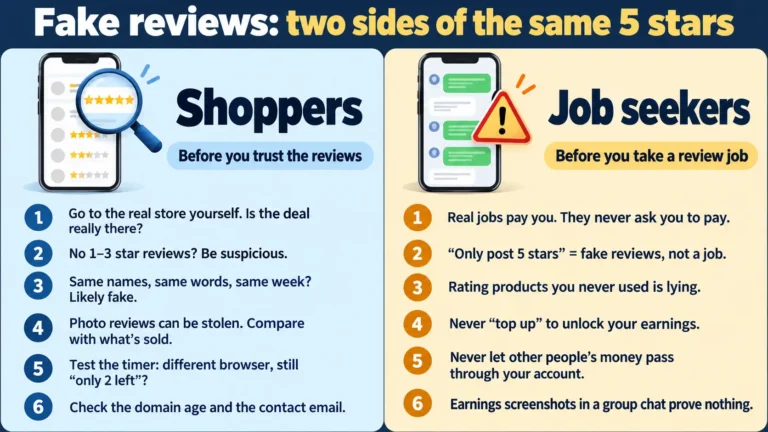
- Treat a sudden burst of identical five-star reviews with suspicion.
For a real cloned-listing case, the payment trap that runs right up to departure, and a deposit checklist you can screenshot, see our full guide to holiday accommodation scams in South Africa. Renting long term rather than for the holidays? Read about rental scams and deposit traps.
4. Fake vouchers, surveys and giveaways
“Answer three questions and win a R1,000 voucher.” Messages like these use the names of well-known retailers to collect personal details or sign you up for paid mobile subscriptions. Woolworths has warned about hoax surveys and voucher competitions on Facebook and WhatsApp, and says it doesn’t ask for ID numbers or personal details that way.
What to do: if you didn’t enter a competition, you can’t win it. If airtime starts disappearing after you clicked one, ask your network how to block or stop premium subscription services.
5. December job scams
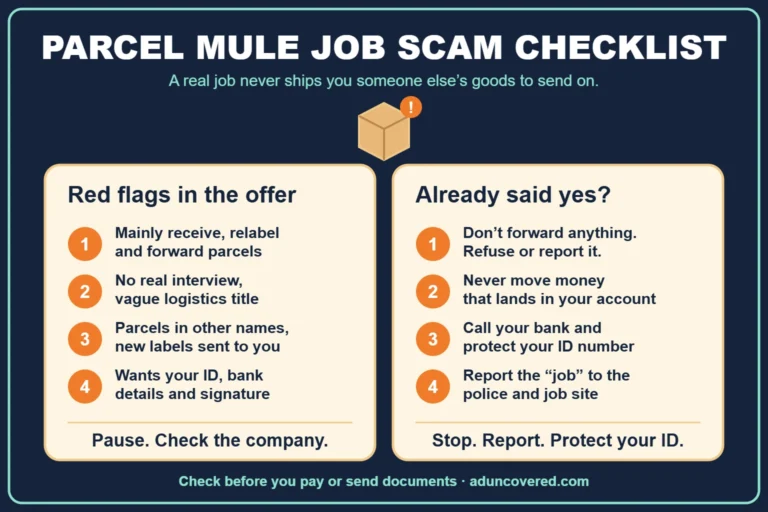
Seasonal work is in demand, and fake “December vacancies” appear on social media under retailer and government names. The trick usually ends with a fee: for an application, “verification” or training. Shoprite has said it never charges candidates a fee and that job-seekers should use its official careers website. The Department of Public Works and Infrastructure warned about fake vacancies where applicants were asked for a verification fee via an e-wallet transfer, stating that it never asks for payment for jobs.
More on how these work: job scams and online task traps.
6. Stokvel and “December payout” schemes
Stokvels are a trusted part of South African saving, which is exactly why fake ones work. The digital scheme United African Stokvel promised returns of 4% to 7% a month and claimed to invest in property and telecoms. According to Moonstone’s report on the FSCA’s findings, none of the money was invested; it was used for personal benefit and to pay earlier members, and the scheme was placed under provisional liquidation in 2023.
Warning signs: returns far above any bank or normal investment, vague answers about where the money goes, payouts that keep getting delayed, and pressure to recruit others. Read more about fake investments.
7. Bank and courier calls asking for an OTP
A caller says there’s a problem with your account or a delivery and asks you to confirm a one-time PIN, approve a notification in your banking app or move money to a “safe” account. SABRIC lists bank and courier impersonation among its festive warnings. A real bank won’t ask for your OTP or ask you to move money to protect it. See how fake fraud department calls work.
8. Cloned voices and deepfake videos
A call sounds exactly like your child or grandchild: they’re in trouble and need money now. Or a familiar celebrity “endorses” an investment in a video advert. SABRIC warns that AI is making these scams more convincing. What to do: hang up and call the person back on the number you already have. Agree on a family safe word. Treat celebrity investment adverts as fake unless the person’s own official channels confirm them.
9. Charity appeals
Generosity peaks in December, and so do fake appeals and crowdfunding pages. Before donating, check that the organisation is registered with the Department of Social Development, and if you want a tax deduction, that it can issue a Section 18A certificate (more tips on choosing a credible NPO). Go to the charity’s own website rather than following a link in a message.
10. “SAPS” letters and calls demanding a fee
In September 2025, SAPS warned about fake police letters sent via WhatsApp, using the SAPS logo and real officers’ names, followed by threatening calls claiming a case has been opened against you and demanding money to make it go away. Police don’t settle cases for a fee. Report it to your nearest police station or Crime Stop on 08600 10111.
11. Marketplace and “wrong number” tricks
If you’re selling to make room before the holidays, watch for buyers who “accidentally” overpay and ask for a refund of the difference; the original payment is fake or will be reversed. Only release goods once money has truly cleared. And a friendly “sorry, wrong number” message that turns into a friendship and then an investment tip or an emergency is a known pattern, as our romance scams guide explains. On dating apps the same script often comes with a stolen profile and, sometimes, faith language: see our dating app scam red flags.
A quick “stop and check” routine
- Pause. Nothing legitimate needs to be sorted in the next five minutes.
- Don’t use the link or number in the message. Go to the official app or website yourself.
- Check with a person. Say it out loud to a friend or family member.
- Look at how you’re asked to pay. EFT or instant payment to a personal account, e-wallet vouchers, gift cards and crypto are big red flags.
- Research the seller or offer outside its own website and adverts.
If you’ve already paid or shared details
- Call your bank’s fraud line immediately, using the number on the back of your card or in the official app. Speed matters with instant payments.
- Open a case at your nearest SAPS station, or report it to Crime Stop on 08600 10111 or via the MySAPS app. Keep screenshots, messages, payment references and the seller’s details.
- If you shared your ID number or documents, consider free Protective Registration with the Southern African Fraud Prevention Service (SAFPS), which alerts its member organisations to take extra care with your details.
- Change passwords you may have entered on a fake page, and turn on two-factor authentication.
- Beware of anyone who offers to get your money back for a fee. Recovery scams target people who have just lost money.
Our step-by-step guide covers what to do immediately after being scammed.
A note for the grandparents, and the people who love them
If you’re older, you’re not “gullible”; you’re a target, because scammers know you may have savings and a trusting nature. If you’re a younger family member, have a gentle chat this December. Make it a conversation, not a lecture: share a couple of the scams above, agree on a safe word, and make sure they know they can always phone you to double-check something, without judgement.
Final thoughts
Scammers rely on rushing you. The moment you slow down, ask questions and check for yourself, most of their tricks fall apart. Have a wonderful festive season, and if a deal looks too good to be true, give it a second look before your money leaves your account.
Check before you pay
About to pay a seller or business you don’t know? Start with a Free Quick Check of the advert link. It screens for common warning signs and shows where each result came from.
If you need the seller researched, a Quick Report or Comprehensive Report brings together source-linked Search Results on the seller and the offer. Neither gives a verdict: you check the sources and decide for yourself.
This article provides general scam-awareness information, not legal or financial advice. Sources are linked beside the claims they support and were checked in October 2026. Company and government processes can change, so use official channels when you report an incident. AdUncovered is independent and is not speaking on behalf of any organisation named here.