Want to make money online after 50? Adverts saying companies will pay people over 45 to “work from home” often lead to a free training, then a webinar, then a paid course or a “done-for-you” online business. Before you pay, ask for the average buyer’s results in writing, the full first-year cost including monthly tools, and the refund terms. Then check the business behind the offer, not the person in the video.
These checks are for readers in South Africa and worldwide. Your rights depend on where you live and how you paid.
The reel that looks like a job
Our founder came across a series of Instagram reels from one account. Each showed an older woman at a kitchen table or on a patio, leafing through a binder of papers to a trending song. The captions read:
- “Retirement tip: If you are between 45 – 65, companies will gladly pay you to promote their products online because you are their sought after demographic.”
- “I was forced to retire at 57. No secret advantage. No pension. No inheritance.”
- A list of household brand names “that will p@y you to work from home”.
- “Comment LEARN and I’ll send you the link to the FREE training… Be sure to provide your email to receive the invite.”
Notice the spelling “p@y”. Writing a word that way can slip past advert filters that look for money promises.
The brand names borrow trust. Many large companies do run affiliate programmes, but they pay commission on sales you bring in. They do not hire people to work from home because of their age.
How the funnel works, step by step
- The hook: a relatable story, and a promise that sounds like a job.
- The capture: you comment a keyword, an automated message sends a link, and you give your email address.
- The free training or webinar: useful-looking content and success stories.
- The pitch: a course plus a “done-for-you” or “build-for-you” business, with large monthly income claims.
- The pressure: limited places, a bonus that expires, or a “book a call” step.
- The running costs: monthly software, hosting, tools, advertising and upsells.
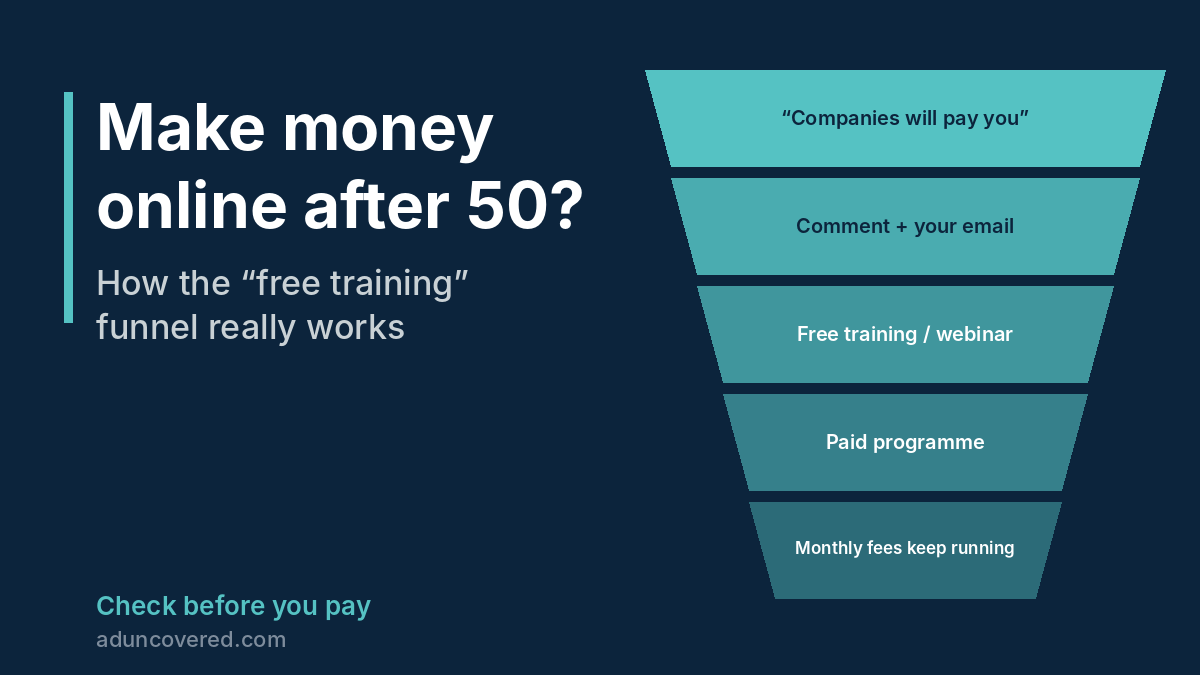
Our founder watched this funnel change while she was looking at it. At first the reel led straight to a “Wealth Builder” sales page, selling a done-for-you setup plus a course with claims of US$5,000 or more a month. Later a webinar appeared between the reel and the sales page. “It looked like building in progress,” she says. Funnels are tested and changed constantly to see what makes more people pay.
She stopped before the webinar and checked the claims. “The advert was for work. That is not what was being sold.”
When the subscription becomes the trap
Our founder knows the next stage from experience. She once paid for a “done-for-you” directory business: a set-up fee, a monthly subscription to a well-known marketing software platform, and a separate subscription for a third-party developer’s app. Together it came to just over R3,000 a month.
The app was still being built. It never produced any income. “Because I invested so much, I did not stop trying to make it work,” she says. Bugs and missing features went “in the backlog”, which kept her paying for another couple of months. In the end she emailed the founders and cancelled. The promises never materialised.
The developer ran many adverts and YouTube videos. “The content is valuable,” she says, “but what is behind that is an income trap.”
This is the sunk-cost pull. The more you have paid, the harder it feels to stop. Set a limit before you start: a date and an amount after which you cancel if the promised results have not appeared.
What regulators have found
- Publishing.com, United States (April 2026): agreed to pay US$1.5 million to settle a Federal Trade Commission case. Its course cost up to US$1,995, and free videos promised a “foolproof, passive income system”. The FTC said most buyers never earned the advertised income, a “no questions asked” refund came with buried conditions, and some testimonials were written by employees or relatives. The order is proposed, not final.
- Click Profit, United States (March 2025): the FTC alleged that “AI-powered” online stores were sold with promises of passive income, for fees of at least US$45,000 plus inventory, and that consumers lost at least US$14 million. These are allegations for the court to decide.
- Ascend Ecom, United States (June 2025): the FTC alleged at least US$25 million in losses from online storefronts sold with AI tools and passive-income promises. A proposed order bans the owners from selling business opportunities or coaching.
- Germany (July 2025): the Lower Saxony consumer centre described a woman contacted on Facebook, invited to a free webinar and signed up in an online sales call. She was promised €800 a month for one to two hours a day, for a €4,000 contract. A pre-ticked box appeared to remove her right to withdraw, and she received pre-made videos and crowded group chats.
Social media is now where these offers find people. In March 2026 the FTC told the US Congress that social media was the contact method with the highest reported fraud losses, at over US$2 billion in its 2025 financial year.
Why people over 50 are targeted
Looking for ways to make money online after 50 is common, and the reasons are real: retrenchment, forced early retirement and a gap in pension savings. So is the wish to keep earning with dignity. These adverts mirror that exactly: a person your age, a kitchen table, a story like yours. Many people who pay never tell anyone, which keeps the pattern quiet. Our guide to scams targeting older South Africans covers why secrecy helps scammers.
Make money online after 50: 10 questions to ask before you pay
- What does the average buyer earn, not the best one? Ask for it in writing.
- What is the total first-year cost, including monthly software, hosting, advertising and upsells?
- Is the “job” in the advert actually a product I am buying?
- What are the refund terms, in writing, and what conditions apply?
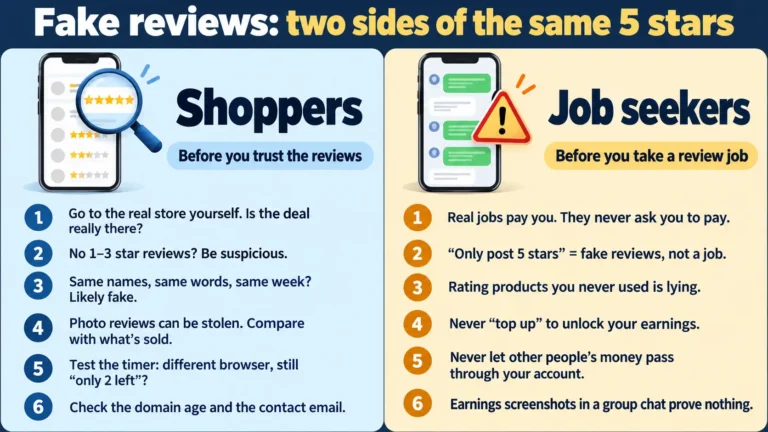
- Who wrote the testimonials? Are they staff, relatives, or paid affiliates? (See how fake reviews work.)
- Can I speak to three buyers I find myself, not ones the seller chooses?
- Which registered business is selling this, where is it, and what is its complaints history? (See how to check if a business is legit.)
- Is the product finished, or still being built?
- If the pitch involves trading or investing, is the business registered with the FSCA in South Africa, or the financial regulator where I live?
- Am I being rushed by a countdown, a bonus or “limited places”?
Your rights, and what to do if you have paid
- South Africa: the Electronic Communications and Transactions Act gives a 7-day cooling-off period for many online transactions. Where it does not apply, the Consumer Protection Act gives 5 business days after direct marketing. For fixed-term payment plans, section 14 lets you cancel with 20 business days’ written notice, subject to a reasonable cancellation penalty.
- Cancel in writing and keep proof. Remove your card from the seller’s account, and ask your bank to stop future charges.
- Dispute card charges with your bank quickly. Since 13 April 2026, South African debit orders can be disputed within 60 calendar days, and reversals are not guaranteed.
- Do not pay a “recovery” service that promises to get your money back. Read how recovery scams work first.
- Report it. See How to Report a Scam in South Africa.
Our founder’s advice
“Easy come, easy go! Don’t trust anybody ever. Investigate thoroughly before you believe anything. All companies lie; you just have to determine the measure of their lies.”
“The lies are not always intentional,” she adds. “Sometimes there’s a disconnect between marketing and the operations or development teams. Marketing promises what the product can’t do yet. For you, the result is the same, so investigate first.”
Where AdUncovered fits
We research the business side of an offer: the seller, the programme and its claims, not the person in the video. Before you pay for a course or a “done-for-you” business, order a Quick Report on the seller and the offer, with a link to every source. For the sales page itself, start with a Free Quick Check of the website address. If you have already paid and something is wrong, the Comprehensive Report researches the seller and your purchase.
Check before you pay
About to pay a seller or business you don’t know? Start with a Free Quick Check of the advert link. It screens for common warning signs and shows where each result came from.
If you need the seller researched, a Quick Report or Comprehensive Report brings together source-linked Search Results on the seller and the offer. Neither gives a verdict: you check the sources and decide for yourself.
Sources
- FTC: Publishing.com to pay $1.5 million (13 Apr 2026)
- FTC: Click Profit (18 Mar 2025)
- FTC: Ascend Ecom (23 Jun 2025)
- Verbraucherzentrale Niedersachsen: Online-Coachings (11 Jul 2025, German)
- FTC testimony to the Joint Economic Committee (25 Mar 2026)
- Consumer Protection Act, section 16
- Consumer Protection Act, section 14
- Payments Association of South Africa: debit order dispute FAQ (2026)